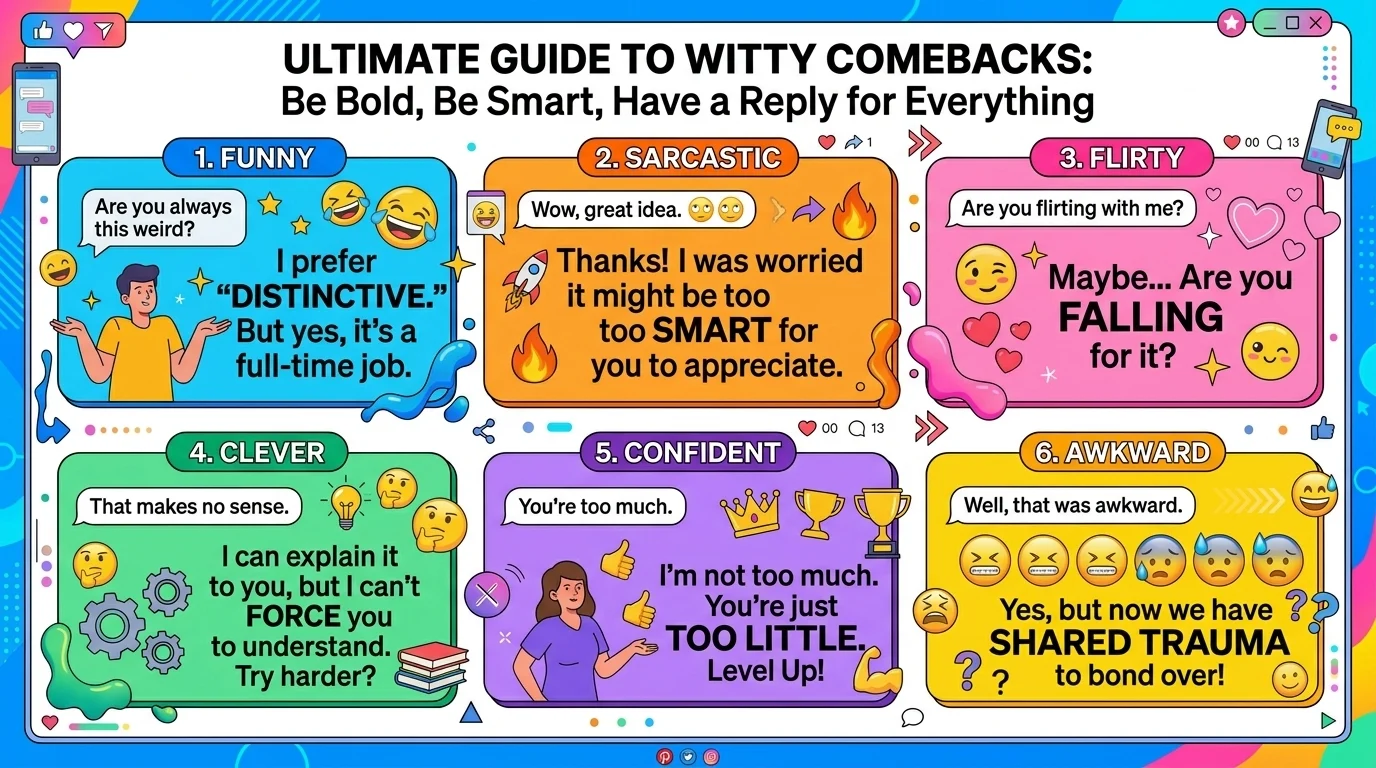
Quick Ans: The best witty comebacks are quick, clever, and confident without trying too hard. A good comeback can shut down awkward comments, turn an insult into a joke, or simply keep the banter going.
Top alternatives: That sounded better in your head, Interesting choice, Anyway, moving on, I’ll pretend that was clever, Thanks for sharing, You tried
We have all had that moment. Someone says something annoying, awkward, rude, or ridiculously confident, and the perfect response only arrives three hours later while you are brushing your teeth. Tragic.
That is exactly why having a few witty comebacks ready can be useful. Whether you are texting friends, dealing with playful banter in DMs, responding to a coworker, handling a random comment online, or talking to someone who clearly enjoys hearing themselves speak, the right reply can change the whole mood.
A witty comeback does not always need to be mean. Sometimes the funniest response is calm, clever, unexpected, or completely unserious. The goal is to match the situation, protect your confidence, and keep your personality intact. Here are plenty of text-message-ready comebacks for almost every mood, moment, and conversation.
Funny Comebacks
“I’m impressed you said that with confidence.”
Example: Use this when someone makes a questionable statement with total certainty.
Meaning: You are humorously questioning their confidence.
“That was almost a good point.”
Example: Use this during playful arguments with friends.
Meaning: You are teasing them without taking things too seriously.
“I’ll give you points for enthusiasm.”
Example: Use this when someone tries hard but misses the mark.
Meaning: You are acknowledging their effort in a funny way.
“You really woke up and chose that opinion.”
Example: Use this when someone shares an unnecessarily bold take.
Meaning: You are joking about their questionable decision.
“Interesting. Continue embarrassing yourself.”
Example: Use this during friendly banter when someone keeps talking nonsense.
Meaning: You are playfully encouraging them to keep going.
“I support your right to be wrong.”
Example: Use this when someone disagrees with you in a lighthearted conversation.
Meaning: You are confidently dismissing their opinion with humor.
“That sounded better in your head, didn’t it?”
Example: Use this after someone delivers a failed joke.
Meaning: You are teasing them for an unsuccessful attempt.
“Bold strategy. Let’s see how that works out.”
Example: Use this when someone makes a questionable choice.
Meaning: You are humorously predicting the consequences.
“I had a response, but you’re not ready for it.”
Example: Use this when you want to create playful mystery.
Meaning: You are jokingly acting like your comeback is too powerful.
“Please hold while I process that nonsense.”
Example: Use this after hearing something ridiculous.
Meaning: You are humorously acting confused.
“I’m going to need subtitles for whatever that was.”
Example: Use this when someone explains something badly.
Meaning: You are joking that their message made no sense.
“Well, that certainly happened.”
Example: Use this after an awkward or strange comment.
Meaning: You are reacting with dry humor.
Clever Comebacks
“I’d explain it, but I left my crayons at home.”
Example: Use this only in playful arguments with people you know well.
Meaning: You are joking that the explanation would need to be extremely simple.
“You make an interesting point. Unfortunately, it’s wrong.”
Example: Use this during a friendly debate.
Meaning: You are dismissing their argument with confidence.
“I’ll take that under consideration and immediately forget it.”
Example: Use this when someone gives unwanted advice.
Meaning: You are humorously rejecting their suggestion.
“That’s one interpretation of reality.”
Example: Use this when someone has a very different version of events.
Meaning: You are politely questioning their perspective.
“You’re entitled to your opinion, even this one.”
Example: Use this when someone shares a bad take.
Meaning: You are teasing them while staying composed.
“I see the logic. I just don’t see where it went.”
Example: Use this when someone’s argument falls apart.
Meaning: You are cleverly pointing out weak reasoning.
“That answer raised more questions than it solved.”
Example: Use this when someone gives a confusing explanation.
Meaning: You are saying their response made things worse.
“I admire the confidence behind that mistake.”
Example: Use this when someone is confidently incorrect.
Meaning: You are calling out their error humorously.
“You almost convinced me for a second.”
Example: Use this when someone makes an unbelievable claim.
Meaning: You are sarcastically suggesting they were nearly convincing.
“Let’s circle back when that makes sense.”
Example: Use this when someone’s comment is confusing.
Meaning: You are politely dismissing the idea.
“That’s adorable. Incorrect, but adorable.”
Example: Use this in playful banter.
Meaning: You are combining teasing with humor.
“Your argument has been received and misplaced.”
Example: Use this when someone keeps repeating a weak point.
Meaning: You are joking that their argument is not worth keeping.
Sarcastic Comebacks
“Wow, what a valuable contribution.”
Example: Use this after an unhelpful comment.
Meaning: You are sarcastically questioning its usefulness.
“I’ll alert the media.”
Example: Use this when someone announces something unimportant.
Meaning: You are exaggerating its importance for humor.
“Thank you for that completely necessary information.”
Example: Use this when someone states the obvious.
Meaning: You are sarcastically pointing out that you already knew.
“Groundbreaking stuff.”
Example: Use this after an obvious observation.
Meaning: You are pretending their comment is revolutionary.
“I can see you gave that a lot of thought.”
Example: Use this when someone says something poorly considered.
Meaning: You are sarcastically questioning their effort.
“Congratulations on having an opinion.”
Example: Use this when someone is overly proud of their take.
Meaning: You are dryly acknowledging their contribution.
“That changes absolutely nothing, but thank you.”
Example: Use this when someone adds irrelevant information.
Meaning: You are dismissing it with sarcasm.
“You should put that on a motivational poster.”
Example: Use this after an overly dramatic statement.
Meaning: You are teasing them for sounding too serious.
“I’ll lose sleep over that.”
Example: Use this when someone makes a weak threat or criticism.
Meaning: You are showing that it does not bother you.
“Please, tell me more things I already know.”
Example: Use this when someone explains the obvious.
Meaning: You are sarcastically calling out repetition.
“That was a lot of words for absolutely nothing.”
Example: Use this when someone talks without making a point.
Meaning: You are humorously criticizing their explanation.
“I’m pretending to be surprised.”
Example: Use this when someone reveals something predictable.
Meaning: You are joking that the outcome was obvious.
Short Comebacks
“Cute.”
Example: Use this when someone says something mildly annoying.
Meaning: You are dismissing it with confidence.
“Try again.”
Example: Use this after a weak joke or insult.
Meaning: You are challenging them to do better.
“That’s wild.”
Example: Use this when someone says something ridiculous.
Meaning: You are reacting without giving them too much attention.
“Anyway.”
Example: Use this when you want to move past an annoying comment.
Meaning: You are ending the topic.
“Noted.”
Example: Use this when you do not want to argue.
Meaning: You are acknowledging without agreeing.
“Fascinating.”
Example: Use this with dry sarcasm.
Meaning: You are pretending to be interested.
“You tried.”
Example: Use this after a failed attempt to insult you.
Meaning: You are dismissing the attempt without overreacting.
“That’s enough.”
Example: Use this when playful banter goes too far.
Meaning: You are setting a boundary.
“Moving on.”
Example: Use this when a topic is not worth discussing.
Meaning: You are ending the conversation.
“Good one.”
Example: Use this when someone makes a joke that is not actually funny.
Meaning: You are responding with dry sarcasm.
“Sure thing.”
Example: Use this when you do not fully believe someone.
Meaning: You are expressing doubt casually.
“Bless your heart.”
Example: Use this when you want a sweet-sounding but pointed response.
Meaning: You are expressing amused disbelief.
Brutal Comebacks
“You’re confusing confidence with being correct.”
Example: Use this when someone speaks as if they cannot possibly be wrong.
Meaning: You are challenging their certainty.
“That insult needed more preparation.”
Example: Use this after a weak attempt to roast you.
Meaning: You are saying their effort was poor.
“You had one job, and that wasn’t it.”
Example: Use this when someone completely misses the point.
Meaning: You are humorously criticizing their performance.
“I’d take that personally, but I respect my peace too much.”
Example: Use this when someone tries to provoke you.
Meaning: You are showing that their comment does not control your mood.
“You seem very committed to misunderstanding me.”
Example: Use this during a frustrating argument.
Meaning: You are calling out deliberate confusion.
“I’m not arguing with you. I’m watching you freestyle.”
Example: Use this when someone’s logic keeps changing.
Meaning: You are joking that they are making things up.
“You make being wrong look like a full-time job.”
Example: Use this in intense but playful banter.
Meaning: You are exaggerating their repeated mistakes.
“That confidence is doing a lot of heavy lifting.”
Example: Use this when someone’s certainty exceeds their knowledge.
Meaning: You are questioning what supports their confidence.
“You’re allowed to stop talking whenever you’re ready.”
Example: Use this when someone keeps digging themselves deeper.
Meaning: You are dryly suggesting they should quit.
“I’d agree with you, but then we’d both be wrong.”
Example: Use this during a playful disagreement.
Meaning: You are confidently rejecting their position.
“You brought energy, just not accuracy.”
Example: Use this when someone passionately says something incorrect.
Meaning: You are acknowledging effort while rejecting the claim.
“I see what you were going for. It didn’t arrive.”
Example: Use this after a joke or insult fails.
Meaning: You are saying their attempt missed completely.
Funny Responses To Insults
“Was that supposed to hurt, or was that the warm-up?”
Example: Use this when someone makes a weak joke at your expense.
Meaning: You are showing that their comment did not affect you.
“I’ve heard better from autocorrect.”
Example: Use this after a poorly written insult online.
Meaning: You are joking about the quality of their words.
“You practiced that, didn’t you?”
Example: Use this when someone delivers a rehearsed insult.
Meaning: You are teasing them for trying too hard.
“I’d be offended, but I’m busy.”
Example: Use this when you want a calm and funny response.
Meaning: You are showing their insult is not important to you.
“That was your best one?”
Example: Use this after a disappointing roast.
Meaning: You are challenging them to improve.
“I appreciate the effort.”
Example: Use this when you want to dismiss an insult politely.
Meaning: You are acknowledging the attempt without feeling affected.
“You almost had me there.”
Example: Use this when an insult is not convincing.
Meaning: You are pretending it nearly worked.
“Please submit your complaint in writing.”
Example: Use this when someone keeps criticizing you.
Meaning: You are turning their complaint into a joke.
“I’ll recover eventually.”
Example: Use this when you want exaggerated sarcasm.
Meaning: You are pretending the insult was devastating.
“That was cute. Keep practicing.”
Example: Use this when the insult feels weak.
Meaning: You are confidently dismissing it.
“I expected more, honestly.”
Example: Use this when someone tries to roast you.
Meaning: You are saying their effort was disappointing.
“My self-esteem survived. Sorry about that.”
Example: Use this when someone wants a reaction from you.
Meaning: You are showing that their comment had no effect.
Flirty Comebacks
“Are you flirting or just naturally this distracting?”
Example: Use this when someone keeps teasing you playfully.
Meaning: You are turning the banter into flirtation.
“Careful, I might start liking you.”
Example: Use this when the conversation has romantic energy.
Meaning: You are playfully admitting attraction.
“That confidence is almost attractive.”
Example: Use this when someone is being cheeky.
Meaning: You are teasing them while giving a subtle compliment.
“Keep talking like that and I’ll assume you miss me.”
Example: Use this when someone keeps finding reasons to message you.
Meaning: You are suggesting they enjoy your attention.
“You’re lucky I find you entertaining.”
Example: Use this when someone annoys you in a charming way.
Meaning: You are admitting that you enjoy their company.
“Is this your way of asking for my attention?”
Example: Use this when someone keeps teasing you.
Meaning: You are playfully calling out their interest.
“That was cute. Do it again.”
Example: Use this when they say something charming.
Meaning: You are encouraging more flirtation.
“You’re getting dangerously close to impressing me.”
Example: Use this when they say something clever.
Meaning: You are teasing them while giving approval.
“I’d argue, but I like talking to you too much.”
Example: Use this during flirty disagreements.
Meaning: You are prioritizing the connection over winning.
“You’re making it difficult to stay mysterious.”
Example: Use this when someone gets you talking.
Meaning: You are playfully suggesting they affect you.
“That line would work better if you said it closer.”
Example: Use this only when the flirting is clearly mutual.
Meaning: You are escalating the romantic energy.
“Keep trying. I’m enjoying this.”
Example: Use this during playful flirting.
Meaning: You are encouraging the banter to continue.
Polite Comebacks
“I understand your point, even if I disagree.”
Example: Use this in a disagreement where you want to stay respectful.
Meaning: You are maintaining your position without escalating.
“That’s an interesting perspective.”
Example: Use this when you want a neutral response.
Meaning: You are acknowledging without agreeing.
“We may have to agree to disagree.”
Example: Use this when the discussion is going nowhere.
Meaning: You are ending the disagreement calmly.
“I’ll keep that in mind.”
Example: Use this when someone gives unwanted advice.
Meaning: You are acknowledging them without promising anything.
“Thanks for sharing your thoughts.”
Example: Use this when you want a professional-sounding response.
Meaning: You are remaining polite while moving on.
“I see things differently.”
Example: Use this when you want to disagree simply.
Meaning: You are expressing a different opinion respectfully.
“That may work for you, but not for me.”
Example: Use this when someone pushes their preferences on you.
Meaning: You are setting a personal boundary.
“I’ll respectfully pass.”
Example: Use this when declining an idea.
Meaning: You are saying no without hostility.
“I appreciate the suggestion.”
Example: Use this when you want to sound gracious.
Meaning: You are thanking them without necessarily agreeing.
“That’s not really my style, but thank you.”
Example: Use this when someone pressures you into something.
Meaning: You are politely declining.
“I think we’re looking at this differently.”
Example: Use this during a calm disagreement.
Meaning: You are acknowledging different viewpoints.
“I’m comfortable with my decision.”
Example: Use this when someone questions your choices.
Meaning: You are confidently ending the discussion.
Professional Comebacks
“Let’s focus on the solution.”
Example: Use this when workplace conversations become unproductive.
Meaning: You are redirecting attention toward problem-solving.
“I understand your concern. Here’s my perspective.”
Example: Use this during a professional disagreement.
Meaning: You are responding calmly and clearly.
“Let’s keep the discussion constructive.”
Example: Use this when someone becomes unnecessarily negative.
Meaning: You are setting a professional tone.
“I’m happy to discuss the facts.”
Example: Use this when emotions are taking over a work conversation.
Meaning: You are encouraging an objective discussion.
“I’d prefer to focus on what we can do next.”
Example: Use this when blame becomes the main topic.
Meaning: You are moving the conversation forward.
“Thanks for the feedback. I’ll consider what’s useful.”
Example: Use this when receiving criticism.
Meaning: You are staying polite while keeping your independence.
“Can we return to the original topic?”
Example: Use this when a meeting goes off track.
Meaning: You are redirecting the discussion.
“I think we can communicate that more effectively.”
Example: Use this when someone’s wording is unhelpful.
Meaning: You are suggesting a better approach diplomatically.
“Let’s clarify the expectations.”
Example: Use this when there is confusion.
Meaning: You are seeking a practical solution.
“I’m open to feedback, but let’s keep it respectful.”
Example: Use this when criticism becomes personal.
Meaning: You are setting a clear boundary.
“That’s one approach. I’m proposing another.”
Example: Use this when discussing different work methods.
Meaning: You are disagreeing professionally.
“Let’s not make this more complicated than necessary.”
Example: Use this when someone overcomplicates a simple issue.
Meaning: You are encouraging clarity and efficiency.
Confident Comebacks
“I know who I am. That’s enough for me.”
Example: Use this when someone tries to define you.
Meaning: You are showing self-confidence.
“You don’t have to understand me.”
Example: Use this when someone judges your choices.
Meaning: You are refusing to seek unnecessary approval.
“I said what I said.”
Example: Use this when you stand by your statement.
Meaning: You are confidently holding your position.
“I’m good with my choices.”
Example: Use this when someone questions your decisions.
Meaning: You are expressing self-assurance.
“Your approval wasn’t on my to-do list.”
Example: Use this when someone demands validation.
Meaning: You are showing independence.
“I’ll survive your opinion.”
Example: Use this when someone criticizes you.
Meaning: You are showing that their judgment does not control you.
“I’m not competing with you.”
Example: Use this when someone turns everything into a contest.
Meaning: You are refusing unnecessary rivalry.
“You can think that. I’ll keep doing me.”
Example: Use this when someone disapproves of your behavior.
Meaning: You are staying true to yourself.
“I’m not here to convince everyone.”
Example: Use this when someone misunderstands you.
Meaning: You are accepting that not everyone needs to agree.
“Confidence looks different when you don’t need permission.”
Example: Use this when someone questions your self-belief.
Meaning: You are emphasizing independence.
“I’m comfortable being misunderstood.”
Example: Use this when people misjudge your intentions.
Meaning: You are showing emotional confidence.
“I’ll take my chances.”
Example: Use this when someone warns you about your choices.
Meaning: You are confidently accepting responsibility.
Dramatic Comebacks
“And just like that, the plot thickens.”
Example: Use this when someone reveals unexpected information.
Meaning: You are humorously treating life like a TV show.
“I did not have that on my bingo card today.”
Example: Use this when something unexpected happens.
Meaning: You are expressing surprise in a playful way.
“The audacity has entered the chat.”
Example: Use this when someone says something extremely bold.
Meaning: You are dramatically reacting to their confidence.
“This episode is getting interesting.”
Example: Use this when a conversation becomes chaotic.
Meaning: You are treating the situation like entertainment.
“Somebody call the writers because this plot is wild.”
Example: Use this when real life becomes unexpectedly dramatic.
Meaning: You are joking that the situation feels scripted.
“I need a minute to appreciate the nonsense.”
Example: Use this when someone says something ridiculous.
Meaning: You are exaggerating your reaction for humor.
“And there it is. The moment we were all waiting for.”
Example: Use this when something predictable finally happens.
Meaning: You are playfully acting like the event was historic.
“I would like to unsubscribe from this storyline.”
Example: Use this when a situation becomes exhausting.
Meaning: You are joking that you want out of the drama.
“The plot twist was unnecessary, but okay.”
Example: Use this when someone surprises you.
Meaning: You are humorously reacting to unexpected events.
“This is why I can’t have peaceful conversations.”
Example: Use this when someone creates unnecessary chaos.
Meaning: You are playfully blaming them for the drama.
“The confidence level is genuinely impressive.”
Example: Use this when someone says something outrageous.
Meaning: You are dramatically reacting to their boldness.
“I need popcorn before we continue.”
Example: Use this when an argument or story becomes entertaining.
Meaning: You are treating the situation like a show.
Cute Comebacks
“Stop, you’re making me laugh.”
Example: Use this when someone’s teasing is actually funny.
Meaning: You are encouraging their playful energy.
“You’re ridiculous, but I like it.”
Example: Use this with someone you enjoy talking to.
Meaning: You are teasing them affectionately.
“That was mean. Say it again.”
Example: Use this when playful teasing makes you laugh.
Meaning: You are jokingly asking for more.
“You’re lucky you’re entertaining.”
Example: Use this with a close friend or crush.
Meaning: You are pretending their charm saves them.
“I’m judging you affectionately.”
Example: Use this when someone does something silly.
Meaning: You are teasing without negativity.
“You’re impossible.”
Example: Use this during playful conversations.
Meaning: You are expressing amused frustration.
“Why are you like this?”
Example: Use this when someone says something hilariously random.
Meaning: You are affectionately questioning their behavior.
“I can’t even be mad at that.”
Example: Use this when someone’s comment is annoyingly funny.
Meaning: You are admitting they made you laugh.
“You’re lucky that made me smile.”
Example: Use this when someone successfully teases you.
Meaning: You are giving them playful credit.
“I hate that you’re funny.”
Example: Use this when someone unexpectedly makes you laugh.
Meaning: You are jokingly admitting they entertained you.
“Okay, that was actually good.”
Example: Use this after a surprisingly clever joke.
Meaning: You are giving reluctant approval.
“You’re getting away with this because I’m nice.”
Example: Use this during playful banter.
Meaning: You are jokingly claiming the moral high ground.
Internet-Style Comebacks
“The confidence is sending me.”
Example: Use this when someone is hilariously sure of themselves.
Meaning: You are saying their confidence is funny.
“Be serious for one second.”
Example: Use this when someone says something unbelievable.
Meaning: You are asking them to stop joking around.
“Please log off.”
Example: Use this when a friend says something ridiculous online.
Meaning: You are jokingly telling them to stop.
“Not you saying that with a straight face.”
Example: Use this when someone makes a bold claim.
Meaning: You are expressing disbelief.
“This is not the flex you think it is.”
Example: Use this when someone brags about something embarrassing.
Meaning: You are pointing out that their brag is not impressive.
“The secondhand embarrassment is real.”
Example: Use this when someone says something awkward.
Meaning: You are joking that their behavior makes you uncomfortable too.
“Respectfully, what?”
Example: Use this when you are completely confused by a statement.
Meaning: You are expressing disbelief while staying playful.
“You thought you ate with that one.”
Example: Use this when someone’s insult or joke falls flat.
Meaning: You are teasing them for thinking they did well.
“I’m crying, but not for the reason you think.”
Example: Use this after something hilariously bad.
Meaning: You are joking about laughing at the situation.
“The audacity is actually impressive.”
Example: Use this when someone makes an outrageous statement.
Meaning: You are humorously reacting to their nerve.
“You really hit send on that.”
Example: Use this when someone sends a questionable text.
Meaning: You are teasing their decision to post or message it.
“That’s enough internet for today.”
Example: Use this when the conversation becomes absurd.
Meaning: You are jokingly ending the chaos.
Chill And Casual Comebacks
“Fair enough.”
Example: Use this when you do not feel like arguing.
Meaning: You are casually accepting their point.
“I hear you.”
Example: Use this when someone shares an opinion.
Meaning: You are acknowledging them without fully agreeing.
“That’s amazing.”
Example: Use this when someone tells you something unbelievable.
Meaning: You are reacting casually.
“Couldn’t be me.”
Example: Use this when someone describes a choice you would never make.
Meaning: You are jokingly distancing yourself from it.
“Do your thing.”
Example: Use this when you want someone to make their own choices.
Meaning: You are letting them proceed independently.
“Whatever works for you.”
Example: Use this when you disagree but do not want conflict.
Meaning: You are ending the discussion casually.
“I’m just here for the vibes.”
Example: Use this when you do not want to take the situation seriously.
Meaning: You are keeping things light.
“Honestly, fair.”
Example: Use this when someone makes a reasonable point.
Meaning: You are giving casual agreement.
“That’s between you and your conscience.”
Example: Use this when someone admits something questionable.
Meaning: You are jokingly removing yourself from responsibility.
“Do what you need to do.”
Example: Use this when you want to sound relaxed.
Meaning: You are giving them space to decide.
“I’ll allow it.”
Example: Use this when you want playful approval.
Meaning: You are jokingly acting in charge.
“Okay, I can respect that.”
Example: Use this when someone surprises you positively.
Meaning: You are giving casual approval.
Responses To Someone Who Thinks They Know Everything
“You should write a book called ‘Things I Didn’t Ask.’”
Example: Use this with someone who constantly gives unsolicited opinions.
Meaning: You are humorously pointing out that nobody asked.
“Do you come with a pause button?”
Example: Use this when someone will not stop lecturing.
Meaning: You are joking about their nonstop talking.
“I’m amazed you managed to fit all that wisdom into one conversation.”
Example: Use this when someone acts overly knowledgeable.
Meaning: You are sarcastically commenting on their behavior.
“Thank you, encyclopedia.”
Example: Use this when someone gives unnecessary facts.
Meaning: You are teasing their know-it-all attitude.
“You must be exhausted from knowing everything.”
Example: Use this when someone always needs to be right.
Meaning: You are sarcastically commenting on their certainty.
“Please, teach me more about my own life.”
Example: Use this when someone tells you what you think or feel.
Meaning: You are calling out their assumptions.
“Amazing. Is there anything you don’t have an opinion on?”
Example: Use this when someone comments on everything.
Meaning: You are questioning their constant input.
“I’ll add that to the pile of unsolicited advice.”
Example: Use this when someone keeps giving directions.
Meaning: You are humorously rejecting the advice.
“You really should start charging for all this information.”
Example: Use this when someone lectures constantly.
Meaning: You are teasing their endless commentary.
“I’m taking notes. Just kidding.”
Example: Use this when you want a dry response.
Meaning: You are showing that you are not impressed.
“You make certainty look exhausting.”
Example: Use this when someone refuses to admit uncertainty.
Meaning: You are questioning their need to always be right.
“I’ll let you enjoy being the expert for today.”
Example: Use this when you want a calm but pointed response.
Meaning: You are stepping back without accepting their authority.
Responses To Unwanted Opinions
“I’ll keep that in mind.”
Example: Use this when someone gives advice you did not request.
Meaning: You are acknowledging it politely.
“Good to know how you feel.”
Example: Use this when someone strongly shares their opinion.
Meaning: You are recognizing their view without agreeing.
“Thanks, but I’ve got it handled.”
Example: Use this when someone tries to take over your decision.
Meaning: You are confidently maintaining control.
“I didn’t ask, but now I know.”
Example: Use this in playful situations with friends.
Meaning: You are humorously pointing out that their opinion was unsolicited.
“I’ll survive without that advice.”
Example: Use this when someone repeatedly tells you what to do.
Meaning: You are showing independence.
“That’s definitely one way to look at it.”
Example: Use this when you disagree with their perspective.
Meaning: You are politely distancing yourself from their view.
“I appreciate your concern.”
Example: Use this when you want to remain gracious.
Meaning: You are recognizing their intention without agreeing.
“I’m going to trust my own judgment on this one.”
Example: Use this when someone pressures you.
Meaning: You are confidently choosing for yourself.
“Thanks for the input. I’m good.”
Example: Use this when you want a short boundary.
Meaning: You are politely declining their advice.
“I’ll take it from here.”
Example: Use this when someone interferes with your choices.
Meaning: You are asserting independence.
“You’re welcome to think that.”
Example: Use this when someone judges your decisions.
Meaning: You are allowing their opinion without changing yourself.
“We don’t have to agree.”
Example: Use this when an opinion debate becomes repetitive.
Meaning: You are calmly ending the disagreement.
FAQs
What are witty comebacks?
Witty comebacks are quick, clever responses used to react to jokes, teasing, criticism, awkward comments, or playful arguments.
What makes a comeback funny?
Timing, confidence, and simplicity usually make a comeback work. The best replies sound natural instead of overly rehearsed.
Are witty comebacks rude?
Not always. Many are playful and harmless, but context matters. A joke between close friends may not work the same way with a stranger or coworker.
What is a good witty comeback to an insult?
Try “Was that supposed to hurt?”, “You tried,” or “I appreciate the effort.” These can dismiss the insult without showing that it affected you.
Can witty comebacks be flirty?
Absolutely. A clever response can turn teasing into flirting with lines like “Are you flirting or just naturally this distracting?”
What should I say if I do not actually want to be rude?
Choose a calm comeback such as “I see things differently,” “I’ll keep that in mind,” or “We may have to agree to disagree.”
Are humorous comebacks appropriate at work?
Light humor can work with coworkers when the workplace culture allows it. For professional situations, keep responses respectful and avoid personal attacks.
How do I think of a comeback quickly?
Listen for the most exaggerated, obvious, or ironic part of what someone says and respond to that. Short responses are often easier to deliver naturally.
Is it okay to use sarcasm?
Yes, when the relationship and situation support it. Sarcasm can easily be misunderstood in text, so consider tone and context.
What is the best comeback when someone wants attention?
A calm response like “Noted,” “Anyway,” or “I’ll survive your opinion” can avoid giving them the reaction they want.
Conclusion
The best witty comebacks are not always the harshest or loudest. Sometimes a calm “Interesting,” a perfectly timed “Try again,” or a funny one-liner is all you need to change the energy of a conversation.
Whether you are dealing with playful banter, annoying comments, awkward DMs, unwanted opinions, or a friend who never misses an opportunity to tease you, the right comeback can help you stay confident and keep the moment entertaining. Try different styles, find the ones that actually sound like you, and remember that timing often beats length.
Save your favorite replies, share this list with your funniest friend, and keep a few ready for the next time the perfect response tries to arrive three hours too late.

Emma Writes is a passionate content writer at ResponsCraft.com, creating practical, well-researched articles that help readers make informed decisions. She enjoys turning complex topics into clear, engaging and easy-to-follow content.