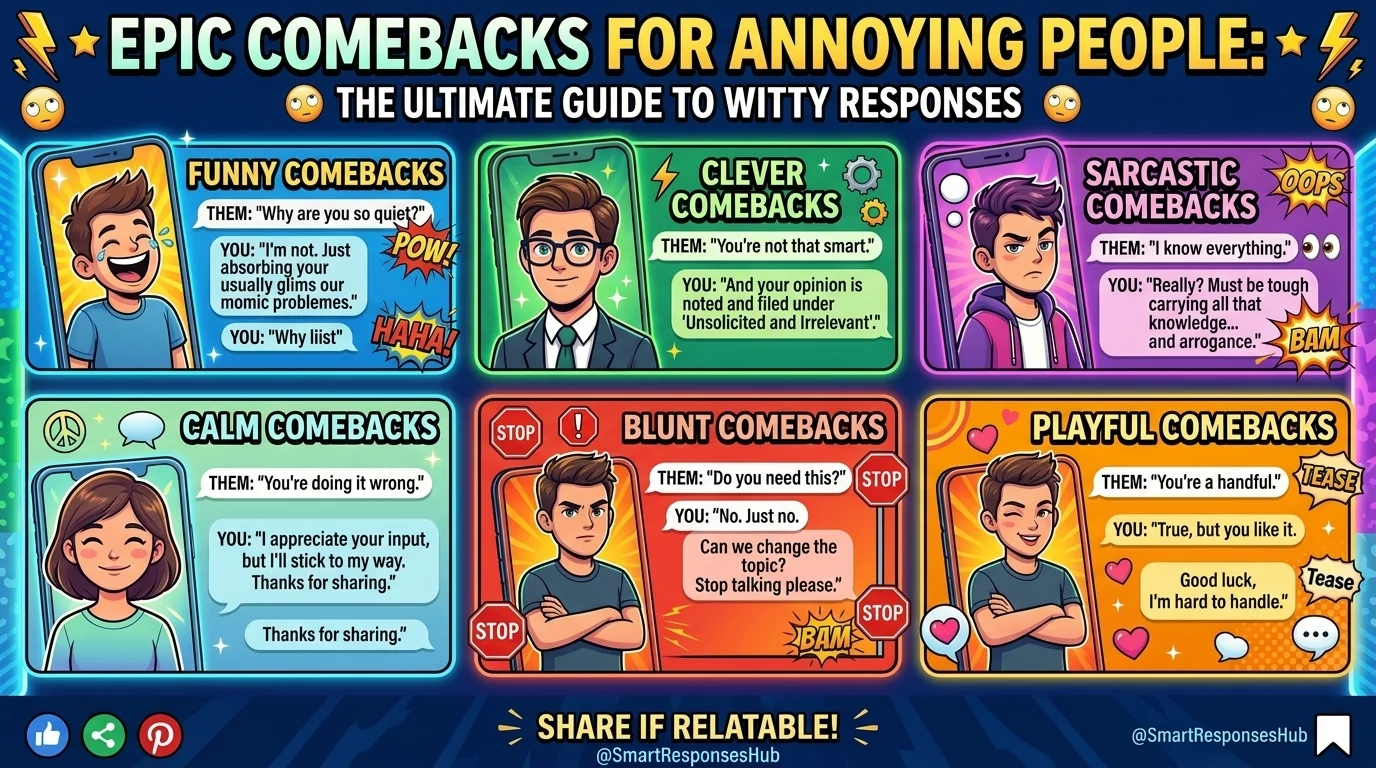
Quick Ans: The best comebacks for annoying people shut down the moment without making you sound overly pressed. You can go funny, sarcastic, calm, or confidently blunt depending on the situation and how much patience you have left.
Top alternatives: “Are you finished?”, “That’s interesting,” “Noted,” “Anyway…”, “I’ll pretend I didn’t hear that”
Annoying people have a special talent for showing up exactly when your patience is running on 1%. Maybe it is a friend who will not stop teasing you, a coworker who has something to say about everything, someone in your DMs asking the same question repeatedly, or that one person who treats every conversation like an audition for attention.
That is where good comebacks for annoying people come in. The right response can set a boundary, end the nonsense, or turn the situation into a joke without creating unnecessary drama. Sometimes a funny one-liner works best. Other times, a calm “Okay?” says everything.
The goal is not to start World War III in the group chat. It is to respond with confidence, humor, and just enough attitude to make your point. Here are ready-to-use replies for every level of annoyance.
Funny Comebacks
“Congratulations, you’re still talking.”
Example: Use this when someone keeps repeating themselves during a casual conversation.
Meaning: You are jokingly pointing out that they have talked long enough.
“Do you come with a mute button?”
Example: Use this with a friend who is intentionally being loud or repetitive.
Meaning: You are humorously saying you need a break from them.
“I admire your commitment to being irritating.”
Example: Use this when someone keeps doing the same annoying thing.
Meaning: You are making fun of their persistence.
“You really woke up and chose this energy.”
Example: Use this when someone starts being annoying for no clear reason.
Meaning: You are playfully questioning their choices.
“Hold on, let me act surprised.”
Example: Use this when someone says something predictable.
Meaning: You are joking that their behavior was expected.
“You’re like a notification I forgot to turn off.”
Example: Use this when someone keeps interrupting or messaging repeatedly.
Meaning: You are comparing their behavior to something persistently distracting.
“That was almost interesting.”
Example: Use this when someone tells an unnecessarily long story.
Meaning: You are teasing them for failing to hold your attention.
“I’m impressed by your ability to make silence look attractive.”
Example: Use this when someone refuses to stop talking.
Meaning: You are humorously suggesting they should be quiet.
“Please continue. I needed more background noise.”
Example: Use this when someone is rambling.
Meaning: You are joking that you are not taking them seriously.
“You have a lot of confidence for someone saying that.”
Example: Use this when someone makes an annoying comment.
Meaning: You are questioning their statement with humor.
“My patience just filed a complaint.”
Example: Use this when someone keeps pushing your buttons.
Meaning: You are jokingly saying they have tested your limits.
“You’re doing amazing at making me miss peace and quiet.”
Example: Use this when someone is being nonstop annoying.
Meaning: You are humorously saying their behavior makes silence appealing.
Clever Comebacks
“Was that supposed to change my mind?”
Example: Use this when someone keeps pushing an opinion.
Meaning: You are confidently showing that they have not convinced you.
“Interesting. I’ll store that somewhere I’ll never look.”
Example: Use this when someone gives unwanted advice.
Meaning: You are dismissing the advice with humor.
“You’ve made your point several times now.”
Example: Use this when someone repeats the same argument.
Meaning: You are calmly telling them to stop repeating themselves.
“I understand what you’re saying. I just disagree.”
Example: Use this when you want to stay composed.
Meaning: You are setting a clear boundary without being rude.
“That sounds like a problem for future you.”
Example: Use this when someone keeps complaining about avoidable issues.
Meaning: You are refusing to take responsibility for their problem.
“I’ll give that opinion the attention it deserves.”
Example: Use this when someone offers an unhelpful comment.
Meaning: You are subtly showing that you are not impressed.
“You seem very passionate about something I didn’t ask about.”
Example: Use this when someone gives unsolicited input.
Meaning: You are pointing out that their opinion was not requested.
“Let’s agree that you’ve said enough.”
Example: Use this when someone will not let a topic go.
Meaning: You are firmly trying to end the conversation.
“That explains a lot, actually.”
Example: Use this when someone says something that reveals their behavior.
Meaning: You are making a subtle but pointed observation.
“I see why this conversation is going nowhere.”
Example: Use this when someone refuses to listen.
Meaning: You are signaling that continuing is pointless.
“You’re entitled to your opinion. I’m entitled to ignore it.”
Example: Use this when someone keeps forcing their viewpoint.
Meaning: You are confidently setting a boundary.
“Thanks for sharing. I’ll recover eventually.”
Example: Use this when someone gives an annoying or unnecessary comment.
Meaning: You are using dry humor to dismiss it.
Sarcastic Comebacks
“Wow. Nobody has ever said that before.”
Example: Use this when someone makes a painfully predictable comment.
Meaning: You are sarcastically saying their remark is unoriginal.
“Fascinating. Please tell me more against my will.”
Example: Use this when someone will not stop talking.
Meaning: You are joking that you do not actually want more information.
“You should put that on a motivational poster.”
Example: Use this when someone says something obvious.
Meaning: You are sarcastically treating their comment as profound.
“I’ll try to survive this information.”
Example: Use this when someone shares something unnecessary.
Meaning: You are exaggerating how unimportant their comment is.
“What would I do without this groundbreaking update?”
Example: Use this when someone tells you something obvious.
Meaning: You are sarcastically pretending the information is important.
“Please, keep explaining things I already know.”
Example: Use this when someone is being condescending.
Meaning: You are calling out their behavior with sarcasm.
“I was having such a peaceful day too.”
Example: Use this when someone suddenly starts annoying you.
Meaning: You are joking that their arrival disrupted your peace.
“That certainly was a choice.”
Example: Use this when someone does something ridiculous.
Meaning: You are sarcastically commenting without saying much.
“Your timing is truly impressive.”
Example: Use this when someone interrupts at the worst moment.
Meaning: You are sarcastically criticizing their timing.
“Thank you for that completely necessary contribution.”
Example: Use this when someone adds nothing useful.
Meaning: You are mocking the lack of value in their comment.
“I’ll pretend that was helpful.”
Example: Use this when someone gives unwanted advice.
Meaning: You are sarcastically dismissing their input.
“You must be exhausted from making everything about you.”
Example: Use this when someone constantly seeks attention.
Meaning: You are calling out self-centered behavior.
Calm Comebacks
“Okay.”
Example: Use this when you do not want to give an annoying person more energy.
Meaning: You are refusing to engage emotionally.
“Noted.”
Example: Use this when someone keeps offering unwanted opinions.
Meaning: You are acknowledging them without agreeing.
“I hear you.”
Example: Use this when you want to stay calm during an irritating conversation.
Meaning: You are showing you listened without inviting more debate.
“We don’t have to agree.”
Example: Use this when someone keeps arguing their point.
Meaning: You are setting a peaceful boundary.
“That’s your perspective.”
Example: Use this when someone presents an opinion as fact.
Meaning: You are separating their view from your own.
“I’m not interested in arguing about this.”
Example: Use this when the conversation becomes repetitive.
Meaning: You are directly ending the argument.
“Let’s move on.”
Example: Use this when someone refuses to drop a topic.
Meaning: You are signaling that the discussion is over.
“I don’t have anything else to add.”
Example: Use this when you want to stop responding.
Meaning: You are calmly closing the conversation.
“I said what I said.”
Example: Use this when someone keeps challenging your answer.
Meaning: You are standing by your statement.
“You’re welcome to feel that way.”
Example: Use this when someone tries to provoke you.
Meaning: You are refusing to take responsibility for their feelings.
“I’m going to leave it there.”
Example: Use this when you want to end the discussion politely.
Meaning: You are setting a final boundary.
“No hard feelings, but I’m done discussing this.”
Example: Use this when you want to remain respectful.
Meaning: You are ending the interaction without escalating it.
Blunt Comebacks
“Are you finished?”
Example: Use this when someone has been talking at you for too long.
Meaning: You are directly signaling that they should stop.
“What exactly do you want me to say to that?”
Example: Use this when someone makes an annoying statement.
Meaning: You are challenging them to explain their point.
“You’re doing too much.”
Example: Use this when someone is overreacting or seeking attention.
Meaning: You are telling them their behavior is excessive.
“That wasn’t necessary.”
Example: Use this when someone makes an unnecessary comment.
Meaning: You are directly calling out the behavior.
“Can we not?”
Example: Use this when someone starts a familiar annoying habit.
Meaning: You are asking them to stop without a long explanation.
“I’m not entertaining this today.”
Example: Use this when someone tries to start drama.
Meaning: You are refusing to participate.
“You can stop now.”
Example: Use this when someone crosses your patience limit.
Meaning: You are giving a clear instruction to end the behavior.
“I got it the first time.”
Example: Use this when someone keeps repeating themselves.
Meaning: You are telling them repetition is unnecessary.
“That’s enough.”
Example: Use this when someone will not stop.
Meaning: You are setting a firm boundary.
“Please find something else to do.”
Example: Use this when someone keeps bothering you.
Meaning: You are directly telling them to redirect their energy.
“I’m not the one today.”
Example: Use this when someone tries to provoke you.
Meaning: You are warning them that you will not tolerate the behavior.
“Try someone else.”
Example: Use this when someone keeps bothering you for a reaction.
Meaning: You are telling them you will not participate.
Funny Text Comebacks
“Currently unavailable for nonsense.”
Example: Use this as a text reply when someone starts being irritating.
Meaning: You are jokingly saying your patience is offline.
“Please leave your chaos after the beep.”
Example: Use this when someone sends ridiculous messages.
Meaning: You are pretending their message reached a voicemail system.
“Loading patience… error.”
Example: Use this in a group chat or DM.
Meaning: You are joking that your patience has run out.
“Respectfully, what are you talking about?”
Example: Use this when someone sends a confusing message.
Meaning: You are questioning them while keeping the tone funny.
“My notifications deserve better.”
Example: Use this when someone repeatedly messages nonsense.
Meaning: You are humorously criticizing the message.
“Typing this with my last nerve.”
Example: Use this when someone has been especially irritating.
Meaning: You are exaggerating your frustration.
“Please submit your complaint during business hours.”
Example: Use this when someone is constantly complaining.
Meaning: You are jokingly treating yourself like a customer service department.
“I’m forwarding this to nobody.”
Example: Use this when someone shares pointless information.
Meaning: You are saying the information has no value.
“This chat needs a season finale.”
Example: Use this when an annoying conversation goes on forever.
Meaning: You are joking that the drama needs to end.
“I fear you have mistaken me for someone interested.”
Example: Use this when someone keeps forcing a topic.
Meaning: You are humorously showing disinterest.
“New phone, who dis?”
Example: Use this when joking with someone you know well.
Meaning: You are playfully pretending you do not know them.
“Anyway, back to literally anything else.”
Example: Use this when you want to change the subject.
Meaning: You are making it clear you are done with the topic.
Replies To Someone Who Won’t Stop Talking
“You’ve got the floor, the ceiling, and apparently the whole building.”
Example: Use this with a talkative friend.
Meaning: You are joking that they have taken over the conversation.
“Do you need an intermission?”
Example: Use this when someone has been talking nonstop.
Meaning: You are humorously suggesting they take a break.
“I’m starting to think breathing is optional for you.”
Example: Use this only with close friends who enjoy teasing.
Meaning: You are joking about how nonstop they are talking.
“Can I schedule a turn?”
Example: Use this when you cannot get a word in.
Meaning: You are humorously asking for a chance to speak.
“I had a response, but the moment passed.”
Example: Use this when someone keeps interrupting you.
Meaning: You are pointing out that they did not leave room for you.
“I’ll just nod until this is over.”
Example: Use this when someone is rambling.
Meaning: You are jokingly admitting you have stopped engaging.
“Your podcast episode is impressive.”
Example: Use this when someone turns a conversation into a monologue.
Meaning: You are comparing their talking to a long broadcast.
“Somewhere in there, I almost had a thought.”
Example: Use this when you keep getting interrupted.
Meaning: You are humorously saying they prevented you from speaking.
“Do you take guest speakers?”
Example: Use this when someone dominates the conversation.
Meaning: You are jokingly asking for a turn.
“I see we’re having a one-person discussion.”
Example: Use this when someone will not let you participate.
Meaning: You are pointing out their lack of listening.
“Please continue. I’ll just be over here aging.”
Example: Use this when their story feels endless.
Meaning: You are exaggerating how long they have been talking.
“The director’s cut was unnecessary.”
Example: Use this when someone gives way too many details.
Meaning: You are joking that a shorter version would have been better.
Replies To Repetitive People
“Yes, you mentioned that.”
Example: Use this when someone repeats the same point.
Meaning: You are reminding them that you already heard it.
“Still the same answer.”
Example: Use this when someone keeps asking the same question.
Meaning: You are refusing to change your response.
“We’ve covered this episode already.”
Example: Use this when the same topic keeps returning.
Meaning: You are humorously saying the conversation is repeating.
“My answer didn’t expire.”
Example: Use this when someone asks again after you already responded.
Meaning: You are joking that your previous answer still applies.
“You’re on repeat.”
Example: Use this when someone says the same thing repeatedly.
Meaning: You are directly pointing out the repetition.
“I heard you the first three times.”
Example: Use this when someone will not stop repeating themselves.
Meaning: You are humorously emphasizing that you understood.
“We need new material.”
Example: Use this when someone keeps making the same joke.
Meaning: You are teasing them for being repetitive.
“Are we looping?”
Example: Use this when the conversation feels repetitive.
Meaning: You are jokingly comparing the situation to a glitch.
“The replay button is stuck.”
Example: Use this when someone repeats themselves.
Meaning: You are humorously describing their behavior.
“Same question, same answer.”
Example: Use this when you want to be brief.
Meaning: You are making it clear nothing has changed.
“I’m familiar with this speech.”
Example: Use this when someone repeats an old argument.
Meaning: You are showing that you have heard it all before.
“Skipping to the next topic.”
Example: Use this when you want to move forward.
Meaning: You are refusing to keep repeating the discussion.
Replies To Nosy People
“Why do you need to know?”
Example: Use this when someone asks overly personal questions.
Meaning: You are asking them to justify their curiosity.
“That’s classified.”
Example: Use this when you want a funny way to avoid answering.
Meaning: You are playfully keeping information private.
“My life isn’t a group project.”
Example: Use this when someone keeps digging into your business.
Meaning: You are setting a boundary around your privacy.
“That information is not publicly available.”
Example: Use this when you want a clever response.
Meaning: You are jokingly refusing to share details.
“I’ll let you know when there’s a press release.”
Example: Use this when someone keeps asking for updates.
Meaning: You are humorously saying they do not need the information.
“Curiosity is working overtime today.”
Example: Use this when someone asks too many questions.
Meaning: You are teasing them for being nosy.
“That’s between me and my calendar.”
Example: Use this when someone asks about your plans.
Meaning: You are playfully keeping your schedule private.
“You ask a lot of questions for someone not on the payroll.”
Example: Use this when someone interrogates you.
Meaning: You are jokingly questioning their authority.
“I missed the part where I signed up for an interview.”
Example: Use this when someone asks multiple personal questions.
Meaning: You are signaling that they are being intrusive.
“Some mysteries should stay mysterious.”
Example: Use this when you want a softer boundary.
Meaning: You are declining to answer without sounding harsh.
“I’ll keep you posted never.”
Example: Use this only with friends who understand your humor.
Meaning: You are jokingly refusing to provide updates.
“That’s a premium subscription question.”
Example: Use this when you want a modern funny comeback.
Meaning: You are implying that access to that information is limited.
Replies To Attention Seekers
“And the spotlight finds you again.”
Example: Use this when someone constantly redirects attention toward themselves.
Meaning: You are playfully calling out the behavior.
“Should we get you a microphone?”
Example: Use this when someone keeps making everything a performance.
Meaning: You are joking about their need for attention.
“The main character has arrived.”
Example: Use this when a friend dramatically enters a conversation.
Meaning: You are teasing their attention-grabbing energy.
“Do you want applause or a standing ovation?”
Example: Use this when someone is fishing for praise.
Meaning: You are sarcastically asking how much attention they want.
“The room was peaceful for a minute.”
Example: Use this when someone interrupts for attention.
Meaning: You are joking that their arrival changed the atmosphere.
“You really found a way to make this about you.”
Example: Use this when someone redirects every topic.
Meaning: You are directly calling out their behavior.
“Should we schedule your next appearance?”
Example: Use this when someone constantly makes dramatic entrances.
Meaning: You are treating their behavior like a performance.
“Your fan club must be busy.”
Example: Use this when someone expects constant attention.
Meaning: You are teasing their confidence.
“I see the spotlight is fully booked today.”
Example: Use this when someone dominates attention.
Meaning: You are humorously pointing out their behavior.
“Amazing. We somehow ended up back at you.”
Example: Use this when they redirect a discussion to themselves.
Meaning: You are sarcastically pointing out the pattern.
“You deserve an award for staying on topic with yourself.”
Example: Use this when someone always talks about themselves.
Meaning: You are joking about their self-focus.
“Plot twist: other people exist too.”
Example: Use this when someone ignores everyone else’s experiences.
Meaning: You are reminding them that they are not the only focus.
Replies To Unwanted Advice
“Thanks, but I’ve got it handled.”
Example: Use this when someone gives advice you did not ask for.
Meaning: You are politely declining their input.
“I’ll keep that in mind.”
Example: Use this when you want a neutral response.
Meaning: You are acknowledging the advice without promising to use it.
“That’s one approach.”
Example: Use this when you disagree with their suggestion.
Meaning: You are politely signaling that you may choose differently.
“Interesting suggestion.”
Example: Use this when you want to remain diplomatic.
Meaning: You are acknowledging the idea without endorsing it.
“I wasn’t looking for advice, but thanks.”
Example: Use this when you need a direct boundary.
Meaning: You are clearly saying their advice was unsolicited.
“I’ll take it under consideration.”
Example: Use this when you want a formal-sounding response.
Meaning: You are politely avoiding commitment.
“I appreciate the concern.”
Example: Use this when their advice comes from a good place.
Meaning: You are recognizing their intention while keeping control.
“I’m going to trust my own judgment here.”
Example: Use this when someone keeps pushing their advice.
Meaning: You are confidently choosing your own approach.
“That works for you, and that’s great.”
Example: Use this when their advice is based on personal preference.
Meaning: You are separating their method from yours.
“I’ll let you know if I need help.”
Example: Use this when you want to set a clear boundary.
Meaning: You are saying you will ask when assistance is wanted.
“Thanks, but I didn’t ask for a consultation.”
Example: Use this when you want humor with a boundary.
Meaning: You are pointing out that their advice was unsolicited.
“My decision is already made.”
Example: Use this when someone will not stop advising you.
Meaning: You are ending the discussion clearly.
Workplace Comebacks
“Thanks for the feedback.”
Example: Use this when you need to remain professional despite annoyance.
Meaning: You are acknowledging them without arguing.
“I’ll take that into consideration.”
Example: Use this in a work conversation.
Meaning: You are politely avoiding an immediate commitment.
“Let’s stay focused on the task.”
Example: Use this when someone derails a meeting.
Meaning: You are redirecting attention to work.
“I think we’ve covered that already.”
Example: Use this when a coworker repeats a point.
Meaning: You are professionally signaling that it is time to move on.
“Could you clarify what outcome you’re looking for?”
Example: Use this when someone complains without offering a solution.
Meaning: You are asking them to be constructive.
“I’ll handle my part.”
Example: Use this when someone micromanages you.
Meaning: You are calmly asserting independence.
“Let’s keep this productive.”
Example: Use this when a discussion becomes unnecessarily annoying.
Meaning: You are setting a professional tone.
“I appreciate your perspective.”
Example: Use this when you disagree but want to remain polite.
Meaning: You are acknowledging their view without agreeing.
“We can revisit that if necessary.”
Example: Use this when you want to close a repetitive discussion.
Meaning: You are postponing the issue without continuing the argument.
“I think we have different approaches.”
Example: Use this when someone keeps challenging your method.
Meaning: You are diplomatically recognizing disagreement.
“Let’s move forward.”
Example: Use this when the conversation is stuck.
Meaning: You are encouraging everyone to stop dwelling on the issue.
“I’m happy to discuss solutions.”
Example: Use this when someone complains repeatedly.
Meaning: You are setting the expectation that the conversation should be constructive.
Short One-Word And Two-Word Replies
“Okay.”
Example: Use this when you do not want to feed the conversation.
Meaning: You are giving minimal engagement.
“Noted.”
Example: Use this when someone gives an unwanted opinion.
Meaning: You are acknowledging without agreeing.
“Anyway.”
Example: Use this when you want to move on immediately.
Meaning: You are ending attention on the annoying topic.
“Sure.”
Example: Use this when you want a neutral response.
Meaning: You are acknowledging without emotional investment.
“Interesting.”
Example: Use this when you want dry distance.
Meaning: You are reacting without giving much away.
“Right.”
Example: Use this when someone says something questionable.
Meaning: You are showing mild disbelief.
“Fascinating.”
Example: Use this when sarcasm fits the situation.
Meaning: You are reacting as though the comment is unusually important.
“Moving on.”
Example: Use this when you want to end the topic.
Meaning: You are clearly redirecting the conversation.
“Hard pass.”
Example: Use this when someone suggests something annoying.
Meaning: You are firmly declining.
“Try again.”
Example: Use this when someone’s comment misses the mark.
Meaning: You are telling them to do better.
“Next.”
Example: Use this when you want to dismiss a pointless comment.
Meaning: You are signaling that the topic is over.
“Enough.”
Example: Use this when someone pushes too far.
Meaning: You are setting a firm limit.
Dramatic Comebacks
“And just when I thought the day couldn’t get more interesting.”
Example: Use this when someone suddenly starts annoying you.
Meaning: You are dramatically reacting to their behavior.
“My peace lasted longer than expected.”
Example: Use this when an annoying person interrupts you.
Meaning: You are joking that their arrival ended your calm.
“This is the plot twist I didn’t ask for.”
Example: Use this when someone creates unnecessary drama.
Meaning: You are comparing their behavior to an unwanted storyline.
“Somebody call the patience department.”
Example: Use this when your patience is disappearing.
Meaning: You are exaggerating your frustration for humor.
“I have survived many things, but this may be the toughest.”
Example: Use this when someone is mildly irritating.
Meaning: You are dramatically exaggerating the situation.
“Tell my group chat I fought bravely.”
Example: Use this when a conversation becomes exhausting.
Meaning: You are jokingly treating annoyance like a battle.
“This was not on my bingo card.”
Example: Use this when someone behaves unexpectedly.
Meaning: You are saying their behavior was surprising.
“The universe is testing my character today.”
Example: Use this when someone pushes your patience.
Meaning: You are joking that the situation is a personal challenge.
“I was not emotionally prepared for this nonsense.”
Example: Use this when something ridiculous happens.
Meaning: You are humorously expressing disbelief.
“And here begins my villain origin story.”
Example: Use this when joking about being pushed to your limit.
Meaning: You are dramatically saying the situation is testing you.
“I would like to unsubscribe from this interaction.”
Example: Use this when you want to leave a conversation.
Meaning: You are humorously saying you no longer want to participate.
“This episode needs to end immediately.”
Example: Use this when drama keeps going.
Meaning: You are treating the situation like an overly long TV show.
Polite But Firm Comebacks
“I’d appreciate it if you stopped.”
Example: Use this when someone repeatedly bothers you.
Meaning: You are clearly asking them to respect your boundary.
“Please don’t speak to me that way.”
Example: Use this when someone becomes disrespectful.
Meaning: You are calmly setting a standard for communication.
“I’m not comfortable with that.”
Example: Use this when someone crosses a personal boundary.
Meaning: You are directly expressing discomfort.
“Let’s keep this respectful.”
Example: Use this when a conversation becomes rude.
Meaning: You are asking for better behavior.
“I don’t find that funny.”
Example: Use this when someone repeatedly makes an annoying joke.
Meaning: You are clearly saying the joke should stop.
“I’d rather not continue this conversation.”
Example: Use this when you want to disengage politely.
Meaning: You are ending the interaction without escalating.
“Please respect my answer.”
Example: Use this when someone keeps pushing after you have responded.
Meaning: You are asking them to accept your boundary.
“I’ve already explained my position.”
Example: Use this when someone demands repeated explanations.
Meaning: You are refusing to keep defending yourself.
“That topic is not up for discussion.”
Example: Use this when someone will not stop asking.
Meaning: You are setting a firm conversational boundary.
“I’m going to step away from this conversation.”
Example: Use this when someone becomes exhausting or disrespectful.
Meaning: You are calmly choosing to disengage.
“We can talk when this becomes productive.”
Example: Use this when a discussion turns into pointless arguing.
Meaning: You are setting conditions for continuing.
“I need some space from this right now.”
Example: Use this when annoyance becomes overwhelming.
Meaning: You are communicating a need for distance.
Playful Comebacks For Friends
“You again? My favorite inconvenience.”
Example: Use this with a close friend who knows you are joking.
Meaning: You are teasing them affectionately.
“I was bored until you arrived with nonsense.”
Example: Use this when a friend starts being ridiculous.
Meaning: You are joking that they bring entertaining chaos.
“You’re lucky I tolerate you.”
Example: Use this in a playful friendship.
Meaning: You are showing affection through teasing.
“Please remain annoying at a safe distance.”
Example: Use this when joking around in person.
Meaning: You are playfully asking for space.
“My favorite headache has arrived.”
Example: Use this with a close friend.
Meaning: You are affectionately teasing them.
“I would miss you if you stopped being annoying.”
Example: Use this when you want a sweet joke.
Meaning: You are admitting their annoying habits are part of the friendship.
“You bring so much chaos into my peaceful life.”
Example: Use this with a dramatic friend.
Meaning: You are teasing their energy while showing affection.
“I blame you for my personality development.”
Example: Use this when a friend has influenced your humor.
Meaning: You are jokingly blaming them for who you have become.
“You’re the reason I need snacks during conversations.”
Example: Use this when chats with them become exhausting.
Meaning: You are humorously saying they require extra patience.
“Some friendships are built on trust. Ours is built on tolerating nonsense.”
Example: Use this when joking about your friendship.
Meaning: You are affectionately describing your dynamic.
“I support your right to be annoying, unfortunately.”
Example: Use this when teasing a close friend.
Meaning: You are joking that you have no choice but to tolerate them.
“Never change. Actually, change a little.”
Example: Use this when you want a funny affectionate roast.
Meaning: You are teasing them while still showing fondness.
Confident Comebacks
“I’m not changing my answer.”
Example: Use this when someone keeps pressuring you.
Meaning: You are firmly standing your ground.
“You don’t have to agree with me.”
Example: Use this during a disagreement.
Meaning: You are confident without needing approval.
“I’m comfortable with my decision.”
Example: Use this when someone questions your choices.
Meaning: You are showing self-assurance.
“That doesn’t work for me.”
Example: Use this when someone tries to push a boundary.
Meaning: You are clearly declining.
“I know what I said.”
Example: Use this when someone keeps challenging your words.
Meaning: You are confidently standing by your statement.
“I’m not explaining myself again.”
Example: Use this when someone demands repeated justification.
Meaning: You are setting a strong limit.
“You can think whatever you want.”
Example: Use this when someone judges you.
Meaning: You are refusing to seek their approval.
“I’m good with my choice.”
Example: Use this when someone keeps questioning your decision.
Meaning: You are showing confidence in yourself.
“That’s not something I need to prove.”
Example: Use this when someone challenges you unnecessarily.
Meaning: You are refusing to perform for their approval.
“I don’t need to win this conversation.”
Example: Use this when someone is obsessed with arguing.
Meaning: You are showing confidence by disengaging.
“My boundaries are not up for debate.”
Example: Use this when someone repeatedly crosses a line.
Meaning: You are making your limits clear.
“I’ve got better things to do.”
Example: Use this when you want to leave an annoying interaction.
Meaning: You are confidently choosing your time and energy.
FAQs
What are good comebacks for annoying people?
Good comebacks depend on the situation. Funny replies can lighten the mood, while calm or firm responses work better when you genuinely need someone to stop.
What is a funny comeback for an annoying person?
Try “Do you come with a mute button?” or “My patience just filed a complaint.” They make your point without taking things too seriously.
How do you shut down an annoying person politely?
Try “I’d appreciate it if you stopped,” “Let’s move on,” or “I’m not interested in continuing this conversation.”
Are sarcastic comebacks appropriate?
They can be with friends or in playful situations. If the person is genuinely disrespectful, a clear and calm boundary is usually more effective.
What should I say if I do not want to be rude?
Use neutral responses like “Noted,” “Okay,” “I hear you,” or “We don’t have to agree.”
How do I respond to someone who keeps repeating themselves?
Try “Yes, you mentioned that,” “Still the same answer,” or “I got it the first time.”
What if humor does not work?
Stop joking and be direct. A simple “Please stop” or “I’m done discussing this” can communicate your boundary clearly.
What is a good comeback for someone annoying you over text?
Try “Currently unavailable for nonsense,” “Loading patience… error,” or “Anyway, back to literally anything else.”
How do I deal with an annoying coworker professionally?
Keep it work-focused with replies like “Let’s stay focused on the task” or “I’m happy to discuss solutions.”
Should I always respond with a comeback?
No. Sometimes the strongest move is giving no reaction at all. If someone wants attention, refusing to feed the behavior can be more effective than any one-liner.
Conclusion
Annoying people are practically unavoidable, but getting stuck for words does not have to be. The right comebacks for annoying people can help you stay funny, confident, calm, or firm without turning every irritating moment into a full-blown argument.
Try a playful line when you are dealing with friends, use sarcasm when the situation is light, and choose clear boundaries when someone genuinely needs to stop. Remember, the best response is the one that fits both your personality and the situation.
Save your favorite lines for later, share this list with your funniest friend, and keep a few comebacks ready for the next person who decides to test your patience. Your last nerve deserves backup.

Lily Carter creates practical, easy-to-follow content for everyday readers at ResponseCraft.com. She enjoys turning complex topics into clear, actionable advice that helps people make smarter decisions.
1 thought on “180+ Comebacks for Annoying People: Funny, Clever, Brutal & Witty Replies”