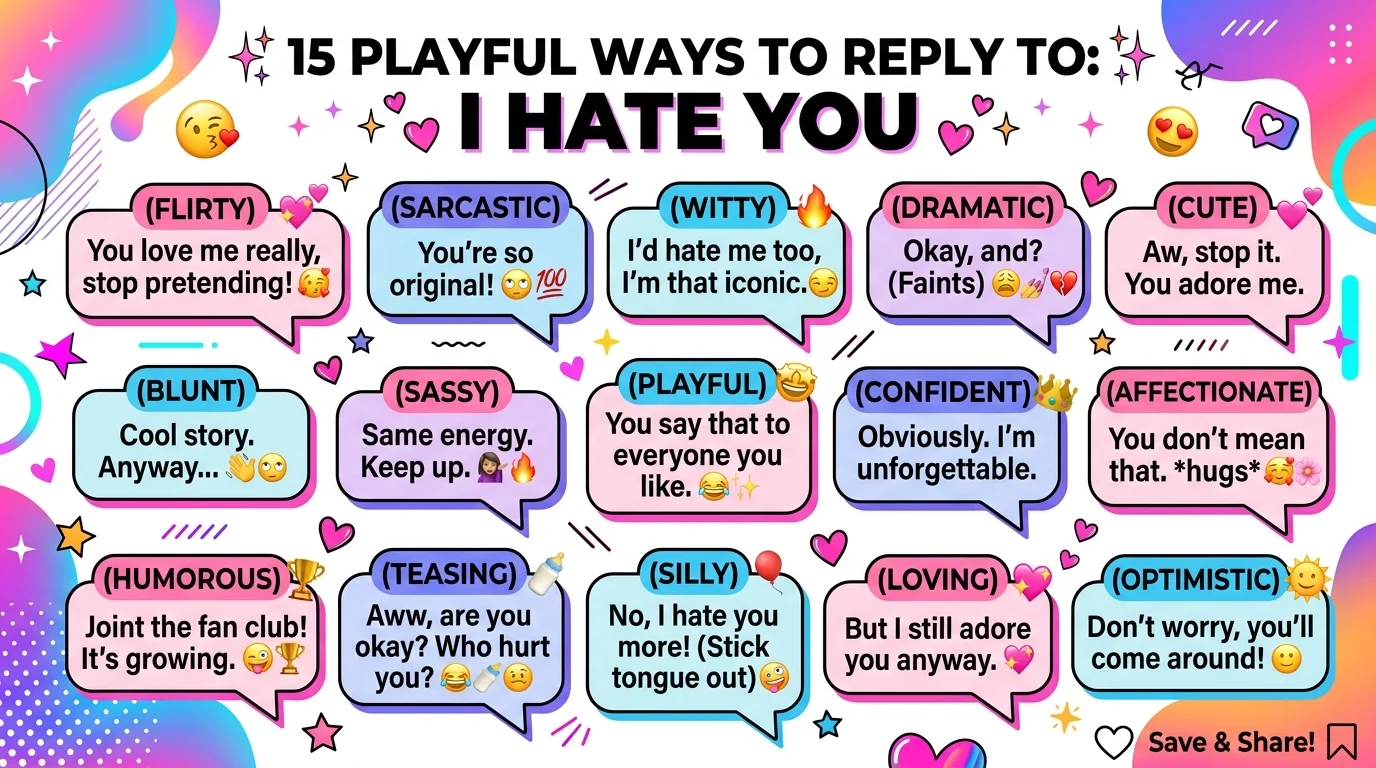
Quick Ans: When someone says “I hate you,” the best response depends on whether they are joking, annoyed, flirting, or genuinely upset. Pick a reply that matches the vibe instead of accidentally turning a tiny moment into a full season finale.
Top alternatives: “You love me really,” “Noted 😂,” “That sounds like a you problem,” “I’ll survive,” “Aww, I missed you too.”
“I hate you” can mean about twelve different things depending on the person, the punctuation, and the number of laughing emojis attached. A friend might say it after you steal the last slice of pizza. A crush might text it after you tease them a little too successfully. Someone at work might say it jokingly after you assign them the task nobody wanted. And yes, sometimes they actually mean they are upset.
That is why knowing how to respond to I hate you matters. The right reply can turn awkward tension into a laugh, keep a flirty moment alive, or calmly set a boundary when things get serious. From funny comebacks and sarcastic one-liners to sweet, confident, and clever responses, there is a perfect reply for almost every situation. So whether this landed in your DMs, group chat, or face-to-face, keep scrolling. Your comeback is waiting.
Funny Responses
“Good thing I’m adorable.” Use this when someone jokingly complains about you after a silly moment.
Meaning: You are playfully refusing to take their mock anger seriously.
“Get in line.” Use this when you want a quick joke with exaggerated confidence.
Meaning: You are pretending that plenty of people already feel the same way.
“I’ll add that to my résumé.” Use this after someone dramatically announces their dislike.
Meaning: You are turning their comment into an imaginary achievement.
“That sounds expensive.” Use this when you want a random, absurd comeback.
Meaning: You are deliberately making their statement funnier by responding unexpectedly.
“Aww, fan behavior.” Use this when their supposed hatred clearly sounds playful.
Meaning: You are teasing them by suggesting they secretly admire you.
“You say that like I’m supposed to cry.” Use this with close friends who enjoy playful banter.
Meaning: You are showing that their comment does not bother you.
“Noted, bestie.” Use this for a casual group-chat style response.
Meaning: You acknowledge the comment without giving it emotional weight.
“I’ll try to recover.” Use this when you want fake dramatic heartbreak.
Meaning: You are jokingly acting devastated by their words.
“Wow, my reputation is growing.” Use this when you want a playful response.
Meaning: You are treating their dislike like unexpected fame.
“That’s okay, I still like snacks.” Use this when you want an intentionally random reply.
Meaning: You are humorously showing that life continues regardless.
“I’ll alert the authorities.” Use this when someone is being hilariously dramatic.
Meaning: You are exaggerating the situation for comedic effect.
“Devastating. Absolutely devastating.” Use this when you want mock seriousness.
Meaning: You are pretending their comment has completely ruined your day.
Brutal Responses
“You’ll be okay.” Use this when someone is being unnecessarily dramatic.
Meaning: You are calmly refusing to entertain the performance.
“And yet, here you are.” Use this when they keep talking to you despite claiming to dislike you.
Meaning: You are pointing out the contradiction in their behavior.
“That’s a lot of emotion for someone who doesn’t care.” Use this when their reaction seems exaggerated.
Meaning: You are highlighting how invested they appear.
“Sounds personal.” Use this when you want a short, confident comeback.
Meaning: You are making their feelings their responsibility.
“I’ll lose exactly zero hours of sleep.” Use this when you want detached confidence.
Meaning: You are saying their opinion does not affect you.
“Okay, and?” Use this when you want maximum brevity.
Meaning: You are refusing to give their statement extra importance.
“You survived the interaction. Congratulations.” Use this with someone who enjoys sharp humor.
Meaning: You are playfully suggesting their complaint is overblown.
“That’s unfortunate for you.” Use this when you want a cool, slightly cutting reply.
Meaning: You are implying their dislike is their problem.
“I’m strangely comfortable with that.” Use this when you want calm confidence.
Meaning: You are showing that rejection does not shake you.
“I can live with that.” Use this when you want to sound completely unbothered.
Meaning: You are refusing to react emotionally.
“You’re allowed to be wrong.” Use this when the relationship allows playful teasing.
Meaning: You are confidently dismissing their claim as inaccurate.
“Thanks for the update.” Use this when you want dry humor instead of an argument.
Meaning: You acknowledge them without feeding the drama.
Flirty Responses
“You hate me or you like me a little too much?” Use this when a crush says it teasingly.
Meaning: You are turning fake annoyance into playful romantic tension.
“Cute way to say you missed me.” Use this after someone playfully complains about you.
Meaning: You are teasing them into admitting they enjoy your attention.
“Keep talking, you’re making this sound romantic.” Use this when the banter is clearly flirtatious.
Meaning: You are confidently framing their teasing as attraction.
“You’re adorable when you pretend.” Use this with someone who enjoys playful flirting.
Meaning: You are suggesting their hatred is obviously fake.
“That’s not what your texts say.” Use this when their messages seem affectionate despite their words.
Meaning: You are playfully calling out mixed signals.
“I’ll take that as a compliment.” Use this when you want confident flirt energy.
Meaning: You are refusing to let the teasing ruin the mood.
“You can hate me over dinner.” Use this when you want to turn banter into a date suggestion.
Meaning: You are using the moment to create an excuse to spend time together.
“Sounds like unresolved chemistry.” Use this when the conversation has obvious flirt tension.
Meaning: You are joking that their annoyance is actually attraction.
“Then why are you smiling?” Use this when you can tell they are secretly amused.
Meaning: You are teasing them about their obvious enjoyment.
“I knew you were obsessed.” Use this when you want playful confidence.
Meaning: You are jokingly interpreting their attention as attraction.
“Say it again, but closer.” Use this only when the flirting is clearly mutual.
Meaning: You are turning their words into a playful invitation.
“I hate how much I like you too.” Use this when you want a cute, openly flirty response.
Meaning: You are admitting mutual attraction while keeping the mood playful.
Polite Responses
“I understand. I hope you’re okay.” Use this when their comment may come from genuine frustration.
Meaning: You are responding with maturity instead of escalating things.
“I hear you.” Use this when you want to acknowledge their feelings calmly.
Meaning: You are showing that you are listening.
“I’m sorry you feel that way.” Use this when you want to stay respectful.
Meaning: You recognize their emotion without creating another argument.
“Let’s talk about what happened.” Use this when there is clearly an issue behind their words.
Meaning: You are inviting a constructive conversation.
“I respect how you feel.” Use this when you want to avoid unnecessary conflict.
Meaning: You are giving their feelings space.
“I didn’t mean to upset you.” Use this when your actions genuinely caused frustration.
Meaning: You are acknowledging the possibility that you hurt them.
“Can we clear the air?” Use this when tension needs to be addressed.
Meaning: You want to resolve the misunderstanding.
“I’d rather understand than argue.” Use this when emotions are running high.
Meaning: You are choosing communication over conflict.
“Thanks for being honest.” Use this when someone expresses genuine feelings.
Meaning: You appreciate direct communication even when it is uncomfortable.
“I respect your space.” Use this when they clearly need distance.
Meaning: You are showing consideration instead of pushing back.
“Let’s not make this worse.” Use this when the conversation is becoming heated.
Meaning: You are trying to prevent further conflict.
“I hope we can work this out.” Use this when the relationship matters to you.
Meaning: You are leaving the door open for reconciliation.
Sarcastic Responses
“Oh no, whatever shall I do?” Use this when someone is obviously joking.
Meaning: You are dramatically pretending to be devastated.
“Breaking news: I have survived.” Use this when you want exaggerated sarcasm.
Meaning: You are making their statement sound hilariously unimportant.
“Please, I’m fragile.” Use this when you want fake emotional drama.
Meaning: You are pretending their words completely crushed you.
“I’ll notify my fan club.” Use this when someone claims to dislike you while giving you attention.
Meaning: You are joking that their attention proves popularity.
“This is my villain origin story.” Use this when you want a dramatic internet-style comeback.
Meaning: You are pretending their comment has created your imaginary villain era.
“I’ll never emotionally recover.” Use this after playful teasing.
Meaning: You are exaggerating your reaction for comedy.
“How will I tell my ancestors?” Use this when you want absurd sarcasm.
Meaning: You are pretending the situation is historically significant.
“My heart has officially left the chat.” Use this when you want a social-media-friendly comeback.
Meaning: You are playfully acting heartbroken.
“I expected better from my biggest supporter.” Use this when teasing someone who secretly likes you.
Meaning: You are sarcastically calling them a supporter.
“Adding that to today’s emotional damage.” Use this when the mood is playful.
Meaning: You are exaggerating a minor insult into a dramatic event.
“How dare you disrespect my brand.” Use this when you want confident sarcasm.
Meaning: You are pretending your personality is a major public brand.
“I’ll file a complaint with myself.” Use this when you want an absurdly dry comeback.
Meaning: You are joking that the complaint will receive absolutely no action.
Cute Responses
“Aww, you’re still talking to me.” Use this when someone is pretending to be annoyed.
Meaning: You are turning their annoyance into something affectionate.
“You don’t mean that.” Use this when the relationship is playful and affectionate.
Meaning: You are gently suggesting their words are not sincere.
“I still like you.” Use this when you want simple, sweet energy.
Meaning: You are responding with affection instead of defensiveness.
“Come here, grumpy.” Use this with someone you know well.
Meaning: You are treating their annoyance as cute rather than threatening.
“You’re too cute to be angry.” Use this when you want a warm compliment.
Meaning: You are softening the moment with affection.
“Okay, but I’m keeping you.” Use this when playful affection is mutual.
Meaning: You are jokingly saying their annoyance will not change your bond.
“Hate me later, smile now.” Use this when you want to lighten the mood.
Meaning: You are encouraging them to relax and enjoy the moment.
“Aww, my favorite complainer.” Use this when teasing a close friend or partner.
Meaning: You are showing affection while playfully calling out their habit.
“I know you secretly love me.” Use this when the relationship supports playful teasing.
Meaning: You are confidently assuming their affection is stronger than their words.
“You’re forgiven.” Use this when you want to reverse the joke.
Meaning: You are playfully acting like they were the one who needed forgiveness.
“Come back when you miss me.” Use this when you want a sweet goodbye.
Meaning: You are leaving the interaction on a warm note.
“Still sending you good vibes.” Use this when you want kindness without getting too serious.
Meaning: You are choosing positivity over matching their negativity.
Dramatic Responses
“My heart has shattered into seventeen pieces.” Use this when you want exaggerated comedy.
Meaning: You are pretending the insult caused enormous emotional damage.
“This betrayal will be remembered.” Use this when a friend jokingly insults you.
Meaning: You are turning a tiny disagreement into a fictional historical event.
“I trusted you.” Use this when you want maximum fake drama.
Meaning: You are pretending their words represent a deep betrayal.
“After everything we’ve been through?” Use this when you want theatrical humor.
Meaning: You are exaggerating your relationship history for laughs.
“I need a moment.” Use this when you want to pretend you are emotionally overwhelmed.
Meaning: You are giving yourself a dramatic pause for comedic effect.
“Tell my Wi-Fi I loved it.” Use this when you want absurd dramatic energy.
Meaning: You are jokingly acting as though your life has ended.
“I shall never recover.” Use this when the situation is obviously harmless.
Meaning: You are turning mild teasing into a theatrical tragedy.
“The friendship era is over.” Use this when joking with a close friend.
Meaning: You are pretending one insult has ended the entire friendship.
“Delete my number immediately.” Use this when you want an exaggerated reaction.
Meaning: You are jokingly threatening to end contact.
“This is my saddest chapter.” Use this when you want mock emotional intensity.
Meaning: You are treating the moment like a dramatic life event.
“I will remember this forever.” Use this when someone has teased you.
Meaning: You are playfully exaggerating how seriously you took it.
“Roll the sad music.” Use this when you want meme-style drama.
Meaning: You are turning the moment into an imaginary emotional montage.
Chill And Casual Responses
“Haha, fair enough.” Use this when you want to keep things relaxed.
Meaning: You are acknowledging the comment without creating tension.
“All good.” Use this when you want a simple, low-key response.
Meaning: You are showing that you are not bothered.
“You’ll get over it.” Use this with friends who are clearly joking.
Meaning: You are confidently brushing off their temporary annoyance.
“Lol, noted.” Use this in casual texting.
Meaning: You acknowledge their words without taking them too seriously.
“No worries.” Use this when you want to keep the interaction peaceful.
Meaning: You are choosing a relaxed response instead of arguing.
“We’re good.” Use this when you want to reassure them.
Meaning: You are signaling that there is no lasting issue.
“Fair.” Use this when you want the shortest possible acknowledgment.
Meaning: You accept their reaction without overexplaining.
“Haha, okay.” Use this when their comment is clearly playful.
Meaning: You are keeping the conversation light.
“I’ll survive.” Use this when you want casual humor.
Meaning: You are showing that their words do not affect you.
“Noted with love.” Use this when you want a friendly twist.
Meaning: You acknowledge the comment while keeping affection in the exchange.
“We’ll live.” Use this when the situation is minor.
Meaning: You are treating the moment as temporary and harmless.
“Cool story.” Use this when playful sarcasm fits the relationship.
Meaning: You are teasing them without becoming serious.
Confident Responses
“You’re entitled to your opinion.” Use this when you want mature confidence.
Meaning: You recognize their opinion without allowing it to define you.
“I’m comfortable being myself.” Use this when someone is genuinely criticizing you.
Meaning: You are showing self-confidence rather than seeking approval.
“That’s okay, I like me.” Use this when you want a positive confidence boost.
Meaning: You are saying your self-worth does not depend on their approval.
“I’m not here to please everyone.” Use this when someone expects you to change.
Meaning: You are standing firmly behind your personality.
“You don’t have to like me.” Use this when you want a calm boundary.
Meaning: You recognize that compatibility is not universal.
“I’ll be just fine.” Use this when you want to sound independent.
Meaning: You are reassuring yourself and the other person that their opinion is not devastating.
“That doesn’t change who I am.” Use this when criticism feels personal.
Meaning: You are separating your identity from someone else’s judgment.
“I know my worth.” Use this when you need a strong but composed reply.
Meaning: You are affirming self-respect.
“I’m good with that.” Use this when you want confident simplicity.
Meaning: You are showing that you can accept disagreement without insecurity.
“No hard feelings.” Use this when you want to close the situation gracefully.
Meaning: You are choosing peace while maintaining confidence.
“You can feel however you feel.” Use this when someone is genuinely upset.
Meaning: You respect their emotions without accepting unnecessary blame.
“I’m not taking that personally.” Use this when you want to remain emotionally steady.
Meaning: You are refusing to let their words control your mood.
Emotional Responses
“That actually hurts to hear.” Use this when their words genuinely affect you.
Meaning: You are honestly communicating your feelings.
“I wish you didn’t feel that way.” Use this when you care about repairing the relationship.
Meaning: You are expressing sadness without attacking them.
“Can you tell me why?” Use this when you want to understand their feelings.
Meaning: You are opening the door to honest communication.
“I didn’t realize you felt this strongly.” Use this when their reaction surprises you.
Meaning: You are acknowledging the seriousness of the moment.
“I care about you, even if we disagree.” Use this when the relationship matters.
Meaning: You are separating conflict from affection.
“I don’t want us to end on bad terms.” Use this when you fear the relationship is deteriorating.
Meaning: You are asking for a more peaceful resolution.
“I’m sorry things got to this point.” Use this when the situation has become genuinely tense.
Meaning: You are expressing regret without assigning blame.
“I never wanted to hurt you.” Use this when your actions caused pain.
Meaning: You are making your intentions clear.
“I value what we have.” Use this when you want to preserve a meaningful connection.
Meaning: You are reminding them that the relationship matters.
“I’d rather fix this than fight.” Use this when an argument is getting nowhere.
Meaning: You are prioritizing resolution over winning.
“Your feelings matter to me.” Use this when you want to show emotional care.
Meaning: You are reassuring them that you are listening.
“Let’s talk when we’re calmer.” Use this when both people are emotional.
Meaning: You are suggesting a healthier time for the conversation.
Sweet Responses
“I could never hate you.” Use this when you want to answer affection with affection.
Meaning: You are making it clear that their place in your life matters.
“That’s okay, I still care about you.” Use this when you want a gentle response.
Meaning: You are choosing kindness despite tension.
“I hope you know I’m here.” Use this when someone is upset but still important to you.
Meaning: You are offering emotional support.
“You mean more to me than one bad moment.” Use this when an argument has caused hurt feelings.
Meaning: You are showing that the relationship matters more than the conflict.
“I’d rather make you smile.” Use this when you want to soften the mood.
Meaning: You are shifting the conversation toward positivity.
“We’ll be okay.” Use this when you want to offer reassurance.
Meaning: You believe the current conflict can pass.
“I’m not going anywhere.” Use this when you want to reassure someone close to you.
Meaning: You are expressing loyalty and emotional security.
“You can be mad, I still care.” Use this when someone needs space but you want to remain supportive.
Meaning: You respect their feelings without withdrawing affection.
“Sending you a hug anyway.” Use this when you want a warm text-message response.
Meaning: You are responding to negativity with tenderness.
“You’re still one of my favorites.” Use this when you want playful sweetness.
Meaning: You are reassuring them while keeping the mood light.
“I hope your day gets better.” Use this when their comment comes from frustration.
Meaning: You are offering kindness rather than escalating.
“Peace offering?” Use this when you want to end the tension.
Meaning: You are inviting them to move past the disagreement.
Clever Responses
“Interesting choice of words.” Use this when you want a subtle, intelligent comeback.
Meaning: You are acknowledging their statement without immediately accepting it.
“Hate is a strong word.” Use this when their comment seems exaggerated.
Meaning: You are gently questioning whether they truly mean it.
“Yet somehow, you keep replying.” Use this when they continue giving you attention.
Meaning: You are pointing out the contradiction in their behavior.
“Your actions disagree.” Use this when their behavior seems affectionate.
Meaning: You are suggesting their actions reveal different feelings.
“I’ll consider the feedback.” Use this when you want dry humor.
Meaning: You are treating their insult like a professional review.
“Noted for future reference.” Use this when you want a clever, detached response.
Meaning: You acknowledge the statement without becoming emotional.
“That conclusion seems premature.” Use this when you want playful intellectual humor.
Meaning: You are joking that their judgment needs more evidence.
“I’ll need supporting evidence.” Use this when someone makes a dramatic claim.
Meaning: You are pretending their statement requires proof.
“Your argument has been received.” Use this when you want mock-formal humor.
Meaning: You are playfully treating their comment like an official submission.
“I respectfully disagree.” Use this when you want polite cleverness.
Meaning: You are confidently rejecting their claim without hostility.
“Case noted, verdict pending.” Use this when you want a playful courtroom reference.
Meaning: You are joking that their statement has not yet been accepted as fact.
“I’ll let your future self decide.” Use this when you suspect their feelings may change.
Meaning: You are confidently suggesting they may rethink their words later.
Sassy Responses
“And I’m supposed to do what with that information?” Use this when someone is being theatrically annoyed.
Meaning: You are challenging them to explain why their statement matters.
“Okay, drama queen.” Use this only with someone who enjoys playful teasing.
Meaning: You are joking that their reaction is exaggerated.
“You’ll miss me later.” Use this when you want confident sass.
Meaning: You are suggesting their current annoyance will not last.
“Stay mad, I guess.” Use this when you want a cheeky comeback.
Meaning: You are refusing to chase after their approval.
“That’s adorable.” Use this when someone expects you to be offended.
Meaning: You are turning their insult into something harmless and amusing.
“I’ll try not to lose sleep.” Use this when you want detached sass.
Meaning: You are showing that their opinion has little impact on you.
“Put it on a T-shirt.” Use this when you want an unexpected joke.
Meaning: You are treating their statement like a slogan.
“Tell me something I don’t know.” Use this when playful confidence fits the moment.
Meaning: You are jokingly acting as though their complaint is obvious.
“Bold of you to admit that.” Use this when they are clearly teasing.
Meaning: You are playfully framing their statement as an unexpected confession.
“You rehearsed that, didn’t you?” Use this when their comeback sounds dramatic.
Meaning: You are teasing them for taking the moment so seriously.
“I’ll pretend to be shocked.” Use this when you want dry sass.
Meaning: You are suggesting their comment is completely unsurprising.
“Anyway, what were you saying?” Use this when you want to dismiss the drama playfully.
Meaning: You are showing that their comment did not derail you.
Short And Direct Responses
“Okay.” Use this when you want to keep your response extremely simple.
Meaning: You acknowledge the statement without escalating it.
“Fair enough.” Use this when you want calm acceptance.
Meaning: You are allowing them to have their feelings.
“Noted.” Use this when you want a dry, concise reply.
Meaning: You have heard what they said.
“Why?” Use this when you genuinely want clarification.
Meaning: You are inviting them to explain their feelings.
“Really?” Use this when their comment surprises you.
Meaning: You are asking whether they actually mean it.
“Okay, then.” Use this when you want to remain composed.
Meaning: You are accepting their statement without arguing.
“Your call.” Use this when you want to leave the next move to them.
Meaning: You are not going to chase the conversation.
“I understand.” Use this when the situation is serious.
Meaning: You are acknowledging their feelings respectfully.
“All right.” Use this when you want a neutral response.
Meaning: You are keeping your emotions under control.
“No problem.” Use this when you do not want conflict.
Meaning: You are showing that you can move forward calmly.
“Take care.” Use this when you need to end the interaction politely.
Meaning: You are closing the conversation without hostility.
“We’re good.” Use this when you want to reassure someone after playful tension.
Meaning: You are signaling that there is no lasting problem.
Creative Responses
“Plot twist: you’ll text me tomorrow.” Use this when someone is joking about disliking you.
Meaning: You are playfully predicting that they will return anyway.
“Hate unlocked: friendship level 99.” Use this when you want gaming-style humor.
Meaning: You are joking that their complaint is part of the relationship.
“Achievement unlocked: offended you.” Use this after harmless teasing.
Meaning: You are treating their reaction like a game achievement.
“Welcome to my fan fiction.” Use this when you want absurd internet humor.
Meaning: You are joking that their attention has become part of your imaginary story.
“Your hate has been accepted into the group chat.” Use this when chatting with friends.
Meaning: You are turning their complaint into a funny membership announcement.
“I’ll frame this moment.” Use this when someone dramatically says they hate you.
Meaning: You are joking that their reaction is memorable.
“Season finale energy.” Use this when a tiny disagreement feels overly dramatic.
Meaning: You are comparing the moment to an intense television ending.
“Character development for both of us.” Use this after playful conflict.
Meaning: You are framing the disagreement as a funny learning experience.
“Adding this to the lore.” Use this when you want current internet slang.
Meaning: You are treating the moment as another chapter in your shared history.
“The friendship cinematic universe expands.” Use this with close friends who enjoy pop-culture humor.
Meaning: You are turning the interaction into an imaginary franchise.
“This belongs in the group-chat archives.” Use this when something funny just happened.
Meaning: You think the moment is memorable enough to preserve.
“Cue the unnecessary emotional soundtrack.” Use this when someone is being dramatically annoyed.
Meaning: You are playfully exaggerating the seriousness of the situation.
Respectful Comebacks
“You can be upset without being disrespectful.” Use this when their words cross a line.
Meaning: You are setting a clear and healthy boundary.
“I’m willing to talk when we can be respectful.” Use this when the conversation becomes hostile.
Meaning: You are keeping communication open while protecting your boundaries.
“I understand you’re angry, but let’s keep this civil.” Use this when emotions are high.
Meaning: You acknowledge their feelings while asking for respectful communication.
“I won’t argue with you.” Use this when continuing the conversation would make things worse.
Meaning: You are choosing not to participate in escalating conflict.
“Let’s take some space.” Use this when both people need time to cool down.
Meaning: You are suggesting a pause rather than another argument.
“I respect your feelings, but I also respect mine.” Use this when you need to stand your ground.
Meaning: You are balancing empathy with self-respect.
“We clearly need a better conversation.” Use this when the issue is deeper than the original phrase.
Meaning: You want to replace emotional reactions with honest discussion.
“I won’t take that personally, but I do take it seriously.” Use this when you want a mature response.
Meaning: You can remain calm while recognizing that the issue matters.
“Let’s focus on what actually happened.” Use this when emotions are clouding the conversation.
Meaning: You are redirecting attention toward facts and resolution.
“I’m not interested in making this uglier.” Use this when conflict is escalating.
Meaning: You are choosing restraint over retaliation.
“We can disagree without attacking each other.” Use this when you want to reset the tone.
Meaning: You are establishing a respectful boundary.
“I’m happy to talk when we’re both ready.” Use this when you want to leave the door open.
Meaning: You are offering communication without forcing it.
Best Replies For Different Situations
“Haha, you love me really.” Use this when your friend or crush is obviously joking.
Meaning: You are turning playful annoyance into affection.
“What did I do?” Use this when you genuinely do not understand their reaction.
Meaning: You are asking for context before responding further.
“I’m sorry, I didn’t mean to upset you.” Use this when you know your actions caused frustration.
Meaning: You are taking responsibility without overcomplicating the apology.
“Okay, let’s talk.” Use this when someone is genuinely angry.
Meaning: You are showing that you are willing to address the issue.
“That’s fair.” Use this when their frustration is understandable.
Meaning: You are acknowledging their perspective.
“You’ll forgive me eventually.” Use this when the mood is playful after a minor mistake.
Meaning: You are confidently expecting the tension to pass.
“I’ll give you some space.” Use this when they clearly need time alone.
Meaning: You are respecting their boundaries.
“Still friends?” Use this when a friend jokingly declares their hatred.
Meaning: You are turning the moment into a playful check-in.
“You’re mad because I’m right.” Use this only when the relationship supports confident teasing.
Meaning: You are playfully blaming their annoyance on losing an argument.
“I’m choosing peace today.” Use this when you want to avoid unnecessary drama.
Meaning: You are deliberately refusing to escalate.
“Come back when you’re ready to laugh about this.” Use this after a minor disagreement.
Meaning: You are leaving room for the situation to cool down.
“Whatever happens, I hope we’re okay.” Use this when the situation feels emotionally important.
Meaning: You are prioritizing the relationship over winning the argument.
FAQs
What does “I hate you” usually mean?
It depends on context. Between friends or crushes, it can be playful teasing. In a serious argument, it may express genuine anger or hurt.
Can “I hate you” be flirty?
Absolutely. When paired with teasing, emojis, laughter, or obvious chemistry, it can be a playful way of showing affection.
What is a good funny response to “I hate you”?
Try “Aww, fan behavior,” “Get in line,” or “Good thing I’m adorable.” Match the humor to your relationship.
What should I say if they genuinely mean it?
Stay calm and ask what happened. “I hear you. Can we talk about why you feel that way?” is a mature place to start.
Can I use these replies at work?
Yes, but keep workplace responses professional. Avoid harsh sarcasm or flirty replies, especially when you are unsure how the other person feels.
What if I don’t actually mean “I hate you” back?
Do not force a dramatic comeback. Try “I’m not mad at you,” “I still care about you,” or “I think we should talk.”
Is humor appropriate when someone says “I hate you”?
Humor works when the situation is clearly playful. If they are genuinely upset, empathy and calm communication are usually better.
What is the best response to “I hate you”?
There is no single perfect reply. The best response matches the relationship, context, and emotion behind the words.
Conclusion
When someone says “I hate you,” your response can completely change the mood. A funny comeback can keep friendly teasing alive, while a flirty line can add chemistry. A confident response can show self-respect, and a thoughtful one can help calm genuine conflict. The trick is reading the room before hitting send. Whether you want to make them laugh, flirt back, stay classy, or simply protect your peace, there is a response here for your moment. Save this list for your next unexpected “I hate you” text, share it with the friend who always starts the drama, and reuse your favorites whenever the group chat gets interesting.

Chloe Brooks is a passionate writer at ResponsCraft.com, creating clear, practical and well-researched content to help readers make informed decisions. She focuses on delivering engaging articles that are accurate, useful and easy to understand.
1 thought on “200+ Ways to Respond to I Hate You: Funny, Flirty, Clever & Confident Replies”