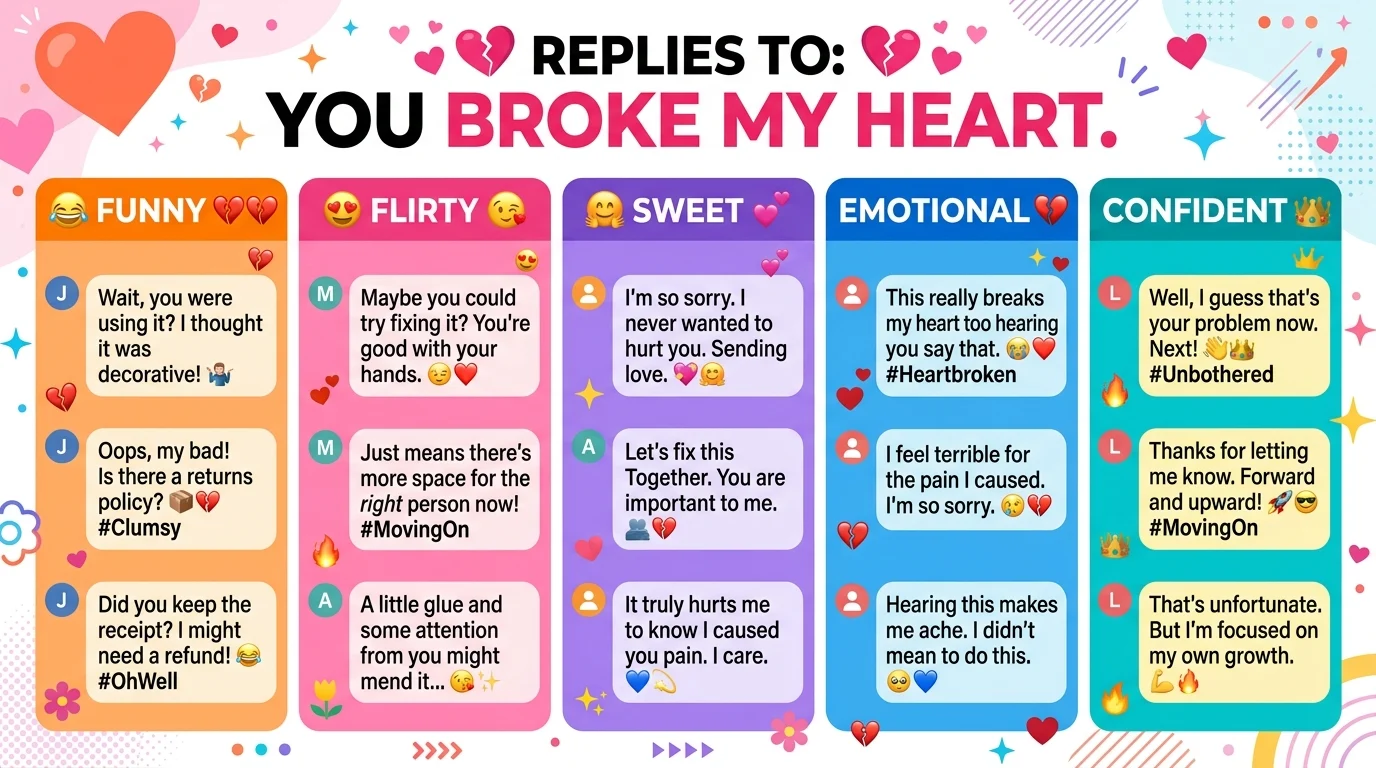
Quick Ans: The best reply to “you broke my heart” depends on the mood and your relationship. You can say sorry, explain yourself, stay firm, flirt, or use humor when the moment feels right.
Top alternatives: “I’m sorry I hurt you,” “I never meant to hurt you,” “Can we talk about it?”, “I still care about you,” “I understand why you feel that way.”
“ You broke my heart” is one of those messages that can stop you mid-scroll. It might arrive in a late-night text after a breakup, in a DM from a crush, after a fight with a friend, or even during a tense conversation at work. Five words can carry a lot of emotion, so your reply matters. A careless answer may make the situation worse, while the right words can bring calm, honesty, or even a little laughter. The trick is choosing a response that fits the moment instead of sounding like a copied movie line. These Replies to you broke my heart give you plenty of options for different moods. You will find sincere apologies, playful lines, flirty answers, calm responses, confident comebacks, and thoughtful messages. Pick the one that feels natural, send it with care, and let the conversation take its next step.
Funny Responses
Light And Playful
“I was aiming for butterflies, not heartbreak.”
Best for a playful moment when you never wanted things to go badly.
Meaning: You are saying that hurting them was never your goal.
“Well, that was definitely not on my to-do list.”
Try this when the conversation is emotional but still friendly.
Meaning: You are surprised by how things turned out.
“I clearly missed the ‘handle with care’ warning.”
This works when you know you were a little careless.
Meaning: You admit you could have treated their feelings better.
“I promise there was no heartbreak plan.”
A light tone fits when they are teasing you about what happened.
Meaning: You are making it clear that the pain was not planned.
“Okay, my apology department is officially open.”
Send this when you want to invite them to talk.
Meaning: You are ready to listen and make things better.
“I wanted a love story, not a plot twist.”
A playful answer works when the situation took an unexpected turn.
Meaning: You wish things had gone differently.
Extra Funny
“Should I send snacks with the apology?”
This fits when food jokes are normal between you.
Meaning: You want to make amends in a cute way.
“Not me accidentally becoming the bad guy.”
A self-aware joke works when you can admit your part in the mess.
Meaning: You know they feel hurt because of you.
“My emotional skills clearly need an update.”
Choose this when you want to laugh at your own mistake.
Meaning: You admit that you could have handled things better.
“That was not the five-star romance experience I had in mind.”
This playful line fits a relationship where jokes are welcome.
Meaning: You are making light of a bad outcome.
“I hear the heartbreak complaint loud and clear.”
A funny but gentle answer works when you do not want to argue.
Meaning: You are acknowledging what they said.
“I brought an apology, not an argument.”
This is useful when you want to lower the tension.
Meaning: You are choosing peace instead of another fight.
Brutal Responses
Firm Replies
“I’m sorry it hurt, but I had to choose what was right for me.”
Choose this when you made a hard choice for yourself.
Meaning: You care about their feelings but stand by your decision.
“Being hurt does not make me wrong about everything.”
This fits when you feel unfairly blamed.
Meaning: You want your side of the story to be heard too.
“I cared about you, but I could not stay.”
A breakup calls for this kind of honest answer.
Meaning: Your care was real, but staying was not possible.
“I will not pretend my feelings were different.”
Use this when honesty caused pain.
Meaning: You refuse to fake emotions just to make things easier.
“I regret the pain, not the truth.”
This works when you had to share a difficult truth.
Meaning: You wish they were not hurt, but you still stand by your honesty.
“I can own my part without taking all the blame.”
A fair response helps when both people made mistakes.
Meaning: You accept responsibility without accepting unfair blame.
Strong Boundaries
“Your feelings matter, but my boundaries matter too.”
This fits when someone keeps pushing your limits.
Meaning: You believe both people deserve respect.
“I never promised something I could not give.”
Choose this when someone expected more than you offered.
Meaning: You are reminding them that you were honest about your limits.
“I understand your pain, but I will not lie to make it easier.”
A direct answer works when they want a promise you cannot make.
Meaning: You choose truth over false comfort.
“I did not leave to hurt you.”
This helps when someone thinks your decision was meant to punish them.
Meaning: Your choice was about your needs, not revenge.
“Sometimes the honest choice still hurts.”
This line fits when there was no easy answer.
Meaning: A necessary decision can still cause sadness.
“I hope you heal, but I will not change my truth.”
A firm ending works when the conversation needs closure.
Meaning: You wish them well while staying true to yourself.
Flirty Responses
Playful Flirting
“Then maybe I owe your heart a little extra attention.”
Send this when the chemistry between you is still strong.
Meaning: You are turning the emotional moment into playful flirting.
“Maybe I should make it up to you over dinner.”
A date hint works when you want to see them again.
Meaning: You are mixing an apology with romantic interest.
“I never wanted to hurt that cute heart of yours.”
This fits when you want a soft and flirty answer.
Meaning: You are showing affection while acknowledging their pain.
“Give me another chance and I’ll be more careful.”
Try this when you want to repair the connection.
Meaning: You are asking for another opportunity.
“What if I told you I know how to make it smile again?”
A playful tone works when flirting is already part of your relationship.
Meaning: You are offering comfort with romantic energy.
“I might need to apologize in person.”
This is a fun choice when you want to hint at meeting up.
Meaning: You are creating a playful reason to see them.
Romantic Replies
“Your heart deserves better, and I want to be better.”
This fits when you want your flirtation to feel sincere.
Meaning: You want to show that you can improve.
“Maybe we need a happier chapter.”
A gentle romantic line works when you hope to reconnect.
Meaning: You think your story may not be finished.
“I still have a soft spot for you, you know.”
Send this when feelings are still there.
Meaning: You are admitting that they still matter to you.
“I hate that I hurt you, especially when I still like you.”
This works when attraction has not disappeared.
Meaning: You are honest about both regret and interest.
“If your heart is still open, I know where to start.”
A confident line fits when reconciliation feels possible.
Meaning: You want to rebuild the connection.
“Let me show you I can do better.”
Choose this when words alone are not enough.
Meaning: You want your actions to prove your feelings.
Polite Responses
Gentle And Respectful
“I’m truly sorry that I hurt you.”
This simple answer works when you want to apologize sincerely.
Meaning: You are showing real regret.
“I understand why you feel that way.”
Choose this when you want to validate their feelings.
Meaning: You are listening instead of arguing.
“I never meant to cause you this much pain.”
This fits when the hurt was not planned.
Meaning: You are explaining your intention.
“Thank you for telling me how you feel.”
A respectful reply works when they finally open up.
Meaning: You value their honesty.
“I’m sorry things turned out this way.”
This suits a complicated situation.
Meaning: You regret the result.
“I would rather listen than make assumptions.”
Try this when you need more details.
Meaning: You want to understand their side.
Calm Replies
“I respect your feelings, even if we disagree.”
This works during a serious disagreement.
Meaning: You can disagree without dismissing them.
“Can we talk when we are both calmer?”
A calm pause helps when emotions are high.
Meaning: You want a better conversation later.
“I’m sorry for the part I played in this.”
This fits when you know you made a mistake.
Meaning: You accept your share of responsibility.
“I never wanted our memories to become painful.”
A thoughtful line works after a breakup.
Meaning: You regret how things ended.
“I hear you, and I will not ignore your feelings.”
Use this when someone feels dismissed.
Meaning: You want them to feel heard.
“I hope we can talk this through with respect.”
This is helpful when you want a peaceful ending.
Meaning: You prefer understanding over another argument.
Professional Responses
Workplace Messages
“I’m sorry the situation affected you this way.”
This fits when the message comes from a coworker.
Meaning: You acknowledge their feelings in a calm way.
“Thank you for sharing your concerns.”
A professional setting calls for a simple response like this.
Meaning: You show respect for their feedback.
“I understand that this was upsetting.”
This works when emotions are part of a work issue.
Meaning: You recognize the impact without becoming too personal.
“I would be happy to discuss this privately.”
Choose this when the matter needs a private talk.
Meaning: You want to handle the issue with care.
“I regret that my decision caused distress.”
This fits when a work decision affected someone.
Meaning: You recognize the effect of your choice.
“I respect your view and would like to understand it better.”
Use this when there has been confusion.
Meaning: You are open to hearing their side.
Formal And Calm
“I’m sorry for any confusion that led to this.”
This works when unclear messages caused the issue.
Meaning: You want to clear up the problem.
“I understand why you were disappointed.”
A calm response fits when someone expected a different result.
Meaning: You accept their reaction.
“Let’s focus on finding a fair solution.”
This is useful when emotions are getting in the way.
Meaning: You want to solve the problem instead of arguing.
“I’m sorry this experience left you feeling hurt.”
A polite answer works when you need to show empathy.
Meaning: You recognize their emotional experience.
“Let’s talk so we can clear up the misunderstanding.”
This helps when both sides may have missed something.
Meaning: You want better understanding.
“Thank you for bringing this to my attention.”
A formal response works when someone raises a concern.
Meaning: You are keeping the conversation calm and professional.
Creative Responses
Poetic Replies
“I wish I could rewind the chapter where your heart got hurt.”
This fits when you want a poetic reply.
Meaning: You wish you could undo the painful moment.
“If hearts came with repair guides, I would read yours twice.”
A creative tone works when you want to show care.
Meaning: You want to understand how to make things better.
“I never wanted our story to take such a painful turn.”
This suits a relationship that changed suddenly.
Meaning: You regret the direction things took.
“Maybe we lost the plot somewhere along the way.”
A clever line fits when the relationship became confusing.
Meaning: You think communication went off track.
“I wish my intentions had reached you before my actions hurt you.”
This works when your actions were misunderstood.
Meaning: You wish your good intentions had been clearer.
“Some chapters hurt more than others.”
A simple poetic answer fits a reflective moment.
Meaning: Painful experiences can still become part of your story.
Thoughtful Replies
“I cannot erase the hurt, but I can learn from it.”
This works when you want to show growth.
Meaning: You accept the past and want to improve.
“Your heart deserved a softer ending.”
Choose this when you regret how things ended.
Meaning: You believe you could have handled things more gently.
“Maybe the real problem was everything we left unsaid.”
This fits when communication failed.
Meaning: Silence may have made the pain worse.
“I wish our memories came with a rewind button.”
A nostalgic answer works when you miss the good times.
Meaning: You wish you could return to happier moments.
“I never wanted our best memories to carry this much pain.”
This fits after a difficult breakup.
Meaning: You regret that happy memories became heavy.
“Some feelings arrive like sunshine and leave like rain.”
A soft message works when you want something meaningful.
Meaning: Emotions can change even when they once felt strong.
Sarcastic Responses
Playful Sarcasm
“I’ll add ‘heartbreaker’ to my résumé.”
This works when both of you enjoy sarcasm.
Meaning: You are joking about the accusation.
“Apparently I missed the heartbreak training session.”
A playful answer fits when you want self-mockery.
Meaning: You admit you handled things poorly.
“I see we are filing official heartbreak reports today.”
This works when the message is playful.
Meaning: You are teasing the seriousness of the statement.
“Should I expect a formal complaint tomorrow?”
A joking tone fits when your relationship is relaxed.
Meaning: You are making the situation sound more official than it is.
“Okay, Shakespeare, I hear you.”
This works when their message is especially dramatic.
Meaning: You are gently teasing their emotional wording.
“That sounds like a full three-act drama.”
A sarcastic reply fits when the story has become complicated.
Meaning: You are joking about the amount of emotion involved.
Extra Sarcasm
“I would like to appeal this heartbreak verdict.”
This fits when you disagree with their version.
Meaning: You are playfully challenging the accusation.
“Do I get a lawyer for this emotional case?”
A silly legal joke works when humor is welcome.
Meaning: You are pretending the situation is a court case.
“Well, that escalated from texting to emotional court.”
This works when the conversation suddenly becomes serious.
Meaning: You are using humor to lower the tension.
“I did not know I had unlocked this level of drama.”
A playful line fits when the situation feels intense.
Meaning: You are joking about the unexpected turn.
“I accept the charge of poor emotional timing.”
This works when your timing really was bad.
Meaning: You are admitting a mistake in a funny way.
“My emotional customer service team is looking into it.”
A mock-formal joke fits a playful relationship.
Meaning: You are pretending to handle a heartbreak complaint.
Cute Responses
Soft Replies
“I’m sorry, I never wanted to hurt your little heart.”
This fits when you want an affectionate apology.
Meaning: You are showing tenderness.
“Come here, let me make it a little better.”
A caring reply works when you want to comfort them.
Meaning: You want to help them feel safe.
“I’m sorry, heart.”
This short message fits when you want something sweet.
Meaning: You are giving a soft apology.
“I wish I could give your heart a big hug.”
A cute answer works when you are texting from far away.
Meaning: You want to comfort them.
“You deserved more kindness from me.”
This suits a situation where you were too harsh.
Meaning: You accept that you could have been gentler.
“Hurting you was never the cute part of our story.”
A sweet joke works when the mood allows it.
Meaning: You make it clear that the pain was never intended.
Affectionate Replies
“Your feelings matter to me.”
This works when someone feels ignored.
Meaning: You want them to know they are important.
“Sending your heart a tiny apology.”
A cute text like this works for a softer mood.
Meaning: You are offering affection and regret.
“I never meant to be careless with your heart.”
This fits when trust has been damaged.
Meaning: You regret treating their feelings lightly.
“If I could hug the hurt away, I would.”
A comforting message works when they are genuinely upset.
Meaning: You wish you could make their pain smaller.
“You are too important for me to pretend I do not care.”
This suits an honest and affectionate moment.
Meaning: You are admitting that their feelings matter.
“I’m sorry, and yes, I still care about you.”
A direct but warm reply works when feelings remain.
Meaning: You combine regret with affection.
Chill And Casual Responses
Easygoing Replies
“I hear you. I really did not mean to hurt you.”
This fits when you want a relaxed answer.
Meaning: You acknowledge their feelings without making things bigger.
“Yeah, I get why you feel that way.”
A casual response works when you want to validate them.
Meaning: You understand their reaction.
“That honestly was not what I wanted.”
This suits a situation where the outcome surprised you.
Meaning: The pain was never your goal.
“Can we talk about it?”
A simple question works when you want to understand the issue.
Meaning: You are opening the door to an honest talk.
“I’m sorry. I could have handled it better.”
This fits when you know you made a mistake.
Meaning: You accept responsibility.
“I never wanted things to get this messy.”
A relaxed answer works when the relationship became difficult.
Meaning: You regret how things unfolded.
Casual And Caring
“I still care, even if things feel weird.”
This works when you want to keep the connection friendly.
Meaning: The tension has not erased your care.
“That sucks, and I’m sorry.”
A very casual apology fits a close relationship.
Meaning: You recognize their pain without overdoing it.
“I wish I could change how it happened.”
This suits a moment when you regret your actions.
Meaning: You wish you had made a better choice.
“I get it. I really do.”
A short reply works when they need to feel heard.
Meaning: You are validating their feelings.
“Let’s not make this worse.”
This fits when an argument is growing.
Meaning: You want to stop more hurt from happening.
“I’m here if you want to talk it out.”
A relaxed invitation works when you want to leave the door open.
Meaning: You are offering a calm conversation.
Confident Responses
Self-Respect
“I can own my mistake without losing myself.”
This works when you want accountability and self-respect.
Meaning: You accept your part without giving up your identity.
“I’m sorry I hurt you, but I also had to be honest.”
A firm answer fits when truth caused pain.
Meaning: You regret the hurt but stand by your honesty.
“I respect your feelings, and I trust my choice.”
This works when someone questions your decision.
Meaning: You can care about their feelings and still stand firm.
“I never wanted to hurt you, but I cannot fake my feelings.”
This suits a relationship that had to end.
Meaning: You choose honesty over pretending.
“I can apologize without taking blame for everything.”
A balanced response works when both people made mistakes.
Meaning: You are willing to be fair to yourself too.
“I know what I meant, even if the result was painful.”
This fits when your intentions are being questioned.
Meaning: You understand your own reasons.
Confident Boundaries
“Your pain matters, and my boundaries matter too.”
This works when someone ignores your limits.
Meaning: Both people deserve respect.
“I will listen, but I will not lie about what I felt.”
A strong answer fits during a hard conversation.
Meaning: You want honesty on both sides.
“I chose honesty instead of giving false hope.”
This suits a difficult ending.
Meaning: You believe truth was kinder in the long run.
“I regret the hurt, not the honesty.”
A firm line works when a difficult truth caused pain.
Meaning: You still believe being honest was right.
“I can care about you and still choose myself.”
This fits when leaving a relationship.
Meaning: Self-respect does not mean a lack of care.
“I know my worth, and I hope you find yours too.”
A strong closing line works when you need distance.
Meaning: You want both people to move forward with confidence.
Emotional Responses
Honest Feelings
“I’m really sorry. Knowing I hurt you hurts me too.”
This works when your regret is genuine.
Meaning: You feel deeply sorry for the pain you caused.
“I wish I knew how much this would hurt you.”
A heartfelt reply fits when you did not see the impact coming.
Meaning: You regret not understanding their feelings sooner.
“You never deserved to feel unimportant.”
This suits someone who felt pushed aside.
Meaning: You are reminding them of their value.
“I should have treated your heart with more care.”
This works when you know you were careless.
Meaning: You accept that you could have been kinder.
“I’m sorry I became part of a painful memory.”
A sincere message fits after a difficult breakup.
Meaning: You regret being connected to their hurt.
“I never wanted your tears to be part of our story.”
This suits a deeply emotional moment.
Meaning: You are sad about the pain that followed.
Deep And Sincere
“I wish I could take back the moments that hurt you.”
This works when you feel strong regret.
Meaning: You wish you could undo your mistakes.
“I know an apology cannot fix everything.”
A mature answer fits when trust has been damaged.
Meaning: You understand that healing takes time.
“You mattered to me, even when I failed to show it.”
This works when someone felt forgotten.
Meaning: Your poor actions did not mean they were unimportant.
“I’m sorry your memories of us carry pain now.”
A thoughtful reply fits after a difficult ending.
Meaning: You regret that good memories became painful.
“I should have chosen kinder words.”
This works when something you said caused pain.
Meaning: You accept responsibility for your communication.
“I hope one day this hurts less.”
A gentle message fits when closure is needed.
Meaning: You sincerely wish them healing.
Sweet Responses
Warm And Kind
“I’m truly sorry. Your heart was never something I wanted to hurt.”
This fits when you want a warm apology.
Meaning: You genuinely care about their feelings.
“I still treasure the good memories we made.”
A sweet reply works after a meaningful relationship.
Meaning: You value what you shared despite the ending.
“You deserved kindness from me.”
This suits a moment when you recognize your mistake.
Meaning: You accept that your behavior could have been better.
“I hope you know I still wish you well.”
A gentle goodbye works when the relationship is ending.
Meaning: You want good things for them.
“Your feelings deserve respect.”
This fits when you want to reassure them.
Meaning: You are taking their emotions seriously.
“I’m grateful for the moments that made us happy.”
A warm message works when reflecting on the past.
Meaning: You want to remember the good as well as the bad.
Sweet Closure
“I hope your heart finds peace.”
This works when closure is needed.
Meaning: You want them to heal and move forward.
“I never wanted to leave you with more pain than happiness.”
A thoughtful response fits after a painful ending.
Meaning: You regret the hurt that followed.
“You were important to me, and I hope you know that.”
This works when someone doubts whether they mattered.
Meaning: You are giving them reassurance.
“I’m sorry for the hurt, and I’m thankful for the love.”
A mature message fits when looking back on a relationship.
Meaning: You hold both regret and gratitude.
“I hope one day you remember us with a smile.”
This suits a breakup that still feels fresh.
Meaning: You hope the pain will fade with time.
“Whatever happens next, I genuinely want good things for you.”
A kind ending works when you want to leave on good terms.
Meaning: You are ending the conversation with goodwill.
Clever Responses
Smart And Thoughtful
“Maybe the real problem was what we left unsaid.”
This works when poor communication caused the hurt.
Meaning: You think silence played a role.
“Intent and impact are not always the same.”
A thoughtful answer fits when your actions had an effect you did not expect.
Meaning: Good intentions do not always prevent pain.
“I cannot change yesterday, but I can change what I do next.”
This suits a conversation about growth.
Meaning: You are choosing better actions going forward.
“A hurt heart needs honesty, not more confusion.”
This works when the situation needs clarity.
Meaning: You want to stop mixed signals.
“Maybe we both understood the situation differently.”
A calm response fits when there was a misunderstanding.
Meaning: You think both sides may have missed something.
“I would rather understand the hurt than argue about it.”
This works when you want a calm discussion.
Meaning: You care more about understanding than winning.
Clever Closure
“If my actions hurt you, I want to understand why.”
This suits a moment when you are ready to listen.
Meaning: You want to learn from the situation.
“Sometimes closure starts with one honest question.”
A thoughtful line works when you want a deeper conversation.
Meaning: Honest questions can help people move forward.
“We cannot edit yesterday, but we can choose tomorrow.”
This fits when reconciliation or closure is possible.
Meaning: The future still depends on your choices.
“I would rather own my mistake than defend it.”
A mature reply works when you know you were wrong.
Meaning: You are choosing accountability.
“Feelings need words before they become assumptions.”
This works when communication failed.
Meaning: Talking earlier may have prevented the hurt.
“A broken heart does not always mean one person was completely wrong.”
This suits a situation where both sides have valid feelings.
Meaning: Relationships can end painfully without a single villain.
Direct And Honest Responses
Simple Truths
“Yes, I hurt you, and I’m sorry.”
This works when you know you caused the pain.
Meaning: You are taking direct responsibility.
“I never meant to break your heart.”
A simple answer fits when the hurt was unplanned.
Meaning: You are making your intention clear.
“I should have told you sooner.”
This suits a situation where delayed honesty made things worse.
Meaning: You regret waiting.
“I cared about you, but I could not keep pretending.”
A direct reply fits when honesty required a difficult choice.
Meaning: You chose truth over pretending.
“I understand why you are hurt.”
This works when you do not have every answer.
Meaning: You are validating their feelings.
“I made a mistake, and I own it.”
A strong apology fits when your actions were wrong.
Meaning: You accept responsibility without excuses.
Honest Conversations
“I should have handled things differently.”
This works when you regret your approach.
Meaning: You recognize that you could have done better.
“I do not expect one apology to fix everything.”
A realistic reply fits when trust has been damaged.
Meaning: You understand that healing takes time.
“I wish I could change what happened, but I cannot.”
This suits a situation where the past cannot be changed.
Meaning: You accept reality while showing regret.
“I still care, even though I hurt you.”
A heartfelt line works when feelings remain.
Meaning: You want them to know the relationship mattered.
“Tell me what you need me to understand.”
This fits when you want to hear their side.
Meaning: You are inviting honest communication.
“I will not make excuses for hurting you.”
A mature response works when you want to take responsibility.
Meaning: You are choosing accountability over defense.
Mature And Compassionate Responses
Understanding Their Feelings
“I’m sorry for the pain I caused, and I’m willing to listen.”
This works when you want a serious talk.
Meaning: You accept responsibility and give them space.
“Your feelings matter, and I want to understand them.”
A caring response fits when someone feels ignored.
Meaning: You are showing patience and respect.
“I cannot control your feelings, but I can control my response.”
This suits a tense conversation.
Meaning: You are choosing to stay calm.
“I wish I had communicated better.”
A simple apology works when poor communication caused problems.
Meaning: You recognize your role.
“I’m sorry for what I did, not only for how things ended.”
This fits when you want a clear apology.
Meaning: You are taking responsibility for your actions.
“I do not want to dismiss your pain because my intentions were different.”
This works when your goal was misunderstood.
Meaning: You know intentions do not erase impact.
Respect And Healing
“I hope we can talk without hurting each other again.”
This fits when both people are upset.
Meaning: You want a calmer and safer conversation.
“I understand if you need some space.”
A respectful reply works when emotions are still fresh.
Meaning: You respect their need for time.
“I wish I had protected our connection with better communication.”
This suits a relationship that mattered deeply.
Meaning: You regret not communicating well enough.
“You do not owe me forgiveness right now.”
A mature response works after a sincere apology.
Meaning: You are giving them time to process their feelings.
“I hope my actions can show more than my words.”
This fits when trust needs to return.
Meaning: You want your behavior to prove your intentions.
“Whatever you choose, I respect what you need.”
A calm ending works when the future is uncertain.
Meaning: You are not trying to pressure them.
When You Want To Reconcile
Asking For Another Chance
“I know I hurt you, but I would like a chance to make things right.”
This works when you genuinely want another chance.
Meaning: You want to repair the relationship.
“I’m not asking you to forget. I’m asking if we can rebuild.”
A thoughtful request fits when trust has been damaged.
Meaning: You want a new start without ignoring the past.
“If you are willing, I want to earn your trust again.”
This suits a situation where an apology is not enough.
Meaning: You are ready to prove yourself through actions.
“I miss us, and I wish I had done things differently.”
A heartfelt line works after a breakup.
Meaning: You still care and regret your choices.
“I know another chance is something I have to earn.”
This fits when you want to avoid pressure.
Meaning: You understand that trust takes effort.
“I would rather rebuild slowly than rush you.”
A patient answer works when the other person needs time.
Meaning: You respect their pace.
Rebuilding Trust
“Can we start with one honest conversation?”
This works when you want to reopen communication.
Meaning: You want to begin fixing things one step at a time.
“I cannot promise perfection, but I can promise honesty.”
A realistic promise fits when rebuilding trust.
Meaning: You are committing to something you can truly control.
“I still believe what we had was worth saving.”
This suits a relationship that still matters.
Meaning: You want to fight for another chance.
“I want to understand what I need to change.”
A mature answer works when you want real improvement.
Meaning: You care about changing behavior, not just saying sorry.
“If your heart is still open, I want to treat it with more care.”
A romantic message fits when another chance feels possible.
Meaning: You want to rebuild the connection with greater care.
“I know trust takes time, and I am willing to give it time.”
This works when they are unsure about you.
Meaning: You will not rush their healing.
FAQs
What does “you broke my heart” mean?
It usually means someone feels deeply hurt, rejected, disappointed, or let down by something you said or did.
Can “you broke my heart” be flirty?
Yes. Between people who already flirt, it can be playful or dramatic rather than serious. Context matters.
What should I say if I really hurt them?
Start with a simple apology. “I’m sorry I hurt you. I should have handled things better” is honest and clear.
Is humor okay?
It depends on the mood. If they are genuinely upset, lead with empathy. Save the jokes for a moment when you know they will land well.
What is a professional response?
Keep it calm and short. “I’m sorry this situation affected you. I’m happy to discuss it privately” works well.
What if I do not mean my apology?
Do not fake it. Try, “I understand that you are hurt, but I want to be honest about how I feel.”
What if I still love them?
Be honest without making promises you cannot keep. “I still care about you, and I’m sorry for the pain between us” is a good start.
Should I reply right away?
If you are calm enough to respond with care, you can reply. When emotions are high, taking a little time may help you avoid saying something you regret.
What if they blame me for everything?
Own your part while keeping your boundaries. You can admit your mistakes without accepting blame for things you did not do.
Can these replies work in DMs?
Yes. These lines work well for texts, Instagram DMs, WhatsApp, Snapchat, and other casual messages.
Conclusion
When someone says, “you broke my heart,” your reply can shape what happens next. A kind apology may calm things down. A confident answer can protect your boundaries. A funny line can bring back some lightness when the mood allows it. You do not need to force one style into every situation. Think about what the person is feeling, decide what you honestly want to say, and choose words that sound natural coming from you. The best reply is not always the cleverest one. Sometimes a simple “I’m sorry” says more than a perfect paragraph. Save this list for your next tricky text, share it with a friend who always asks what to say, and keep your favorite replies ready for those “what do I even say?” moments.

Chloe Brooks is a passionate writer at ResponsCraft.com, creating clear, practical and well-researched content to help readers make informed decisions. She focuses on delivering engaging articles that are accurate, useful and easy to understand.
2 thoughts on “150+ Replies to “You Broke My Heart” for Every Mood and Situation”