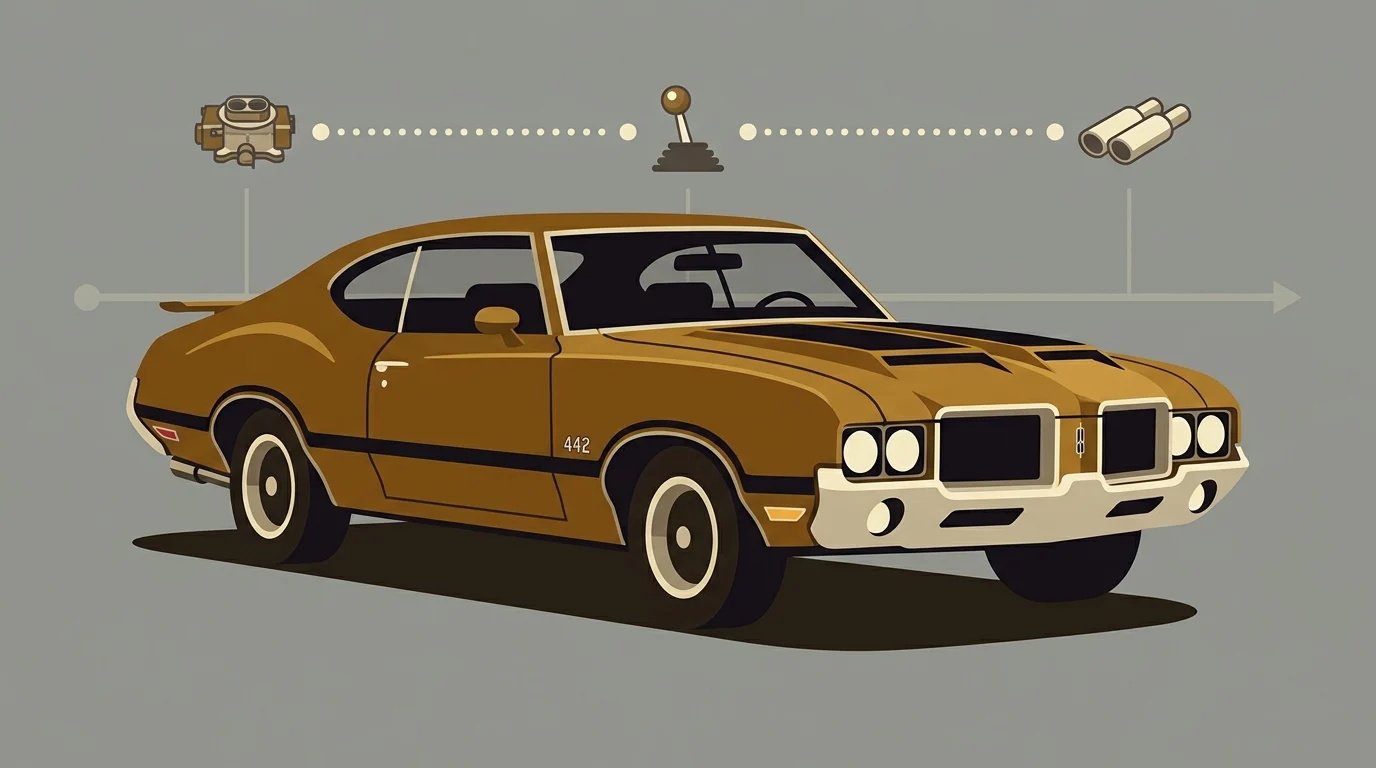
Quick Answer: The Oldsmobile 442 (also written 4-4-2) is a classic American muscle car produced between 1964 and 1987. The name originally stood for 4-barrel carburetor, 4-speed manual transmission, and dual exhausts. In 1965, the meaning shifted to 400 cubic-inch V8, 4-barrel carburetor, and dual exhaust after Oldsmobile upgraded the engine .
Few American muscle car names carry as much history and confusion as the Oldsmobile 442. The numbers look like an engine displacement, but they never were. The name has been pronounced “four-four-two” for over sixty years, yet its definition changed almost immediately after launch. For classic car enthusiasts and curious readers alike, understanding what 442 means requires a short trip through General Motors history, a rivalry with Pontiac, and a naming convention that outlived its own logic.
The 442 was Oldsmobile’s answer to the Pontiac GTO, which had shocked the industry in 1963 by stuffing a full-size V8 into a mid-size body . Oldsmobile engineers responded by upgrading the Cutlass with police-spec parts and a memorable badge. The car became a legend, and the 442 name became shorthand for Oldsmobile performance, just as GTO meant Pontiac and SS meant Chevrolet .
This guide explains the Oldsmobile 442 meaning completely. You will learn what the numbers originally stood for, how the definition changed, why the name survived even after the parts no longer matched, and how the 442 fits into muscle car history.
What Does 442 Stand For?
The original 442 meaning was a simple checklist of performance features. When the package debuted in 1964 as an option on the F-85 and Cutlass, the numbers represented:
- 4-barrel carburetor
- 4-speed manual transmission
- 2 (dual) exhausts
Oldsmobile technically called the option “B09 Police Apprehender Pursuit,” a name that never had a chance of catching on . The 4-4-2 shorthand, sometimes written with hyphens in early years, was far easier to say and remember. Early advertising and dealer materials leaned into the name, and the badge appeared on fenders and decklids .
| Era | 442 Meaning | Key Change |
|---|---|---|
| 1964 | 4-barrel carb, 4-speed manual, dual exhaust | Original definition |
| 1965 | 400 cubic-inch V8, 4-barrel carb, dual exhaust | Engine displacement replaced transmission reference |
| 1968 onward | 442 as standalone model, meaning became nostalgic | Name retained despite equipment changes |
How the Meaning Changed in 1965
The original definition only lasted one model year. Pontiac had broken GM’s internal rule limiting mid-size cars to 330 cubic inches by putting a 389 V8 in the GTO . Once that barrier fell, Oldsmobile followed suit. For 1965, the 442 received a new 400 cubic-inch V8, and the first number in the name was quietly redefined .
The new meaning became 400 cubic-inch engine, 4-barrel carburetor, and dual exhausts. This created an odd side effect. Because the 4 no longer referenced the transmission, buyers could now order a 442 with an automatic transmission. The name had already started drifting from its literal origins .
By 1968, the 442 became its own separate model rather than an option package on the Cutlass . The badges dropped the hyphens and read simply “442” . Oldsmobile brochures and internal documents continued using “4-4-2,” but the public and the marketing materials largely moved on .
Why the Name Survived Even When the Parts Didn’t
The most interesting part of the 442 story is how the name outlived its own definition. By the late 1960s, Oldsmobile offered the 442 with three-speed manuals, three-speed automatics, and even a single two-barrel carburetor on some configurations . The numbers no longer described what was under the hood. They had become a brand, a signal of performance intent rather than a specification sheet.
In 1970, GM lifted its engine size limits for mid-size cars, and the 442 became available with a 455 cubic-inch V8. The 442 badge no longer corresponded to 400 cubic inches, but nobody at Oldsmobile was eager to rename the car . By 1972, the 442 had been downgraded from a standalone model back to a Cutlass trim package, and buyers could order it with a low-output two-barrel 350 engine that made 160 net horsepower . The name was pure nostalgia by then, a nod to the car’s performance glory days.
The 442 Through the Decades
The Oldsmobile 442 went through several distinct phases during its production run from 1964 to 1987.
1964 to 1967: The First Generation. The original 442 was a conservative but capable package. The 1964 model used a 330 cubic-inch V8 rated at 310 horsepower, paired with heavy-duty suspension, a Muncie four-speed, and dual exhausts. Motor Trend tested an early example and recorded a 0 to 60 mph time of 7.5 seconds and a quarter-mile run of 15.5 seconds at 90 mph . A total of 2,999 were sold in the first year .
1968 to 1971: The Golden Era. This is the period most collectors consider the 442’s peak. The car became its own model, received a major redesign with curvier bodywork, and gained access to bigger engines. The W-30 performance package, which included a fiberglass hood with scoops and a more aggressive camshaft, became increasingly popular . The 1970 model year is often considered the high-water mark, with the 455 V8 rated at 365 horsepower and 500 lb-ft of torque .
1972 to 1980: The Decline. Rising insurance costs, emission regulations, and the oil crises of the 1970s sapped the 442’s performance. The name became a trim package rather than a distinct model, and engine options grew steadily less impressive .
1985 to 1987: The Revival. Oldsmobile brought the 442 back as a rear-wheel-drive Cutlass variant with a 5.0-liter 307 cubic-inch V8 and a four-speed automatic. Production was limited to roughly 3,000 to 4,300 units per year, making these later models relatively rare today .
1990 to 1991: The Final Chapter. The 442 name briefly returned on a front-wheel-drive Cutlass Calais with a four-cylinder engine. This version, sometimes called the Quad 442, is generally considered a distant echo of the original and is not what most enthusiasts mean when they talk about a 442 .
442 vs GTO: The Rivalry That Created a Legend
The Oldsmobile 442 would not exist without the Pontiac GTO. When Pontiac launched the GTO in 1963 as an option on the LeMans, it effectively invented the muscle car formula: a big engine in a mid-size body at an affordable price. Oldsmobile, a fellow GM division, wanted a piece of that market .
Oldsmobile’s response was the 442, which launched for the 1964 model year. It was a more conservative package than the GTO in some ways, using a 330 cubic-inch engine rather than Pontiac’s 389, but it made up for it with a comprehensive suspension and brake upgrade drawn from police specifications . The rivalry between the two cars pushed both brands to keep improving, and by the late 1960s both were producing some of the most powerful and iconic American cars of the era.
Frequently Asked Questions About the Oldsmobile 442
What does 442 stand for on an Oldsmobile?
The original meaning was 4-barrel carburetor, 4-speed manual transmission, and dual exhausts. In 1965, after Oldsmobile upgraded to a 400 cubic-inch engine, the first number was redefined to mean 400 cubic inches .
Is it pronounced “four-four-two” or “four-forty-two”?
It is pronounced “four-four-two,” with each number said individually. The car never had a 442 cubic-inch engine, so “four-forty-two” is incorrect .
What year was the best Oldsmobile 442?
Most collectors point to the 1968 to 1971 models as the most desirable. These years combined the standalone model status, the redesigned body, and the availability of high-performance engines like the 455 and the W-30 package .
Did the Oldsmobile 442 ever have an automatic transmission?
Yes. The original 1964 definition required a four-speed manual, but once the meaning changed in 1965 to reference the engine instead of the transmission, automatic transmissions became available .
How many Oldsmobile 442s were made?
Production varied widely by year. The 1964 model sold 2,999 units . The late 1980s revival models were produced in limited numbers, with roughly 3,000 to 4,300 units per year . Peak production in the late 1960s reached around 37,000 units in a single year .
Conclusion
The Oldsmobile 442 meaning is a story of a name that refused to die. It started as a literal description of three performance parts: a four-barrel carburetor, a four-speed manual, and dual exhausts. Within a year, the definition had already shifted to reference a bigger engine. By the end of the 1960s, the numbers were pure branding, a badge that signaled muscle car heritage even when the parts underneath no longer matched.
That persistence is what makes the 442 special. It survived the muscle car boom, the emissions era, and a brief front-wheel-drive revival. It never had a 442 cubic-inch engine, and it never needed one. The name itself became the point.
If you ever find yourself standing next to a classic Oldsmobile at a car show, you now know what the badge means and why the owner will smile when you say “four-four-two” instead of “four-forty-two.” Share this guide with a fellow car enthusiast, or leave a comment with your favorite 442 memory.

Chloe Brooks is a passionate writer at ResponsCraft.com, creating clear, practical and well-researched content to help readers make informed decisions. She focuses on delivering engaging articles that are accurate, useful and easy to understand.