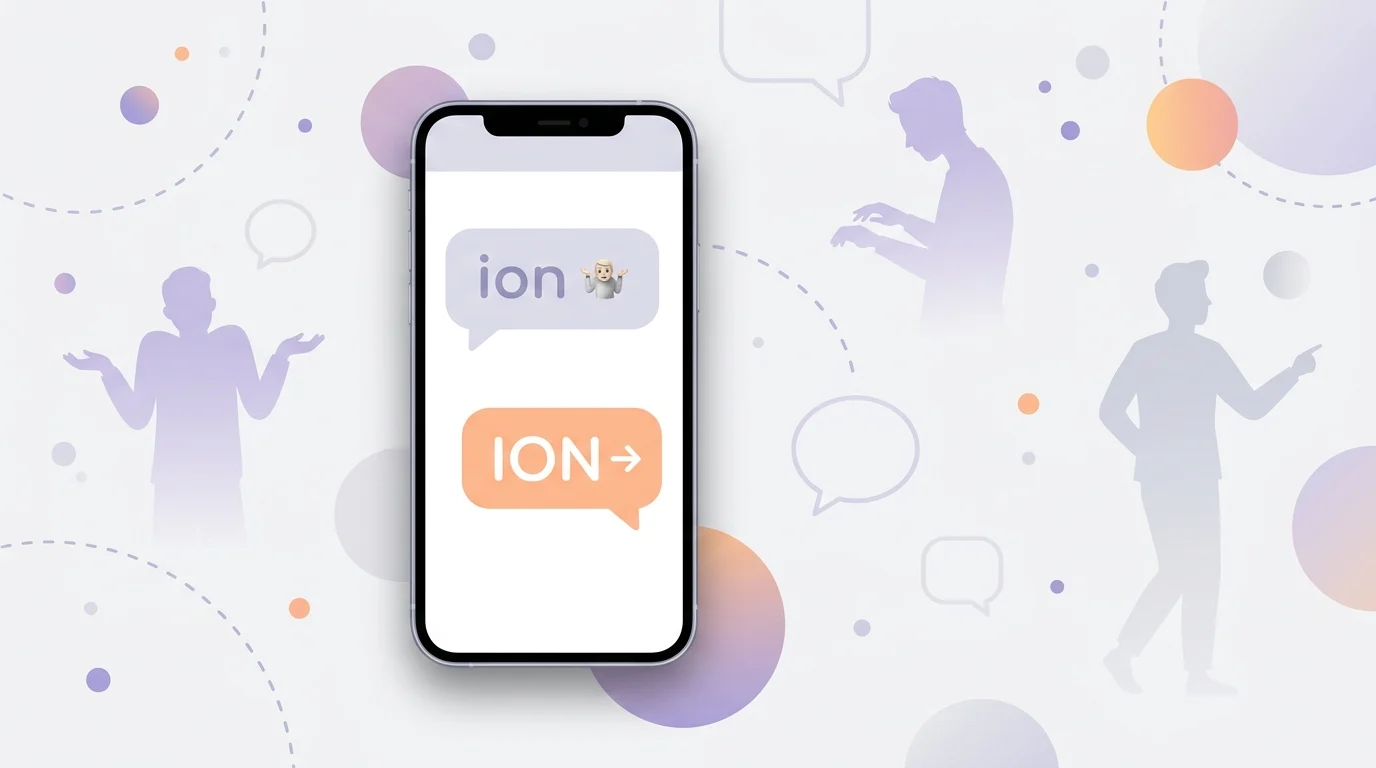
Quick Answer: ION in texting most commonly stands for “I don’t.” It is a phonetic spelling of how “I don’t” sounds when spoken quickly, used as a shortcut before verbs like know, want, think, or care. In all capital letters, ION can also mean “In Other News,” used to change the subject in a conversation .
Text slang evolves faster than most people can keep up with, and ION is a perfect example of how language bends to fit the speed of a thumb on a keyboard. Dictionary.com traces the slang use of “ion” to the 2000s, when internet writing began reflecting the way people actually speak. Say “I don’t know” fast and casually, and the sounds blur together into something that looks exactly like “ion know” .
The term has two distinct lives. As a lowercase word, ion is a phonetic shortcut rooted in Black English and casual speech. As an all-caps acronym, ION serves as a conversational transition, like saying “anyway” or “by the way” . Both meanings are widely used across TikTok, Snapchat, Instagram, and everyday group chats.
This guide explains the ION meaning in text completely. You will learn the two main definitions, how to tell which one applies, how to respond, and when to avoid using it entirely. The goal is to make a confusing piece of slang simple enough to use with confidence.
What Does ION Stand For?
ION has two primary meanings in digital communication, and context decides which one is active.
| ION Meaning | When It Is Used | Tone |
|---|---|---|
| I don’t | Before a verb to express refusal, uncertainty, or disinterest | Casual, neutral |
| In Other News | To change the subject or introduce a new topic | Transitional, conversational |
The first meaning, “I don’t,” is the more common of the two in everyday texting. It functions as a phonetic contraction. Instead of typing “I don’t know,” someone types “ion know.” Instead of “I don’t want to,” they type “ion want to” .
The second meaning, “In Other News,” is an initialism used to pivot the conversation. It works the same way as “anyway” or “by the way,” signaling that the speaker is moving on to a different subject .
There is also a third, unrelated meaning. In science, an ion is an atom or molecule with an electric charge. That definition has nothing to do with texting, but it explains why the word looks familiar .
ION Meaning as “I Don’t”
This is the definition you will encounter most often in casual chat. ION is a phonetic rendering of “I don’t,” written to match the way the phrase sounds in relaxed, fast speech. Dictionary.com explains that saying “I don’t know” quickly produces a sound that resembles “ion-oh,” which is why the spelling caught on .
People use ION before a wide range of verbs to express different shades of meaning.
Common examples include:
- “Ion know” for “I don’t know”
- “Ion want to” for “I don’t want to”
- “Ion think so” for “I don’t think so”
- “Ion care” for “I don’t care”
The tone of ION depends heavily on what follows it and how the message is punctuated. A simple “ion know” is neutral and casual. “Ion care” can sound dismissive or cold depending on the relationship between the people talking. “ion😭” with a crying emoji feels self-deprecating and funny .
How to Respond to “ION” Meaning “I Don’t”
If someone replies to your question with ION, they are giving you a casual negative response. You do not need to treat it as rude or evasive. It is simply a fast way of saying no or I don’t know.
Helpful responses depend on what was asked:
- If they said “ion know,” offer information or suggest they check elsewhere.
- If they said “ion want to,” accept the answer without pressure.
- If they said “ion think so,” ask what they do think instead.
The key is to match their casual energy. A formal reply to a casual ION can feel mismatched, like wearing a suit to a beach party.
ION Meaning as “In Other News”
When written in all capital letters, ION often means “In Other News.” This usage is a conversational pivot. It signals that the speaker is done with the current topic and ready to move on to something else .
Social media glossary Later explains that ION in this sense “signifies a transition to a different topic or a shift in focus from the current discussion” . It is the texting equivalent of a news anchor saying “in other news” before introducing a completely unrelated story.
A typical example looks like this:
- Person A: “Did you finish the assignment?”
- Person B: “Yeah, finally.”
- Person A: “ION, did you see what dropped on Netflix?”
The first exchange ends, and ION marks the boundary before a new subject begins. It is efficient and widely understood in group chats and social media threads.
How to Respond to “ION” Meaning “In Other News”
When someone uses ION to change the subject, they are inviting you to follow them to the new topic. The best response is to engage with whatever comes after the ION. You do not need to acknowledge the transition itself. Just answer the new question or react to the new information.
ION vs IDK: What’s the Difference?
Both ION and IDK relate to not knowing something, but they are not interchangeable in every situation.
IDK stands for “I don’t know” and is neutral and universal. Every age group and demographic understands it. Lowercase “idk” is simply the casual version of a standard abbreviation .
ION, when used to mean “I don’t,” is more conversational and culturally specific. It is rooted in Black English and carries a relaxed, fluent energy that IDK does not. It is also broader in scope. IDK only covers the phrase “I don’t know,” while ION can precede any verb .
If you want to be universally understood, IDK is the safer choice. If you want to sound natural and current in casual digital spaces, ION fits better.
When Should You Avoid Using ION?
ION belongs in informal communication only. Using it in the wrong context can make you seem careless or unprofessional.
Avoid ION in:
- Work emails or messages to managers
- Conversations with teachers or parents
- Academic writing or school assignments
- Any situation where clarity matters more than speed
The acronym is harmless in casual settings, but it carries a low-effort, cool-kid energy that does not translate well to formal environments. A text to a friend saying “ion know” is fine. A text to your boss saying “ion know” is not.
Frequently Asked Questions About ION
What does ION mean in a text?
ION most commonly means “I don’t.” It is a phonetic shortcut used before verbs like know, want, or care. In all capital letters, it can also mean “In Other News,” used to change the subject .
Is ION rude or offensive?
ION itself is neutral slang. It is not a bad word. However, phrases like “ion care” can sound dismissive depending on tone and context. The rudeness comes from what follows the ION, not the acronym itself .
How do I know if ION means “I don’t” or “In Other News”?
Look at the capitalization and the sentence structure. Lowercase “ion” before a verb usually means “I don’t.” All-caps “ION” followed by a comma and a new topic usually means “In Other News” .
What does “ion know” mean?
“Ion know” is a casual way of writing “I don’t know.” It reflects the way the phrase sounds when spoken quickly and informally. It is common on TikTok, Snapchat, and in group chats .
Can I use ION in a professional email?
No. ION is informal internet slang and should only be used in casual texting or social media. Using it with a boss, client, or in any formal setting would be inappropriate .
Conclusion
The ION meaning in text depends on capitalization and context. As a lowercase word, it means “I don’t,” a phonetic shortcut that makes casual conversation faster and more natural. As an all-caps acronym, it means “In Other News,” a simple way to change the subject without a formal transition. Both meanings are widely understood in digital spaces, but neither belongs in professional communication.
Next time you see ION in a message, check the capitalization and the words around it. Are they saying they do not know something, or are they moving on to a new topic? Once you know which meaning is active, replying becomes simple. Share this guide with someone who has ever been confused by three letters, or leave a comment with the most creative use of ION you have seen.

Emma Writes is a passionate content writer at ResponsCraft.com, creating practical, well-researched articles that help readers make informed decisions. She enjoys turning complex topics into clear, engaging and easy-to-follow content.
1 thought on “ION Meaning in Text: What “ION” Really Means and How to Reply”