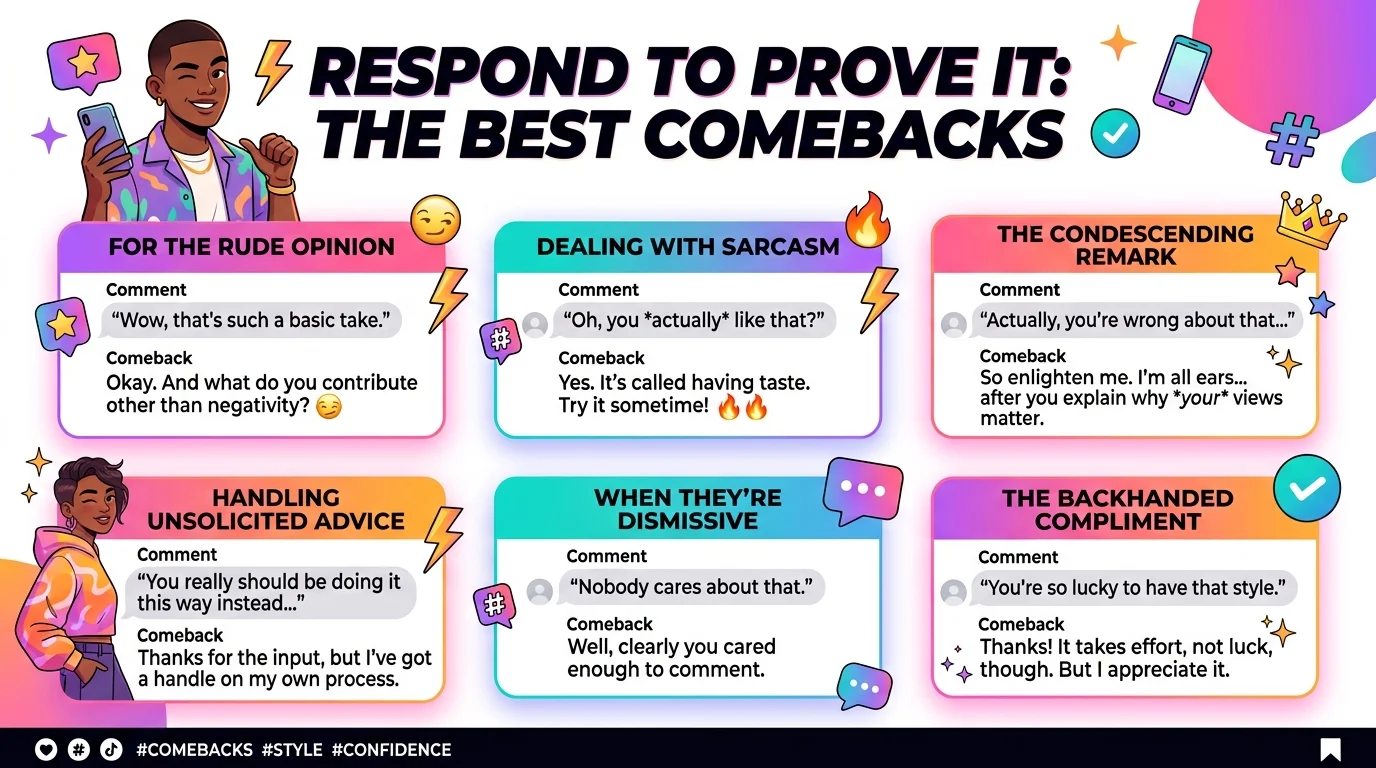
Quick Ans: “Respond to prove it” usually challenges someone to back up what they just said with actions instead of words. The best reply depends on whether you want to flirt, joke around, stay confident, or set a boundary.
Top alternatives: “Bet, watch me,” “Challenge accepted,” “Actions speak louder,” “Say less,” “I’ll show you”
Someone says, “You wouldn’t do it,” “You really like me,” or “You think you can handle this?” and suddenly you need a reply that does more than sit there looking at the keyboard. That is where respond to prove it replies come in handy. Whether you are texting a crush, replying to a DM, joking with friends, handling a playful challenge, or answering someone at work, the right response can instantly change the vibe. A clever reply can make you sound confident. A funny one can keep things light. A flirty one can turn a tiny challenge into a whole moment. And sometimes, a simple “Bet” says everything. The trick is matching your response to the situation instead of forcing a dramatic comeback when “watch me” would do the job perfectly.
Funny Responses
“Bet, I hope you’re ready for the plot twist.”
Use this when someone confidently challenges you and you want to keep the mood playful.
Meaning: You are accepting the challenge while hinting that something unexpected is coming.
“Okay, let me put my proof shoes on.”
Use this when you want to turn the challenge into a silly moment.
Meaning: You are jokingly preparing to demonstrate your point.
“Proof loading… please do not refresh.”
Use this for a playful text when you want to build suspense.
Meaning: You are saying the evidence is coming with a humorous internet-style twist.
“Say less, detective.”
Use this when someone asks you to prove something you already feel confident about.
Meaning: You are ready to provide proof and teasing them at the same time.
“I accept this very unnecessary investigation.”
Use this when the challenge feels dramatic but harmless.
Meaning: You are playfully pretending their request is a serious investigation.
“Fine, prepare your evidence department.”
Use this when you want to respond with exaggerated confidence.
Meaning: You are joking that they should get ready to examine your proof.
“Challenge accepted, snacks recommended.”
Use this when you want to make a simple challenge sound entertaining.
Meaning: You are confidently accepting while making the situation funny.
“You asked for proof, not a documentary.”
Use this when someone keeps demanding evidence.
Meaning: You are jokingly saying you will prove your point without overdoing it.
“Alright, Sherlock, watch closely.”
Use this when someone is playfully skeptical of you.
Meaning: You are teasing them while confidently promising proof.
“Let me cook for exactly thirty seconds.”
Use this when you want a modern, meme-friendly response.
Meaning: You are asking for a moment to prove your point.
“I was born for unnecessary challenges like this.”
Use this when you want to exaggerate your enthusiasm.
Meaning: You are humorously presenting yourself as perfectly prepared.
“Proof? With pleasure and mild confusion.”
Use this when you want to sound playful rather than serious.
Meaning: You are willing to prove yourself while keeping the exchange light.
Flirty Responses
“Careful what you ask me to prove.”
Use this when someone gives you a playful challenge and there is obvious chemistry.
Meaning: You are accepting the challenge while adding a teasing romantic edge.
“Come closer and find out.”
Use this when the conversation already has a confident, flirty tone.
Meaning: You are inviting them to discover the answer for themselves.
“I’d rather show you than tell you.”
Use this when someone doubts your feelings or intentions.
Meaning: You believe actions will communicate more than words.
“You sure you can handle the proof?”
Use this when you want to turn their challenge into playful flirting.
Meaning: You are teasing them by suggesting your proof might be impressive.
“Give me the chance and I’ll make it obvious.”
Use this when someone questions whether you are genuinely interested.
Meaning: You are confidently promising to demonstrate your feelings.
“Keep testing me and you might like the results.”
Use this when the exchange is already playful and romantic.
Meaning: You are teasing them while suggesting the outcome could be attractive.
“I can prove it, but you might get attached.”
Use this when you want a cheeky romantic comeback.
Meaning: You are playfully suggesting that your actions could make them like you more.
“Watch me turn your doubt into a smile.”
Use this when someone playfully questions your intentions.
Meaning: You are promising to prove yourself in a charming way.
“Your challenge just made this more interesting.”
Use this when someone dares you to demonstrate what you claimed.
Meaning: Their skepticism has made the interaction more exciting for you.
“I was hoping you’d ask.”
Use this when you want to sound confident and subtly flirtatious.
Meaning: You are implying that you were eager for an opportunity to prove yourself.
“You really want me to prove it? Cute.”
Use this when you want a confident, teasing response.
Meaning: You find their challenge amusing and enjoy the attention.
“Then stop asking and watch.”
Use this when you want to sound bold without writing a long message.
Meaning: You are confidently letting your actions make the argument.
Confident Responses
“Challenge accepted.”
Use this when you want a short, unmistakably confident reply.
Meaning: You are fully willing to prove your point.
“Watch me.”
Use this when someone doubts your ability or intentions.
Meaning: You are confident that your actions will settle the matter.
“I don’t need to convince you twice.”
Use this when you want to sound self-assured.
Meaning: You trust your ability to prove yourself without excessive explanation.
“Give me the opportunity.”
Use this when someone wants evidence before believing you.
Meaning: You are asking for a chance to demonstrate your claim.
“Actions will answer that.”
Use this when you prefer showing rather than explaining.
Meaning: You believe your behavior will provide the strongest proof.
“You’ll see soon enough.”
Use this when you want to create confident suspense.
Meaning: You are certain that the proof will become obvious.
“I’m not worried about proving it.”
Use this when you want to remain calm under skepticism.
Meaning: You are confident enough not to feel pressured by their doubt.
“Just give me the green light.”
Use this when you are ready to act on your claim.
Meaning: You are waiting for permission or an opportunity to demonstrate it.
“I stand by what I said.”
Use this when the conversation is more serious or direct.
Meaning: You are confidently maintaining your position.
“You asked, so I’ll deliver.”
Use this when you want to sound capable and decisive.
Meaning: You are promising to back up your words.
“No speech needed. Just results.”
Use this when someone keeps asking for explanations.
Meaning: You prefer tangible proof over more talking.
“Consider it handled.”
Use this when you want an efficient, confident response.
Meaning: You are signaling that proving your point is already under control.
Sarcastic Responses
“Absolutely, let me submit my application for approval.”
Use this when someone is being overly demanding about proof.
Meaning: You are sarcastically exaggerating how seriously they are treating the situation.
“Sure, because apparently my word needs a witness.”
Use this when someone keeps doubting you.
Meaning: You are teasing them for requiring excessive evidence.
“Would you like the presentation in slides too?”
Use this when someone wants a detailed demonstration.
Meaning: You are joking that their request has become unnecessarily elaborate.
“Fine, Your Honor.”
Use this when the person sounds like they are putting you on trial.
Meaning: You are playfully mocking their skepticism.
“I’ll alert the evidence department immediately.”
Use this when you want a dry, humorous comeback.
Meaning: You are pretending their request requires official paperwork.
“Because apparently words have lost their job.”
Use this when someone refuses to believe what you said.
Meaning: You are sarcastically pointing out their lack of trust.
“Would you like a signed certificate?”
Use this when someone keeps asking you to prove yourself.
Meaning: You are exaggerating their demand for confirmation.
“One moment while I summon the proof committee.”
Use this when the situation is clearly playful.
Meaning: You are jokingly pretending that proving your point requires a committee.
“Relax, detective, the case is not that complicated.”
Use this when someone is investigating your claim.
Meaning: You are teasing them for being overly suspicious.
“I’ll provide evidence in triplicate.”
Use this when you want a mock-formal sarcastic response.
Meaning: You are joking that they are demanding an unreasonable amount of proof.
“Noted. My performance review begins now.”
Use this when someone challenges your abilities.
Meaning: You are sarcastically framing the moment as an official evaluation.
“Fine, I’ll let the evidence speak while you recover.”
Use this when you want playful confidence with a sarcastic edge.
Meaning: You are implying that your proof will settle the argument decisively.
Clever Responses
“A claim without action is just a rumor.”
Use this when you want a thoughtful but concise response.
Meaning: You are acknowledging that real proof comes from behavior.
“Fair enough. Let the results answer.”
Use this when someone reasonably asks you to back up your statement.
Meaning: You are comfortable letting results establish credibility.
“Proof is better when it speaks for itself.”
Use this when you want to sound composed and intelligent.
Meaning: You believe strong evidence does not need excessive explanation.
“Then judge the actions, not the words.”
Use this when someone questions your sincerity.
Meaning: You are directing their attention toward what you actually do.
“Skepticism makes the reveal more satisfying.”
Use this when you want to turn doubt into playful suspense.
Meaning: You see their doubt as making the eventual proof more rewarding.
“You asked for evidence, so watch the experiment.”
Use this when you want a witty response to a challenge.
Meaning: You are framing your actions as the test that will settle the issue.
“The answer is coming with receipts.”
Use this when someone doubts your story or claim.
Meaning: You are confidently promising evidence.
“Let reality settle the argument.”
Use this when you want to avoid unnecessary debate.
Meaning: You prefer facts and actions over back-and-forth discussion.
“Consider this the preview.”
Use this when you have already started proving your point.
Meaning: You are suggesting that what they have seen is only the beginning.
“I could explain, but results have better timing.”
Use this when you want a clever alternative to arguing.
Meaning: You would rather let your actions make the case.
“You want proof? Pay attention.”
Use this when you want a direct but intelligent comeback.
Meaning: You are confidently telling them to observe what happens next.
“Doubt noted. Outcome pending.”
Use this when you want a short, witty response.
Meaning: You acknowledge their skepticism while confidently anticipating success.
Playful Responses
“Ooooh, a challenge?”
Use this when someone playfully asks you to prove your point.
Meaning: You are excited to turn the exchange into a fun challenge.
“Say less, I’m in.”
Use this when you want an energetic response.
Meaning: You are immediately accepting the challenge.
“Now you’ve made it interesting.”
Use this when their request motivates you to prove yourself.
Meaning: Their challenge has added excitement to the situation.
“You really want to see what happens?”
Use this when you want to build playful suspense.
Meaning: You are teasing them about the possible result.
“Okay, game on.”
Use this when the conversation feels lighthearted.
Meaning: You are happily accepting the challenge.
“I like your confidence.”
Use this when someone boldly doubts you.
Meaning: You are playfully acknowledging their skepticism.
“Well, now I have something to prove.”
Use this when you want to turn doubt into motivation.
Meaning: Their challenge has encouraged you to demonstrate your point.
“Let’s make this interesting.”
Use this when you want to add playful energy.
Meaning: You are suggesting that proving yourself can become part of the fun.
“You opened that door.”
Use this when someone invites you to demonstrate what you claimed.
Meaning: You are teasing them for giving you the opportunity.
“Don’t blink.”
Use this when you want a short, dramatic playful reply.
Meaning: You are suggesting that your proof will happen quickly.
“I was waiting for someone to challenge me.”
Use this when you want to sound enthusiastic.
Meaning: You are genuinely ready to demonstrate your ability.
“Alright, let’s make this fun.”
Use this when you want to keep the exchange upbeat.
Meaning: You are accepting the challenge without taking it too seriously.
Cute Responses
“Okay, I’ll show you.”
Use this when you want a soft and simple response.
Meaning: You are willing to prove yourself without sounding intense.
“Just trust me a little.”
Use this when someone doubts your intentions.
Meaning: You are gently asking for some faith before showing proof.
“I’ll prove it with actions.”
Use this when you want to sound sincere and caring.
Meaning: You want your behavior to demonstrate what you feel.
“Fine, but don’t act surprised.”
Use this when you want a cute, teasing reply.
Meaning: You are confidently promising to prove your point.
“You’ll see, promise.”
Use this when someone is uncertain about what you said.
Meaning: You are reassuring them that proof is coming.
“Let me make you believe me.”
Use this when you want a warm response to doubt.
Meaning: You are willing to earn their trust through your actions.
“I’ve got you.”
Use this when someone wants reassurance rather than a debate.
Meaning: You are promising dependable support.
“Give me one chance.”
Use this when you want to sound sincere and hopeful.
Meaning: You are asking for an opportunity to demonstrate your intentions.
“You make proving it kind of fun.”
Use this when the challenge comes from someone you enjoy talking to.
Meaning: Their attention makes the situation enjoyable for you.
“I promise the proof will be cute.”
Use this when you want to make the challenge playful.
Meaning: You are keeping the exchange affectionate and light.
“Okay, watch this little demonstration.”
Use this when you want a charmingly playful answer.
Meaning: You are inviting them to see your actions for themselves.
“I’ll let my actions do the smiling.”
Use this when you want a sweet, slightly poetic reply.
Meaning: You want your behavior to communicate warmth without overexplaining.
Romantic Responses
“I’ll show you how serious I am.”
Use this when someone doubts the depth of your feelings.
Meaning: You want to demonstrate sincerity through consistent actions.
“You won’t have to wonder for long.”
Use this when you want to reassure someone romantically.
Meaning: You intend to make your feelings clear through your behavior.
“Let me prove it one action at a time.”
Use this when trust matters more than dramatic declarations.
Meaning: You believe genuine affection is demonstrated consistently.
“I’d rather make you feel it than just say it.”
Use this when someone questions your affection.
Meaning: You want your care to be experienced rather than merely heard.
“Give me time, and I’ll make it obvious.”
Use this when you want to sound patient and sincere.
Meaning: You are confident that your feelings will become clear naturally.
“My actions have a lot to say.”
Use this when words feel insufficient.
Meaning: You believe behavior can communicate romantic intentions better than promises.
“I’ll make sure you never have to ask twice.”
Use this when you want to sound devoted and confident.
Meaning: You intend to make your intentions clear through consistency.
“Let me turn that doubt into certainty.”
Use this when someone needs reassurance.
Meaning: You want to replace uncertainty with trust.
“I have nothing to hide and plenty to show.”
Use this when someone playfully challenges your feelings.
Meaning: You are confidently open about your intentions.
“Watch how I treat you.”
Use this when you want to focus on meaningful behavior.
Meaning: You believe the way you treat someone reveals genuine feelings.
“You deserve proof, not promises.”
Use this when you want to emphasize sincerity.
Meaning: You understand that trust is earned through actions.
“Let me show you instead of making another speech.”
Use this when someone is tired of hearing declarations.
Meaning: You want to demonstrate affection through real behavior.
Polite Responses
“Absolutely, I’d be happy to show you.”
Use this when you want to accept a reasonable challenge respectfully.
Meaning: You are willing to provide evidence without becoming defensive.
“Fair enough, I understand your point.”
Use this when someone asks you to support your claim.
Meaning: You respect their desire for confirmation.
“I can demonstrate that for you.”
Use this when you want a calm and courteous response.
Meaning: You are prepared to support your statement with action.
“That’s reasonable. Let me show you.”
Use this when someone politely asks for proof.
Meaning: You agree that evidence can clarify the situation.
“Of course, I’ll back that up.”
Use this when you want to sound cooperative.
Meaning: You are willing to support your words with evidence.
“I understand why you’d want proof.”
Use this when someone is uncertain about your claim.
Meaning: You acknowledge their perspective instead of dismissing it.
“Let me demonstrate what I mean.”
Use this when words alone are not enough.
Meaning: You want to make your point clearer through action.
“No problem, I can show you.”
Use this when you want a friendly and uncomplicated reply.
Meaning: You are comfortable proving your point.
“That’s fair. Actions can clarify things.”
Use this when you want to remain mature and composed.
Meaning: You recognize the value of practical evidence.
“I appreciate the honesty. Let me prove it.”
Use this when someone openly admits their doubts.
Meaning: You respect their honesty and want to respond constructively.
“I’ll let my actions speak for me.”
Use this when you want to avoid unnecessary arguing.
Meaning: You prefer behavior to communicate your intentions.
“Give me the opportunity, and I’ll demonstrate it.”
Use this when you want to sound patient and respectful.
Meaning: You are requesting a fair chance to support your claim.
Professional Responses
“I’m happy to provide evidence.”
Use this when a colleague or client asks you to support a professional claim.
Meaning: You are confidently offering relevant proof.
“Let me demonstrate the results.”
Use this when discussing performance or outcomes at work.
Meaning: You want measurable results to support your statement.
“I can support that with the relevant data.”
Use this when someone questions a work-related assertion.
Meaning: You are prepared to provide factual evidence.
“The results should speak for themselves.”
Use this when your work already provides measurable proof.
Meaning: You trust the outcome to demonstrate your effectiveness.
“I’ll provide the documentation.”
Use this when formal evidence is appropriate.
Meaning: You are offering concrete records to support your position.
“Let me walk you through the evidence.”
Use this when someone needs clarification rather than a quick answer.
Meaning: You are prepared to explain the supporting information.
“I can demonstrate that with the available results.”
Use this when discussing professional performance.
Meaning: You intend to use measurable outcomes as evidence.
“I understand the need for verification.”
Use this when someone requests proof in a formal setting.
Meaning: You respect the importance of confirming information.
“I’ll follow up with supporting details.”
Use this when proof requires additional information.
Meaning: You are committing to provide relevant evidence.
“Let’s review the results together.”
Use this when you want a collaborative professional response.
Meaning: You are inviting the other person to evaluate the evidence with you.
“I’m confident the evidence will support my point.”
Use this when you want to sound assured but professional.
Meaning: You trust the available evidence to validate your statement.
“I’ll let the outcome demonstrate it.”
Use this when performance will provide the strongest proof.
Meaning: You prefer measurable outcomes over unsupported claims.
Creative Responses
“Let the receipts tell the story.”
Use this when you want a modern, memorable response.
Meaning: You are letting evidence provide the explanation.
“The proof is about to become the plot.”
Use this when you want a dramatic internet-style comeback.
Meaning: You are turning the act of proving yourself into the main event.
“Welcome to the evidence era.”
Use this when you want a playful social-media-ready response.
Meaning: You are joking that actions and proof are taking center stage.
“Consider this your behind-the-scenes preview.”
Use this when you are about to demonstrate something.
Meaning: You are teasing that more proof is coming.
“The receipts have entered the chat.”
Use this when someone doubts your claim.
Meaning: You are confidently announcing that supporting evidence exists.
“Plot twist: I actually meant it.”
Use this when someone doubts your sincerity.
Meaning: You are playfully revealing that your original statement was genuine.
“Proof mode: activated.”
Use this when you want a short, meme-friendly reply.
Meaning: You are ready to demonstrate your point.
“Let the evidence have its main-character moment.”
Use this when you want a humorous creative response.
Meaning: You are giving the proof permission to settle the conversation.
“The demonstration starts now.”
Use this when you want to make a simple challenge feel dramatic.
Meaning: You are confidently beginning the process of proving yourself.
“Your skepticism has officially inspired the sequel.”
Use this when someone challenges you after you already made your point.
Meaning: Their doubt has motivated you to provide even more proof.
“No spoilers, just results.”
Use this when you want to build anticipation.
Meaning: You are promising evidence without revealing everything immediately.
“Watch the words become receipts.”
Use this when you want a clever social-media-style comeback.
Meaning: You are promising to transform your claims into tangible proof.
Chill And Casual Responses
“Bet.”
Use this when you want the shortest possible confident reply.
Meaning: You accept the challenge without overthinking it.
“Sure, watch.”
Use this when someone casually doubts you.
Meaning: You are calmly promising to prove yourself.
“I got you.”
Use this when you want a relaxed and friendly response.
Meaning: You are reassuring them that you can back up your claim.
“Say no more.”
Use this when you are ready to demonstrate your point.
Meaning: You understand the challenge and are willing to act.
“Easy.”
Use this when you are completely confident about proving yourself.
Meaning: You believe the challenge will require little effort.
“Give me a minute.”
Use this when you need time to provide proof.
Meaning: You are accepting the challenge while asking for a moment.
“You’ll see.”
Use this when you want a casual answer with a little mystery.
Meaning: You are confident that the truth will become clear.
“Fair.”
Use this when you acknowledge that someone reasonably wants evidence.
Meaning: You accept their request without making it a big deal.
“I can do that.”
Use this when you want a straightforward response.
Meaning: You are confident in your ability to prove the point.
“No stress.”
Use this when you want to reassure someone that proving yourself is easy.
Meaning: You are relaxed and comfortable with the challenge.
“Alright, bet.”
Use this when you want a little more energy than a simple “Bet.”
Meaning: You are casually accepting the challenge.
“Just watch.”
Use this when you want a calm but confident comeback.
Meaning: You are letting your actions provide the answer.
Direct Responses
“I’ll prove it.”
Use this when you want a clear and decisive answer.
Meaning: You are directly committing to backing up your statement.
“Give me the chance.”
Use this when you need an opportunity to demonstrate your point.
Meaning: You are asking to be judged by what you do.
“Watch what I do next.”
Use this when you want to emphasize action.
Meaning: You are telling them that your next move will provide proof.
“I have nothing to prove with words.”
Use this when you prefer action over discussion.
Meaning: You believe behavior is more convincing than explanations.
“You’ll get your answer.”
Use this when you want to sound firm but not aggressive.
Meaning: You are confident that the evidence will arrive.
“Let me show you.”
Use this when you want a simple and direct response.
Meaning: You are ready to demonstrate what you claimed.
“I’ll back it up.”
Use this when someone challenges your statement.
Meaning: You are promising evidence or action.
“Judge me by the results.”
Use this when you want your outcome to matter more than your words.
Meaning: You are asking them to evaluate what you actually accomplish.
“Give me one opportunity.”
Use this when you want a fair chance to demonstrate your intentions.
Meaning: You are requesting an opportunity to prove yourself.
“I said what I said, and I’ll show it.”
Use this when you want to combine confidence with action.
Meaning: You stand behind your words and intend to support them.
“No argument needed.”
Use this when you want to shut down unnecessary debate.
Meaning: You believe proof will settle the matter.
“Actions incoming.”
Use this when you want a short, modern response.
Meaning: You are signaling that proof is about to follow.
Dramatic Responses
“You have summoned the proof.”
Use this when you want to make a tiny challenge hilariously dramatic.
Meaning: You are pretending their request has unleashed an important event.
“Very well. Let the demonstration begin.”
Use this when you want theatrical energy.
Meaning: You are dramatically accepting the challenge.
“You asked for proof, and history will remember this moment.”
Use this when you want an exaggerated humorous reply.
Meaning: You are turning a simple challenge into a legendary event.
“The moment has arrived.”
Use this when you are ready to prove your point.
Meaning: You are building suspense around your response.
“Prepare yourself for undeniable evidence.”
Use this when you want mock-serious drama.
Meaning: You are confidently promising proof.
“And so begins the demonstration.”
Use this when you want a theatrical but playful response.
Meaning: You are announcing the start of your attempt to prove yourself.
“You wanted proof. You shall receive proof.”
Use this when you want an intentionally dramatic comeback.
Meaning: You are enthusiastically accepting the challenge.
“The evidence has awakened.”
Use this when you want meme-like exaggeration.
Meaning: You are humorously presenting your proof as something powerful.
“Today, doubt meets its final boss.”
Use this when you want exaggerated confidence.
Meaning: You are joking that your proof will completely defeat skepticism.
“This is the beginning of the end for your doubts.”
Use this when you want a dramatic comeback.
Meaning: You are confidently predicting that your actions will settle everything.
“Cue the dramatic music.”
Use this when you want to make the moment intentionally theatrical.
Meaning: You are treating the challenge like a major cinematic scene.
“Witness the evidence.”
Use this when you want a short, theatrical response.
Meaning: You are inviting them to observe your proof.
Sincere Responses
“I understand why you need to see it.”
Use this when someone doubts your intentions for a genuine reason.
Meaning: You are acknowledging their feelings instead of becoming defensive.
“I’ll show you through my actions.”
Use this when trust is more important than words.
Meaning: You want consistent behavior to demonstrate sincerity.
“I don’t expect you to believe me immediately.”
Use this when someone needs time to trust you.
Meaning: You respect their uncertainty and are willing to earn their confidence.
“Give me the chance to show you.”
Use this when you genuinely want to demonstrate your intentions.
Meaning: You are asking for an opportunity to build trust.
“I’d rather prove it than promise it.”
Use this when you want to emphasize authenticity.
Meaning: You value dependable actions over empty assurances.
“You can judge me by what I do.”
Use this when you want to accept accountability.
Meaning: You are comfortable letting your behavior determine their impression.
“I mean what I said.”
Use this when someone questions your sincerity.
Meaning: You are affirming that your words were genuine.
“I’ll be consistent, not just convincing.”
Use this when you want to communicate maturity.
Meaning: You understand that trust requires ongoing actions.
“I want you to feel certain, not pressured.”
Use this when discussing trust or emotional intentions.
Meaning: You want reassurance to come naturally rather than through pressure.
“Let me earn your trust.”
Use this when someone is hesitant to believe you.
Meaning: You recognize that trust is built over time.
“I’ll let time and actions answer.”
Use this when you do not want to make exaggerated promises.
Meaning: You believe consistency will reveal the truth.
“You don’t have to take my word for it.”
Use this when you want to sound transparent.
Meaning: You are comfortable allowing your actions to provide confirmation.
Boundary-Setting Responses
“I can prove it, but I won’t perform for approval.”
Use this when someone is demanding proof in an uncomfortable way.
Meaning: You are willing to communicate honestly without feeling obligated to earn validation.
“I’m happy to explain, but I won’t be pressured.”
Use this when a conversation starts becoming demanding.
Meaning: You are open to communication while maintaining your boundaries.
“You can ask, but I get to decide what I share.”
Use this when someone expects proof that feels too personal.
Meaning: You are reminding them that you control your own information.
“Trust takes time, not tests.”
Use this when someone repeatedly challenges your sincerity.
Meaning: You believe genuine trust should develop through consistency.
“I’ll show you what I’m comfortable showing.”
Use this when someone requests more proof than you want to provide.
Meaning: You are establishing a clear personal limit.
“I don’t need to prove my worth.”
Use this when the challenge becomes personal or disrespectful.
Meaning: You are protecting your self-respect.
“I can stand by my words without chasing approval.”
Use this when someone tries to make you prove yourself unnecessarily.
Meaning: You remain confident without depending on their validation.
“If you need time to believe me, that’s okay.”
Use this when someone is genuinely uncertain.
Meaning: You are giving them space instead of forcing trust.
“I’ll communicate clearly, but I won’t argue endlessly.”
Use this when a conversation keeps going in circles.
Meaning: You are setting a limit on repetitive debates.
“My actions are mine to choose.”
Use this when someone tries to pressure you into demonstrating something.
Meaning: You are reinforcing your right to control your behavior.
“I respect your doubts, and I respect my boundaries too.”
Use this when you want to stay calm during a disagreement.
Meaning: You acknowledge their perspective while protecting your own limits.
“You don’t have to believe me, but you do have to respect my answer.”
Use this when someone refuses to accept your boundaries.
Meaning: You are separating their opinion from your right to make your own choices.
FAQs
What Does “Respond to Prove It” Mean?
It means someone wants you to back up what you said with evidence, actions, or a demonstration instead of simply making a claim.
Is “Respond to Prove It” Flirty?
It can be. In a conversation with a crush or romantic interest, it may sound like a playful challenge that invites teasing, confidence, or chemistry.
What Is a Good Flirty Response?
Try “I’d rather show you than tell you” or “Careful what you ask me to prove.” Both keep the tone confident and playful.
What Is a Professional Response?
For work, use something straightforward such as “I’m happy to provide evidence” or “Let me demonstrate the results.”
What If I Don’t Actually Mean What I Said?
Do not create fake proof just to win the exchange. A simple “Honestly, I was exaggerating” or “I was just joking” is clearer and more respectful.
Is Humor Appropriate?
Yes, when the relationship and situation are casual. Avoid jokes when the person is asking for serious evidence, discussing trust, or handling an important professional issue.
Can “Respond to Prove It” Sound Aggressive?
Sometimes. The phrase can feel challenging depending on context and tone. A softer alternative is “Can you show me?”
What Is the Shortest Reply?
“Bet.” It is casual, confident, and perfect when the conversation already has a playful tone.
Conclusion
A good respond to prove it reply does not have to be complicated. Sometimes “Bet” is enough. Other times, a clever joke, flirty tease, sincere promise, or confident “watch me” fits the moment better. Your response can completely change the energy of a text, DM, friendship, crush conversation, or workplace exchange, so choose one that actually matches the vibe. The best replies feel natural, not rehearsed. Try a few different styles, save your favorites, and keep the ones that sound like you. Whether you are trying to make someone laugh, flirt a little, stand your ground, or simply back up your words, you now have plenty of options ready to send. Save this list and share it with someone who always needs the perfect comeback.

Chloe Brooks is a passionate writer at ResponsCraft.com, creating clear, practical and well-researched content to help readers make informed decisions. She focuses on delivering engaging articles that are accurate, useful and easy to understand.
1 thought on “180 Best “Respond to Prove It” Replies: Funny, Flirty, Clever & Confident Responses”