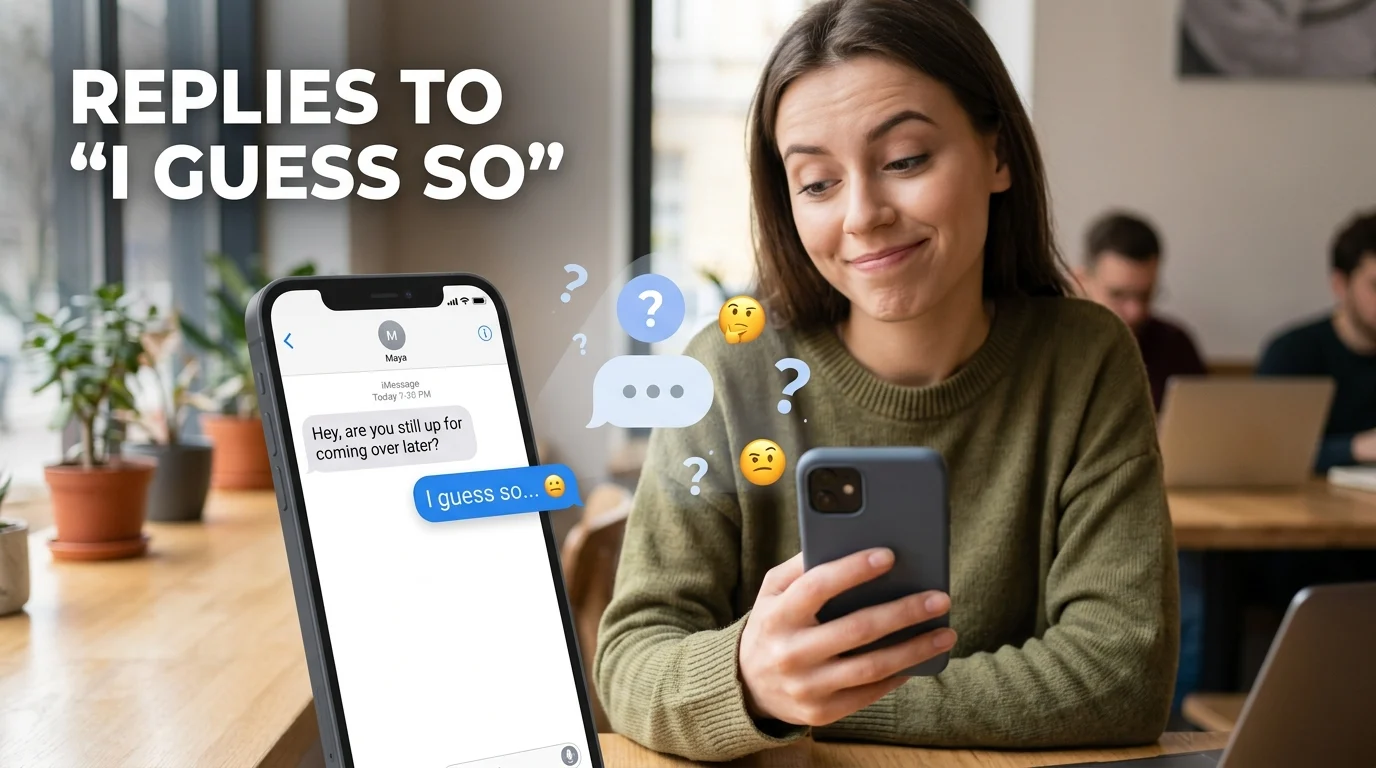
Quick Ans: When someone says “I guess so,” the best reply depends on their tone and the situation. For example, you can keep things casual with “That sounds like a yes to me.” If they sound unsure, try “You don’t sound convinced. What’s really on your mind?” Meanwhile, a funny response could be “That was the most confident maybe I’ve ever heard.” If the conversation is flirty, you could say “I’ll take that little yes and run with it.” Therefore, whether you want to sound funny, confident, caring, flirty, playful, or slightly sarcastic, there are plenty of ways to respond naturally.
The phrase “I guess so” is short, but it can mean surprisingly different things. Sometimes, it simply means yes. However, depending on the conversation, it can also suggest hesitation, uncertainty, indifference, reluctance, or even playful teasing. Because of that, knowing how to respond can be a little tricky.
For instance, someone might say “I guess so” because they agree but do not feel strongly about it. On the other hand, they might be unsure about what they want. Sometimes, they may simply be trying to keep the conversation relaxed.
Fortunately, your response can guide the conversation in whatever direction feels natural. You can ask a follow-up question if you want clarity. Alternatively, you can joke around if the mood is light. Likewise, you can flirt, reassure them, tease them, or simply move forward.
So, if you are searching for replies to “I guess so,” this guide has plenty of ready-to-send options. From short texts to funny comebacks and thoughtful responses, you can easily find something that matches the moment.
Simple Replies To “I Guess So”
Sometimes, the simplest response works best. After all, you do not always need to turn a short statement into a long conversation. These replies are natural, easy, and suitable for everyday texting.
- Sounds like a yes to me.
Use this when you want to accept their uncertain agreement casually.
Meaning: You are treating their response as a positive answer. - I’ll take that as a yes.
Use this when their hesitation does not bother you.
Meaning: You are playfully interpreting their answer positively. - Fair enough.
Use this when you want to acknowledge their response without pushing.
Meaning: You accept what they said without demanding more. - Okay, I’ll go with that.
Use this when you are ready to move forward.
Meaning: You are accepting their answer and continuing the conversation. - That works for me.
Use this when their response gives you enough information.
Meaning: You are comfortable with their answer. - Alright, sounds good.
Use this for a relaxed everyday conversation.
Meaning: You are keeping things positive and uncomplicated. - I’ll count that as agreement.
Use this when you want a slightly playful tone.
Meaning: You are humorously treating their uncertainty as agreement. - Okay then, we have a deal.
Use this when discussing a plan or decision.
Meaning: You are confidently moving the conversation forward. - Good enough for me.
Use this when their answer is acceptable.
Meaning: You do not need further explanation. - Works either way.
Use this when you are not emotionally invested in their answer.
Meaning: You are showing that you are flexible. - Gotcha.
Use this for a very short casual reply.
Meaning: You understand what they are saying. - Alright, I hear you.
Use this when you want to acknowledge their uncertainty.
Meaning: You recognize their response without judging it.
Funny Replies To “I Guess So”
A hesitant “I guess so” can create the perfect opening for humor. Therefore, if the conversation is playful, these responses can keep things entertaining without making the situation awkward.
- Wow, the confidence is overwhelming.
Use this when their answer sounds especially uncertain.
Meaning: You are joking about their lack of confidence. - That was the most enthusiastic yes ever.
Use this when they clearly sound unexcited.
Meaning: You are teasing them about their weak agreement. - I can practically hear the excitement.
Use this when their tone seems completely unenthusiastic.
Meaning: You are playfully exaggerating their lack of excitement. - Should I throw a party or wait?
Use this when you want to exaggerate their hesitant response.
Meaning: You are joking about how uncertain their yes sounds. - That “yes” needs a little confidence boost.
Use this when they sound unsure.
Meaning: You are teasing them while encouraging more certainty. - I guess so? That sounds suspicious.
Use this when their answer feels questionable.
Meaning: You are jokingly suggesting that something is being left unsaid. - That sounded like a yes wearing a disguise.
Use this when they probably agree but hesitate.
Meaning: You are playfully pointing out their hidden agreement. - Okay, Captain Confidence.
Use this when you want a short sarcastic joke.
Meaning: You are teasing their uncertain attitude. - I’ll pretend that was a confident answer.
Use this with someone who enjoys playful teasing.
Meaning: You are humorously upgrading their hesitant response. - Your “I guess so” deserves an award for uncertainty.
Use this when they are being especially indecisive.
Meaning: You are joking about how unsure they sound. - That sounded like a yes with several conditions.
Use this when their agreement feels reluctant.
Meaning: You suspect they are not completely convinced. - Okay, but where did all that confidence come from?
Use this when their response is clearly hesitant.
Meaning: You are playfully calling attention to their uncertainty.
Short Replies To “I Guess So”
If you are texting quickly, a short response can be more natural. Similarly, these options work well when you do not want to overthink the conversation.
- Cool.
Use this when you want to keep things brief.
Meaning: You acknowledge their answer casually. - Fair.
Use this when you accept their uncertainty.
Meaning: You respect their response. - Alright.
Use this when you want a neutral reply.
Meaning: You are accepting what they said. - Works.
Use this when their answer is enough to continue.
Meaning: You are satisfied with the response. - Okay then.
Use this when you want a relaxed tone.
Meaning: You are moving the conversation forward. - Got it.
Use this when you understand their position.
Meaning: You have acknowledged their answer. - Noted.
Use this when you want something slightly playful.
Meaning: You are acknowledging their response without elaborating. - I’ll take it.
Use this when their answer is good enough.
Meaning: You are accepting their hesitant agreement. - Good enough.
Use this when you want a casual response.
Meaning: Their answer works for you. - Say less.
Use this when their response already gives you enough information.
Meaning: You understand and do not need more explanation. - Alrighty.
Use this when you want a cheerful casual reply.
Meaning: You are keeping the conversation light. - Deal.
Use this when their response relates to an agreement.
Meaning: You are confidently accepting the arrangement.
Flirty Replies To “I Guess So”
When someone says “I guess so” during a flirty conversation, you can turn their uncertainty into playful chemistry. However, keep the response aligned with the level of flirting already happening.
- I’ll take that little yes.
Use this when you want a subtle flirty tone.
Meaning: You are playfully treating their hesitation as interest. - You sound cute when you’re unsure.
Use this when you already have comfortable chemistry.
Meaning: You are turning their hesitation into a compliment. - I think you secretly mean yes.
Use this when their hesitation feels playful.
Meaning: You are teasing them about their possible interest. - That sounded almost convincing.
Use this when you want gentle flirtation.
Meaning: You are playfully challenging their uncertain answer. - I’ll work on turning that into a definite yes.
Use this when the conversation is clearly playful.
Meaning: You are teasing them about becoming more certain. - You can just admit you agree with me.
Use this when you want confident banter.
Meaning: You are playfully challenging their hesitation. - That hesitation is kind of adorable.
Use this when you want something sweet and flirty.
Meaning: You find their uncertainty charming. - I guess you like the idea more than you’re admitting.
Use this when their response seems teasing.
Meaning: You are playfully suggesting hidden interest. - Hmm, I think I can do better than an “I guess.”
Use this when you want confident flirting.
Meaning: You are inviting them to be more direct. - Come on, give me the real answer.
Use this when you want a slightly bolder exchange.
Meaning: You want them to reveal how they actually feel. - That sounded like a shy yes.
Use this when their hesitation seems playful.
Meaning: You are interpreting their uncertainty flirtatiously. - I’ll let you pretend you’re undecided.
Use this when you want teasing confidence.
Meaning: You are joking that you already know their answer.
Playful Replies To “I Guess So”
Sometimes, you want to tease without sounding sarcastic or overly serious. Therefore, playful replies are a great middle ground.
- That’s one way to say yes.
Use this when you want to tease them gently.
Meaning: You think they basically agreed. - You really love keeping me guessing, don’t you?
Use this when they are being deliberately vague.
Meaning: Their uncertainty is making the conversation playful. - I’ll allow the hesitation this time.
Use this when you want a joking response.
Meaning: You are pretending to have authority over their answer. - You could just say yes, you know.
Use this when you want friendly teasing.
Meaning: You believe their response is unnecessarily uncertain. - Interesting choice of words.
Use this when their answer makes you curious.
Meaning: You suspect there is more behind their response. - That sounds like a very careful yes.
Use this when they seem cautious.
Meaning: You are playfully noticing their hesitation. - I see we’re being mysterious today.
Use this when they are avoiding a direct answer.
Meaning: You are teasing them for being vague. - You’re making this more complicated than it needs to be.
Use this with someone who enjoys banter.
Meaning: You think they could answer more directly. - That answer has layers.
Use this when their tone is ambiguous.
Meaning: You think there may be more behind their words. - Should I decode that for you?
Use this when they seem unsure.
Meaning: You are joking that their answer needs interpretation. - Very diplomatic of you.
Use this when they avoid giving a clear yes.
Meaning: You are teasing their careful wording. - Okay, mystery person.
Use this when you want a cute playful reply.
Meaning: You are joking about their unclear answer.
Replies To “I Guess So” When They Sound Unsure
If their “I guess so” sounds genuinely uncertain, humor may not be the best move. Instead, you can invite them to explain themselves while keeping the conversation comfortable.
- You sound unsure. What are you thinking?
Use this when their hesitation seems genuine.
Meaning: You want to understand their feelings. - Is that a yes, or are you still deciding?
Use this when clarity matters.
Meaning: You are asking them to be more direct. - You don’t seem completely convinced.
Use this when their tone suggests doubt.
Meaning: You notice their hesitation and want to acknowledge it. - Take your time if you’re not sure.
Use this when you do not want to pressure them.
Meaning: You are giving them room to decide. - It’s okay if you’re unsure.
Use this when they seem uncomfortable answering.
Meaning: You are making the conversation feel safer. - What’s making you hesitate?
Use this when you want more context.
Meaning: You are asking about the reason behind their uncertainty. - You can be honest with me.
Use this when you sense they are holding back.
Meaning: You are encouraging an open answer. - I’d rather know what you really think.
Use this when the honest answer matters.
Meaning: You value sincerity more than agreement. - No pressure, just tell me how you feel.
Use this when you want to reduce tension.
Meaning: You are inviting honesty without forcing an answer. - If you’re not sure, we can talk about it.
Use this when the topic is important.
Meaning: You are offering space for discussion. - That sounds like a maybe.
Use this when their response is genuinely ambiguous.
Meaning: You recognize that they have not fully agreed. - What would make you feel more certain?
Use this when you want to understand their concerns.
Meaning: You are encouraging constructive conversation.
Confident Replies To “I Guess So”
Confidence can make a response feel smooth and natural. However, confidence works best when it does not dismiss the other person’s feelings.
- I’ll take that as progress.
Use this when they are slowly becoming more agreeable.
Meaning: You see their response as a positive step. - I knew you’d come around.
Use this with someone who is playfully resisting.
Meaning: You are confidently teasing them. - We’re getting somewhere now.
Use this when the conversation is moving forward.
Meaning: Their response gives you enough encouragement. - That’s all I needed to hear.
Use this when their answer satisfies you.
Meaning: You are confidently accepting their response. - Good, we’re on the same page.
Use this when their answer indicates agreement.
Meaning: You believe you now share the same understanding. - I’ll count that as a win.
Use this when you want playful confidence.
Meaning: You are treating their agreement as a small success. - See? We got there eventually.
Use this after some back-and-forth.
Meaning: You are joking about finally reaching agreement. - I knew there was a yes hiding in there.
Use this when they were hesitant.
Meaning: You believe their uncertainty was temporary. - Perfect. Let’s go with it.
Use this when a decision has been made.
Meaning: You are confidently moving ahead. - That’s good enough for me.
Use this when you do not need stronger confirmation.
Meaning: You are comfortable with their answer. - Excellent, I’ll consider that settled.
Use this when you want playful confidence.
Meaning: You are jokingly declaring the matter decided. - And there we have it.
Use this after they finally agree.
Meaning: You are playfully marking the end of the discussion.
Sarcastic Replies To “I Guess So”
A little sarcasm can be funny when both people understand each other. Still, use these carefully because sarcasm can sound dismissive without the right tone.
- Well, that was incredibly decisive.
Use this when their answer is extremely hesitant.
Meaning: You are teasing their lack of certainty. - I can feel your enthusiasm from here.
Use this when they sound unexcited.
Meaning: You are joking about their low energy. - Thank you for that powerful statement.
Use this when their answer is vague.
Meaning: You are humorously exaggerating its importance. - That confidence is truly inspiring.
Use this when they sound unsure.
Meaning: You are playfully saying the opposite. - I’ll alert the newspapers.
Use this when they finally agree to something minor.
Meaning: You are exaggerating the importance of their answer. - Very convincing. Almost.
Use this when their answer does not persuade you.
Meaning: You are jokingly challenging their certainty. - Bold words from someone saying “I guess.”
Use this when they sound particularly unsure.
Meaning: You are highlighting the contradiction humorously. - I appreciate the overwhelming enthusiasm.
Use this when they sound reluctant.
Meaning: You are teasing their lack of excitement. - That may be the least confident yes I’ve heard.
Use this when their answer is barely affirmative.
Meaning: You are joking about their hesitation. - Okay, we’ll call that a temporary yes.
Use this when they seem uncertain.
Meaning: You are humorously leaving room for their mind to change. - I’ll frame that answer for future reference.
Use this when you want exaggerated sarcasm.
Meaning: You are joking about how memorable their response is. - You really committed to the “maybe” energy.
Use this when their answer is noticeably vague.
Meaning: You are teasing their uncertainty.
Cute Replies To “I Guess So”
If you want your response to sound sweet rather than sarcastic, these options keep the mood friendly. In addition, they work well with close friends and someone you like.
- Aww, I’ll take that little yes.
Use this when their hesitation sounds cute.
Meaning: You are affectionately accepting their response. - You’re adorable when you’re unsure.
Use this when you have a close relationship.
Meaning: You are turning their hesitation into a compliment. - That’s a cute way of saying yes.
Use this when they basically agree.
Meaning: You find their wording endearing. - I think that counts as a yes.
Use this when you want something gentle.
Meaning: You are interpreting their answer positively. - Okay, I’ll accept your tiny yes.
Use this when you want playful affection.
Meaning: You are treating their agreement as cute. - You could just say yes, cutie.
Use this when the relationship allows affectionate teasing.
Meaning: You want a clearer answer while flirting lightly. - That little hesitation was sweet.
Use this when their uncertainty feels charming.
Meaning: You appreciate their shy response. - I’ll pretend I didn’t hear the “I guess.”
Use this when you want gentle teasing.
Meaning: You are playfully focusing on the positive part. - Okay, I’ll take your almost-yes.
Use this when their response is hesitant but positive.
Meaning: You are affectionately accepting their uncertainty. - You make indecision sound adorable.
Use this when you want a sweet compliment.
Meaning: You find their hesitation charming. - That was a very cute maybe.
Use this when their answer feels playful.
Meaning: You are responding affectionately to their uncertainty. - Fine, I’ll take it as a yes for now.
Use this when you want playful sweetness.
Meaning: You are accepting their answer while teasing them.
Replies To “I Guess So” From A Friend
Friends usually give you more room to joke around. Therefore, you can use casual banter, playful teasing, or simple acknowledgment depending on the friendship.
- Bro, that was not convincing at all.
Use this when your friend sounds unsure.
Meaning: You are teasing them about their weak answer. - You can just say yes, you know.
Use this when you want friendly teasing.
Meaning: You think they are making the answer unnecessarily complicated. - I’ll accept that, buddy.
Use this when their answer works for you.
Meaning: You are casually acknowledging their response. - That sounded like a very reluctant yes.
Use this when they seem hesitant.
Meaning: You are pointing out their lack of enthusiasm. - Okay, mysterious one.
Use this when your friend avoids being direct.
Meaning: You are joking about their vague response. - I’m choosing to hear that as yes.
Use this when you want playful confidence.
Meaning: You are interpreting their answer positively. - You really thought about that one, huh?
Use this when they took time to answer.
Meaning: You are teasing their hesitation. - That answer needs a confidence upgrade.
Use this when they sound uncertain.
Meaning: You are jokingly encouraging stronger certainty. - Fine, I’ll take the maybe.
Use this when you do not need a definite answer.
Meaning: You are accepting their uncertainty casually. - You are impossible sometimes.
Use this with a friend who enjoys teasing.
Meaning: You are playfully calling out their indecision. - Okay, I guess so too.
Use this when you want to mirror their wording.
Meaning: You are jokingly copying their uncertainty. - Deal, even though that was barely a yes.
Use this when their answer is good enough.
Meaning: You are accepting it while keeping the banter alive.
Replies To “I Guess So” From Someone You Like
When someone you like says “I guess so,” their tone matters. If they seem playful, you can flirt. If they seem uncertain, however, it is better to ask what they mean.
- You know you can be honest with me, right?
Use this when you want a sincere answer.
Meaning: You are inviting them to share their real feelings. - I think there’s a more confident answer hiding in there.
Use this when they are playfully hesitant.
Meaning: You are encouraging them to be more direct. - I’ll take that as a shy yes.
Use this when their tone seems cute.
Meaning: You are interpreting their hesitation affectionately. - You’re making me curious now.
Use this when their answer leaves you wondering.
Meaning: You want to know what they really mean. - Okay, but what are you really thinking?
Use this when you want honest communication.
Meaning: You are asking them to explain their uncertainty. - That sounds like you want to say yes.
Use this when their tone suggests interest.
Meaning: You are playfully interpreting their hesitation. - I’ll wait for the confident version.
Use this when you want gentle teasing.
Meaning: You are encouraging them to answer more clearly. - You’re cute when you try to avoid answering.
Use this when flirting is already comfortable.
Meaning: You are turning their hesitation into playful chemistry. - I have a feeling you’re holding back.
Use this when you sense uncertainty.
Meaning: You are inviting them to be more open. - You don’t have to guess with me.
Use this when you want a reassuring tone.
Meaning: You are encouraging honesty and comfort. - That “I guess” has me wondering.
Use this when you want them to elaborate.
Meaning: Their answer has made you curious. - Give me the real answer when you’re ready.
Use this when you want to avoid pressure.
Meaning: You are giving them space to be honest.
Clever Replies To “I Guess So”
A clever response can keep the conversation interesting without being overly sarcastic. Similarly, these lines work well when you want to sound confident and quick-witted.
- So we agree, with a little hesitation sprinkled on top.
Use this when they basically agree but sound uncertain.
Meaning: You are humorously summarizing their response. - I’ll translate that from “maybe” to “probably.”
Use this when you want playful interpretation.
Meaning: You are suggesting they are leaning toward yes. - That answer leaves plenty of room for interpretation.
Use this when their meaning is unclear.
Meaning: You are pointing out the ambiguity. - Interesting. I’ll file that under “mostly yes.”
Use this when you want clever humor.
Meaning: You are categorizing their uncertain agreement. - So technically, we have progress.
Use this when they have moved toward agreement.
Meaning: You see their response as a small positive step. - I appreciate the carefully negotiated answer.
Use this when they are being cautious.
Meaning: You are joking about their careful wording. - That sounds like a yes with fine print.
Use this when they seem to have reservations.
Meaning: You suspect their agreement has conditions. - I’m hearing 70 percent yes.
Use this when you want playful exaggeration.
Meaning: You are humorously assigning certainty to their answer. - Let me guess, you’re keeping your options open.
Use this when they avoid commitment.
Meaning: You think they are deliberately staying uncertain. - That response definitely came with a question mark.
Use this when their tone is unclear.
Meaning: You noticed their uncertainty. - So the official answer is… maybe?
Use this when you want a clever short reply.
Meaning: You are joking about the ambiguity. - I’ll consider that an answer in progress.
Use this when they need more time.
Meaning: You recognize that they have not fully decided.
Caring Replies To “I Guess So”
Sometimes “I guess so” signals uncertainty, disappointment, or low confidence. Therefore, a caring response can help the person feel heard rather than pressured.
- You sound a little unsure. Are you okay?
Use this when their tone seems emotionally different.
Meaning: You are checking on their well-being. - If something is bothering you, you can tell me.
Use this when you sense they are holding back.
Meaning: You are offering a safe space to talk. - It’s completely okay not to know yet.
Use this when they are uncertain about a decision.
Meaning: You are reassuring them that uncertainty is normal. - Take your time. There’s no rush.
Use this when they need space.
Meaning: You are removing pressure from the situation. - I’d rather you tell me honestly.
Use this when you want genuine communication.
Meaning: You value honesty over automatic agreement. - You don’t have to agree just to make me happy.
Use this when you worry they are people-pleasing.
Meaning: You are encouraging an authentic answer. - Whatever you decide, I’ll understand.
Use this when the decision is personal.
Meaning: You are offering support regardless of their choice. - Want to talk through it?
Use this when they seem conflicted.
Meaning: You are offering to help them process the situation. - I can tell you’re not completely sure.
Use this when their hesitation is obvious.
Meaning: You are acknowledging their uncertainty. - You can tell me what you really think.
Use this when you want openness.
Meaning: You are encouraging honest communication. - It’s okay if your answer is different from mine.
Use this when there may be disagreement.
Meaning: You are showing respect for their perspective. - Whatever you’re feeling, you can be honest with me.
Use this when the conversation is personal.
Meaning: You are creating room for openness and trust.
Best Replies To “I Guess So” For Texting
Text conversations often need responses that are natural, short, and easy to send. Consequently, these options balance personality with simplicity.
- Haha, I’ll take that as a yes.
Use this when you want casual humor.
Meaning: You are accepting their hesitant agreement. - You sound very unsure 😂
Use this when the conversation is playful.
Meaning: You are joking about their uncertainty. - Okay, but I need the confident version.
Use this when you want more certainty.
Meaning: You are asking for a clearer response. - Fair enough, I get you.
Use this when you want to acknowledge their feelings.
Meaning: You understand their hesitation. - That’s basically a yes, right?
Use this when you think they agree.
Meaning: You are checking whether their answer is positive. - I’m hearing a very hesitant yes.
Use this when you want playful teasing.
Meaning: You are noticing their uncertainty. - Okayyy, I’ll accept it.
Use this when you want a relaxed response.
Meaning: You are playfully accepting their answer. - Hmm, should I be convinced?
Use this when their answer sounds weak.
Meaning: You are playfully questioning their certainty. - I’ll pretend that sounded confident.
Use this when you want gentle sarcasm.
Meaning: You are joking about their hesitation. - No worries, I understand.
Use this when you want to sound supportive.
Meaning: You respect their uncertainty. - That tells me enough for now.
Use this when you do not need more information.
Meaning: You are comfortable continuing without certainty. - Okay, we’ll work with that.
Use this when you want to move forward.
Meaning: Their answer is sufficient for the moment.
FAQs About Replies To “I Guess So”
What does “I guess so” usually mean?
“I guess so” usually indicates agreement with some level of uncertainty. However, the exact meaning depends on the person’s tone, the topic, and the relationship between you.
What is a good reply to “I guess so”?
A simple response is “I’ll take that as a yes.” Alternatively, if they sound uncertain, you can ask, “You seem unsure. What are you thinking?”
How do I respond to “I guess so” from someone I like?
If the conversation is flirty, you can say “I’ll take that as a shy yes.” However, if they genuinely seem unsure, asking what they really think is usually more helpful.
Is “I guess so” a yes or a no?
Usually, it leans toward yes, but it is not always a strong or enthusiastic yes. Therefore, context matters. If the answer is important, asking a follow-up question can prevent misunderstanding.
How can I respond to “I guess so” in a funny way?
Try “That was the most confident yes ever.” Similarly, “I can feel your enthusiasm from here” works when the other person is clearly being playful.
What should I say if someone sounds unsure?
You can respond with “It’s okay if you’re unsure. What are you thinking?” This approach acknowledges their hesitation while giving them room to explain.
Can I flirt when someone says “I guess so”?
Yes, if the conversation already has a comfortable flirty tone. For example, “You sound cute when you’re unsure” adds playful affection without being too intense.
What is a short reply to “I guess so”?
You can simply say “Fair,” “Alright,” “Got it,” “Works,” or “I’ll take it.” These options are especially useful for quick text conversations.
What if they say “I guess so” sarcastically?
If their tone sounds sarcastic, you can match the energy with something like “Very convincing” or “That sounded enthusiastic.” However, if you are unsure, asking what they mean is safer.
How do I make my response sound confident?
Keep it simple and direct. For example, “Perfect, let’s go with it” sounds confident because you acknowledge the answer and move forward.
What if “I guess so” sounds negative?
Do not automatically assume they mean no. Instead, ask a gentle question such as “You sound unsure. Is something bothering you?” This gives them an opportunity to explain.
Should I ask what they mean?
If their answer affects an important decision or relationship conversation, yes. In contrast, if the topic is casual, you can simply accept the response and continue chatting.
Conclusion
Knowing how to respond to “I guess so” is mostly about reading the tone behind the words. Sometimes, the phrase is simply a casual yes. However, it can also signal hesitation, uncertainty, reluctance, or playful teasing. Therefore, your reply should match the situation rather than relying on one fixed response. If the mood is light, try a funny or playful comeback. If there is romantic chemistry, a flirty reply can keep the conversation interesting. On the other hand, if someone genuinely seems unsure, a caring question may work better. Ultimately, the best response is one that keeps the conversation natural while giving the other person room to express what they really mean.

Emma Writes is a passionate content writer at ResponsCraft.com, creating practical, well-researched articles that help readers make informed decisions. She enjoys turning complex topics into clear, engaging and easy-to-follow content.