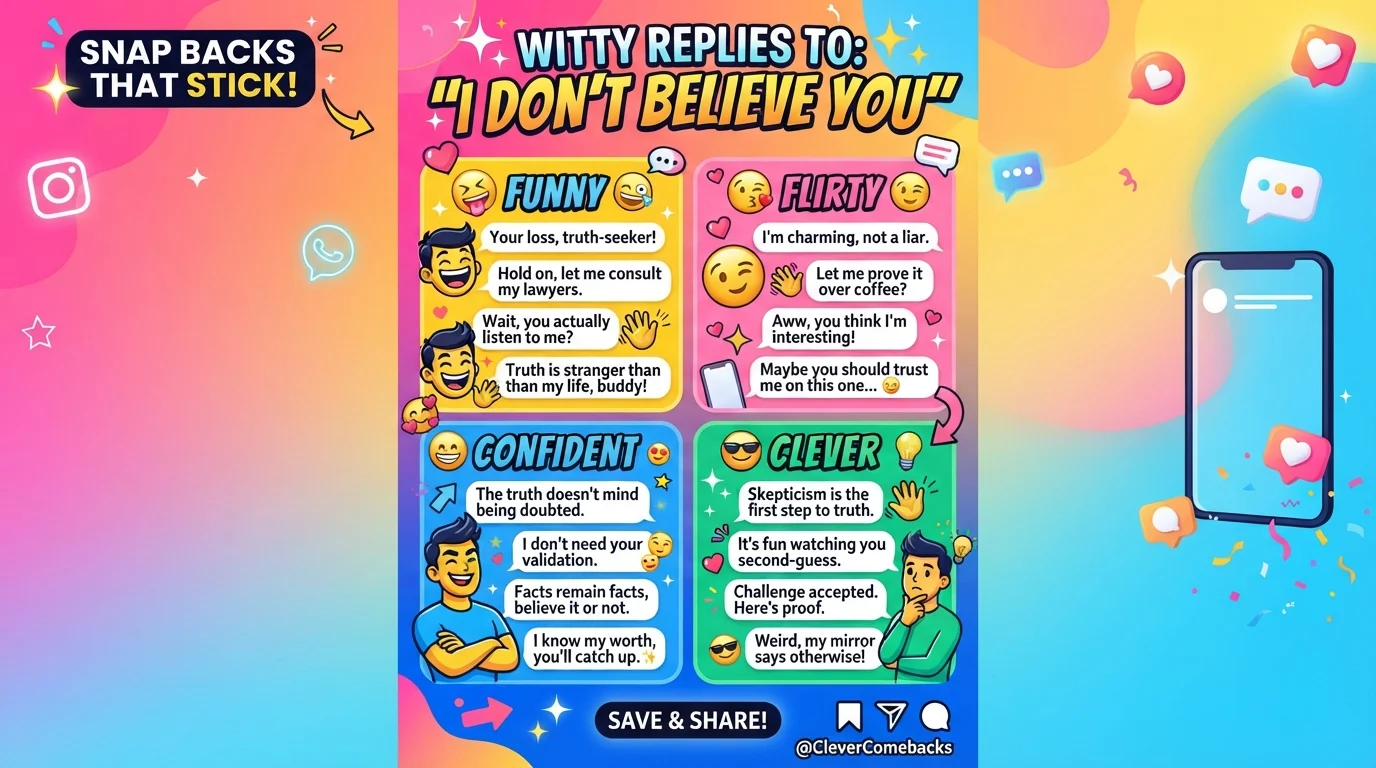
Quick Ans: When someone says “I don’t believe you,” the best reply depends on whether they are teasing, doubting you, flirting, or genuinely questioning what you said. Try matching their energy instead of overexplaining.
Top alternatives: Then let me prove it, You’ll believe me eventually, Why would I lie?, Challenge accepted, I guess you’ll have to find out
“ I don’t believe you” can turn a perfectly normal conversation into a tiny courtroom drama. Maybe your friend thinks your story sounds impossible, your crush suspects you are flirting, or a coworker needs proof before accepting what you said. Sometimes they are genuinely doubtful, and sometimes they are simply having fun with you.
That is why the perfect response depends on the vibe. A confident answer can shut down unnecessary doubt, while a funny comeback can keep the conversation light. If it is your crush, you can even turn their skepticism into playful flirting. For friends, a little sarcasm usually works beautifully.
This guide to replies to I don’t believe you gives you ready-to-send responses for texts, DMs, friendships, dating, work conversations, teasing, and serious situations. Pick your mood, choose your line, and let the conversation continue without turning it into a full legal investigation.
Funny Responses
Okay, Detective, investigate away.
Use this when a friend is jokingly questioning your story.
Meaning: You are playfully accepting their skepticism.
I promise the truth is not boring this time.
Use this when your story sounds unusually unbelievable.
Meaning: You are humorously insisting that you are telling the truth.
Believe me before I start presenting evidence.
Use this when someone keeps doubting you playfully.
Meaning: You are joking that you have proof ready.
Fine, I’ll call my witnesses.
Use this when a friend refuses to believe something funny or unexpected.
Meaning: You are exaggerating the situation for humor.
Your trust issues are showing.
Use this with someone who constantly questions everything you say.
Meaning: You are teasing them about their skepticism.
I didn’t prepare a PowerPoint for this, unfortunately.
Use this when someone demands proof over something casual.
Meaning: You are joking about how seriously they are taking the situation.
You really woke up ready to doubt me today.
Use this when someone is unusually skeptical.
Meaning: You are playfully calling attention to their disbelief.
Believe it or not, I have standards.
Use this when someone thinks you are making something up.
Meaning: You are jokingly defending your honesty.
This is why I need a documentary crew.
Use this when your story sounds too unbelievable to explain normally.
Meaning: You are exaggerating the story for comedic effect.
I can’t believe you don’t believe me.
Use this when you want to mirror their skepticism humorously.
Meaning: You are playfully turning their words back on them.
Should I bring charts and graphs?
Use this when someone wants excessive proof.
Meaning: You are joking that their doubt has become unnecessarily serious.
Okay, I’ll let reality prove me right.
Use this when you are confident the truth will become obvious.
Meaning: You are calmly standing by your statement.
Sarcastic Responses
Of course you don’t. Shocking.
Use this when someone predictably doubts you.
Meaning: You are teasing them for their expected reaction.
Trust is clearly thriving here.
Use this when someone jokingly questions your honesty.
Meaning: You are using sarcasm to highlight their disbelief.
I’ll try to survive this betrayal.
Use this when a friend doubts something harmless.
Meaning: You are dramatically pretending to be offended.
Your faith in me is inspiring.
Use this when someone clearly has very little confidence in your story.
Meaning: You are sarcastically commenting on their skepticism.
Wow, what a vote of confidence.
Use this when someone doubts you after you make a claim.
Meaning: You are jokingly pretending their doubt is encouraging.
I feel so trusted right now.
Use this when someone questions your honesty.
Meaning: You are sarcastically pointing out the lack of trust.
And here I thought we had something special.
Use this with a close friend when they refuse to believe you.
Meaning: You are pretending their doubt has personally wounded you.
Not even a little faith? Impressive.
Use this when their skepticism is especially strong.
Meaning: You are teasing them for refusing to trust you.
I’ll add “untrustworthy” to my résumé.
Use this when someone jokingly accuses you of lying.
Meaning: You are exaggerating the situation for comedic effect.
Clearly, my reputation precedes me.
Use this when someone doubts you because of your usual behavior.
Meaning: You are humorously acknowledging your questionable reputation.
Okay, trust has left the building.
Use this when the conversation becomes playfully skeptical.
Meaning: You are joking that their disbelief has gone too far.
I see how it is now.
Use this when you want a short sarcastic comeback.
Meaning: You are pretending to be offended by their doubt.
Flirty Responses
Then I guess you’ll have to find out.
Use this when you want to turn skepticism into playful romantic tension.
Meaning: You are inviting them to discover the truth for themselves.
You’ll believe me when you get to know me better.
Use this when talking to someone you are interested in.
Meaning: You are suggesting that closeness will make them trust you.
Maybe I just like keeping you curious.
Use this when your crush doubts something you said.
Meaning: You are playfully enjoying the attention and mystery.
I could prove it if you let me.
Use this when the conversation already has obvious flirting.
Meaning: You are confidently turning their doubt into an invitation.
You’re cute when you’re skeptical.
Use this when their disbelief feels playful rather than serious.
Meaning: You are turning their doubt into a compliment.
I guess I’ll have to convince you personally.
Use this when you want a confident romantic comeback.
Meaning: You are suggesting a more personal way to settle the question.
Keep doubting me, it gives me an excuse to impress you.
Use this when you enjoy playful competition with a crush.
Meaning: You are using their skepticism as motivation to win them over.
You don’t believe me yet. That’s the fun part.
Use this when you want to keep the conversation mysterious.
Meaning: You are enjoying the anticipation of proving yourself.
I promise I’m more convincing in person.
Use this when texting someone you want to meet.
Meaning: You are subtly suggesting an in-person conversation.
Your doubt is strangely adorable.
Use this when their skepticism is playful and affectionate.
Meaning: You find their reaction charming rather than annoying.
Give me a chance to change your mind.
Use this when you want a direct but playful romantic response.
Meaning: You are confidently asking for an opportunity to prove yourself.
You’ll believe me eventually, especially if I keep smiling like this.
Use this when flirting is already comfortable and playful.
Meaning: You are using charm to keep the conversation romantic.
Polite Responses
I understand why you might be skeptical.
Use this when someone genuinely has doubts about what you said.
Meaning: You are acknowledging their perspective respectfully.
That’s fair, but I’m being honest with you.
Use this when you want to reassure someone without sounding defensive.
Meaning: You are calmly standing behind your statement.
I can understand your hesitation.
Use this when the information sounds surprising or unusual.
Meaning: You are showing empathy toward their doubt.
I assure you, I’m telling the truth.
Use this when honesty matters more than humor.
Meaning: You are giving clear reassurance.
You don’t have to take my word for it.
Use this when you can provide evidence.
Meaning: You are offering them another way to verify your claim.
I respect that you want to be certain.
Use this when someone needs confirmation.
Meaning: You are responding maturely to their skepticism.
I completely understand your concern.
Use this when the person has a reasonable reason to question you.
Meaning: You are validating their feelings.
I’m happy to clarify if you need more context.
Use this in a serious conversation where confusion may be involved.
Meaning: You are offering additional information instead of arguing.
I wouldn’t expect you to believe something without reason.
Use this when you want to encourage thoughtful discussion.
Meaning: You are showing respect for their judgment.
I’m confident you’ll understand once you see the details.
Use this when evidence can settle the disagreement.
Meaning: You are calmly expressing confidence in your position.
I appreciate your honesty about how you feel.
Use this when someone openly admits their doubt.
Meaning: You value their direct communication.
Let’s clear up any misunderstanding.
Use this when disbelief may come from confusion.
Meaning: You want to resolve the issue calmly.
Confident Responses
Then I’ll prove it.
Use this when you are certain you can back up your words.
Meaning: You are confident enough to let evidence speak.
You don’t have to believe me right now.
Use this when you are comfortable standing by your statement.
Meaning: Your confidence does not depend on immediate approval.
The truth doesn’t need convincing forever.
Use this when you know the facts will eventually become clear.
Meaning: You trust reality to support your claim.
I know what I said, and I stand by it.
Use this when someone challenges your statement.
Meaning: You are calmly defending your position.
You’ll see soon enough.
Use this when circumstances will eventually confirm what you said.
Meaning: You are confident that time will prove you right.
I’m not here to convince you, just to tell you the truth.
Use this when you want to avoid unnecessary arguing.
Meaning: You are prioritizing honesty over winning the conversation.
Doubt me if you want. I know the truth.
Use this when someone refuses to accept your explanation.
Meaning: You are maintaining confidence despite their skepticism.
I have nothing to hide.
Use this when someone seriously questions your honesty.
Meaning: You are signaling openness and confidence.
Check the facts and decide for yourself.
Use this when evidence is available.
Meaning: You are encouraging independent verification.
I said what I said.
Use this when you want a short, firm response.
Meaning: You are standing firmly behind your words.
Believe me or verify it yourself.
Use this when you want to avoid a pointless argument.
Meaning: You are confident enough to let evidence settle the issue.
You’ll realize I was telling the truth.
Use this when you expect the situation to prove you right.
Meaning: You are calmly predicting that their doubt will disappear.
Clever Responses
Skepticism noted. Evidence loading.
Use this when someone doubts you and you want a witty answer.
Meaning: You are jokingly preparing to prove your claim.
Believe later, investigate now.
Use this when you want to turn doubt into curiosity.
Meaning: You are encouraging them to check the facts.
Truth rarely needs a sales pitch.
Use this when you want a mature but clever response.
Meaning: You are saying genuine facts can stand on their own.
Doubt is allowed. Being wrong is also allowed.
Use this when the conversation is playful but competitive.
Meaning: You are reminding them that skepticism can backfire.
Your disbelief changes nothing about the facts.
Use this when you want to sound composed and intelligent.
Meaning: You are separating truth from someone’s personal opinion.
Consider this your official invitation to verify it.
Use this when you can provide proof.
Meaning: You are confidently encouraging them to check.
The plot will prove me right eventually.
Use this when the conversation feels playful or dramatic.
Meaning: You are joking that future events will reveal the truth.
I respect the doubt. I still stand by my statement.
Use this when you want a balanced response.
Meaning: You acknowledge their view without surrendering yours.
Interesting theory. Unfortunately, the facts disagree.
Use this when someone confidently assumes you are lying.
Meaning: You are cleverly pointing out that evidence supports you.
You can question me, but you can’t rewrite reality.
Use this when the conversation becomes more serious.
Meaning: You are firmly defending the truth.
That’s okay. Confidence does not require unanimous approval.
Use this when someone refuses to accept your explanation.
Meaning: You are saying you do not need everyone to agree with you.
Let’s let the evidence settle this debate.
Use this when you want to move from arguing to verification.
Meaning: You prefer facts over opinions.
Cute Responses
Aww, you really don’t believe me?
Use this when you want to sound playfully disappointed.
Meaning: You are turning their skepticism into a cute moment.
You’ll believe me eventually, promise.
Use this when the conversation is warm and casual.
Meaning: You are reassuring them without sounding defensive.
You’re too cute when you doubt me.
Use this with someone you are comfortable teasing.
Meaning: Their skepticism feels charming to you.
Okay, but I’m telling you the truth.
Use this when you want to reassure them gently.
Meaning: You are being sincere without creating tension.
Trust me just a tiny bit.
Use this when someone is playfully skeptical.
Meaning: You are asking for a little faith in a sweet way.
I promise I’m not making this up.
Use this when your story sounds surprising.
Meaning: You are offering friendly reassurance.
You know I wouldn’t lie to you.
Use this with someone close to you.
Meaning: You are reminding them of the trust between you.
Fine, I’ll win you over.
Use this when their doubt feels playful.
Meaning: You are turning the disagreement into a fun challenge.
Give me one chance to prove it.
Use this when you want to resolve their doubt positively.
Meaning: You are asking for an opportunity to demonstrate the truth.
Your little skeptical face is adorable.
Use this when you know the person well enough for affectionate teasing.
Meaning: You are turning their doubt into a compliment.
I promise, cross my heart.
Use this when you want a youthful and playful reassurance.
Meaning: You are emphasizing that you are being truthful.
You’ll see, sweetheart.
Use this when the relationship is affectionate and comfortable.
Meaning: You are combining reassurance with warmth.
Chill And Casual Responses
Fair enough.
Use this when you do not want to argue over your statement.
Meaning: You accept their skepticism without taking it personally.
You’ll see.
Use this when future events will prove your point.
Meaning: You are calmly confident.
No worries, I know what happened.
Use this when someone doubts your version of events.
Meaning: You are staying relaxed while standing by your story.
That’s okay, believe me later.
Use this when you want to keep things casual.
Meaning: You are not pressuring them to agree immediately.
I get it. It sounds unbelievable.
Use this when your story genuinely sounds surprising.
Meaning: You understand why they are skeptical.
Guess you’ll have to wait and see.
Use this when the truth will become obvious later.
Meaning: You are keeping the response light and slightly mysterious.
Trust me on this one.
Use this when you want a simple reassurance.
Meaning: You are asking them to give you some faith.
You’ll know soon enough.
Use this when the situation is still developing.
Meaning: You are confident that clarity is coming.
It’s really true, though.
Use this when you want to reassure someone without overexplaining.
Meaning: You are simply restating your honesty.
I swear I’m telling you the truth.
Use this when friendly reassurance is needed.
Meaning: You are emphasizing that you are not joking.
You can doubt me for now.
Use this when you are comfortable waiting for proof.
Meaning: You are not bothered by their temporary skepticism.
We’ll see who’s right.
Use this when the conversation has a playful competitive edge.
Meaning: You are turning doubt into a friendly challenge.
Brutal Yet Classy Responses
You don’t have to believe me, but don’t accuse me without proof.
Use this when someone’s doubt starts becoming disrespectful.
Meaning: You are setting a clear boundary without unnecessary drama.
Your doubt is your choice, not my problem.
Use this when someone refuses to accept the truth.
Meaning: You are refusing to carry responsibility for their skepticism.
I explained myself. The rest is up to you.
Use this when you have already provided enough information.
Meaning: You are ending an unproductive debate.
If you need proof, ask for it instead of assuming I’m lying.
Use this when someone jumps to conclusions.
Meaning: You are demanding fair communication.
I won’t argue with someone committed to doubting me.
Use this when the conversation has become repetitive.
Meaning: You are choosing peace over endless debate.
You can question my words without disrespecting me.
Use this when their tone crosses a line.
Meaning: You are calmly establishing a boundary.
Disagreement is fine. Accusations are different.
Use this when someone treats doubt as proof of dishonesty.
Meaning: You are separating healthy skepticism from unfair judgment.
I don’t need to convince you of something I know is true.
Use this when you are confident and ready to move on.
Meaning: You are refusing to chase approval.
If you don’t trust me, say that honestly.
Use this when disbelief appears to come from a deeper trust issue.
Meaning: You are encouraging direct communication.
Believe what you want, but don’t rewrite what happened.
Use this when someone is misrepresenting your explanation.
Meaning: You are firmly defending your version of events.
I’ve been honest with you. What you do with that is your choice.
Use this when you want a mature but firm response.
Meaning: You are making your position clear without arguing.
I’m not going to beg you to believe me.
Use this when you want to end a frustrating conversation.
Meaning: You are protecting your confidence and boundaries.
Responses For Friends
You know me better than that.
Use this when a close friend jokingly questions your honesty.
Meaning: You are reminding them of your friendship and trust.
Have I ever lied to you about something like this?
Use this when you want your history to support your claim.
Meaning: You are appealing to the trust you’ve built.
Bestie, I’m literally telling you the truth.
Use this when a friend refuses to accept your story.
Meaning: You are reassuring them in a casual way.
Fine, don’t believe me until the evidence arrives.
Use this when proof is coming later.
Meaning: You are staying playful while standing by your claim.
You really think I’d make that up?
Use this when the story sounds strange but is genuine.
Meaning: You are asking your friend to reconsider their doubt.
I swear, this actually happened.
Use this when recounting a surprising event.
Meaning: You are emphasizing that the story is real.
Your disbelief is personally offending my friendship résumé.
Use this when you want a silly comeback.
Meaning: You are joking about the trust between you.
Fine, I’ll bring receipts next time.
Use this when a friend repeatedly doubts your stories.
Meaning: You are jokingly promising to provide evidence.
You know I’m too lazy to invent a story this detailed.
Use this when your explanation is complicated.
Meaning: You are humorously suggesting the story is too elaborate to fake.
Okay, trust issues aside, I’m serious.
Use this when you want your friend to stop joking.
Meaning: You are signaling that your statement is genuine.
You’ll apologize when you realize I was right.
Use this when the situation is playful and you expect to be proven correct.
Meaning: You are confidently predicting the outcome.
Now I have something to prove, apparently.
Use this when their doubt turns into a friendly challenge.
Meaning: You are embracing the competition playfully.
Responses For Crushes
You don’t believe me? That’s adorable.
Use this when your crush playfully questions your words.
Meaning: You are turning skepticism into flirtation.
Then let me change your mind.
Use this when the conversation has romantic chemistry.
Meaning: You are confidently accepting the challenge.
I guess I’ll have to impress you.
Use this when your crush doubts a compliment or claim.
Meaning: You are turning their skepticism into motivation.
You really make me work for your trust, huh?
Use this when playful romantic tension is already established.
Meaning: You are teasing them about making you prove yourself.
I like that you’re not easily convinced.
Use this when their skepticism is attractive to you.
Meaning: You appreciate their confidence and independence.
Challenge accepted.
Use this when you want a short, confident flirting response.
Meaning: You are happily taking on the challenge of proving yourself.
Maybe you need to spend more time with me.
Use this when you want to hint at seeing them more often.
Meaning: You are connecting trust with getting closer.
Keep questioning me and I’ll keep flirting with you.
Use this when the conversation is already playful.
Meaning: You are turning their skepticism into an excuse for more flirting.
I could probably convince you over coffee.
Use this when you want to suggest a casual date.
Meaning: You are using the situation to create an opportunity to meet.
You don’t believe me yet, but you’re definitely listening.
Use this when your crush keeps engaging with the conversation.
Meaning: You are teasing them about secretly being interested.
I have a feeling I’ll win you over.
Use this when you want a confident romantic response.
Meaning: You believe your charm will eventually convince them.
Just wait, I’ll make you a believer.
Use this when the flirting is bold but still playful.
Meaning: You are confidently promising to prove your point.
Supportive Responses
It’s okay if you need time to process it.
Use this when someone doubts surprising information.
Meaning: You are giving them space instead of pressuring them.
I understand why this is hard to believe.
Use this when the situation is unexpected or emotional.
Meaning: You are acknowledging their reaction with empathy.
Take your time, I’ll explain everything.
Use this when more context may help.
Meaning: You are offering patience and reassurance.
You don’t have to decide immediately.
Use this when someone needs time before accepting your statement.
Meaning: You are removing pressure from the conversation.
I’m here if you want to talk it through.
Use this when disbelief comes from confusion or concern.
Meaning: You are offering continued support.
I won’t pressure you to believe me.
Use this when someone needs emotional space.
Meaning: You respect their ability to process information independently.
Let’s go through it together.
Use this when evidence or context can clarify the situation.
Meaning: You want to resolve doubt cooperatively.
I know it sounds surprising, but I’m being honest.
Use this when your statement is difficult to accept.
Meaning: You are combining empathy with reassurance.
You can ask me anything about it.
Use this when someone has genuine questions.
Meaning: You are showing openness and transparency.
I want you to feel comfortable with the truth.
Use this when the topic is emotionally important.
Meaning: You care more about understanding than winning an argument.
I’m not upset that you need reassurance.
Use this when someone admits uncertainty.
Meaning: You are making it safe for them to ask questions.
We’ll figure it out together.
Use this when the situation affects both of you.
Meaning: You are offering partnership instead of pressure.
Short And Text-Ready Responses
Then I’ll prove it.
Use this when you want a confident reply with minimal words.
Meaning: You are accepting the challenge.
You’ll see.
Use this when future events can confirm your statement.
Meaning: You are confidently waiting for proof.
Trust me.
Use this when you want a simple reassurance.
Meaning: You are asking them to have faith in you.
Fair enough.
Use this when you do not want to argue.
Meaning: You accept their skepticism calmly.
Just wait.
Use this when the truth will become clear later.
Meaning: You are confident time will prove your point.
I swear.
Use this when you want to emphasize sincerity.
Meaning: You are strongly reassuring them.
Challenge accepted.
Use this when their doubt feels playful.
Meaning: You are ready to prove yourself.
Believe me later.
Use this when immediate agreement is unnecessary.
Meaning: You are comfortable letting time settle the issue.
You’ll believe me soon.
Use this when evidence is coming.
Meaning: You are confident their doubt will disappear.
That’s okay.
Use this when you do not want to take their skepticism personally.
Meaning: You are keeping the conversation relaxed.
I know what happened.
Use this when someone questions your account of an event.
Meaning: You remain confident in your experience.
Wait and see.
Use this when the future will reveal the truth.
Meaning: You are inviting them to watch what happens next.
FAQs About “I Don’t Believe You”
What does “I don’t believe you” mean?
It usually means someone doubts your statement, though they may be teasing rather than seriously accusing you.
What is the best reply to “I don’t believe you”?
“Then let me prove it” is confident, simple, and works in many situations.
How do I respond when a crush says “I don’t believe you”?
Try “Then I guess you’ll have to find out” for a playful and flirty response.
What is a funny response?
Try “Okay, Detective, investigate away” when the situation is lighthearted.
What if they genuinely think I am lying?
Stay calm, explain the facts, and offer proof instead of becoming defensive.
Can “I don’t believe you” be flirty?
Yes. In romantic conversations, it can be playful teasing or an invitation to prove yourself.
What is a polite response?
“I understand why you might be skeptical, but I’m being honest with you” works well.
Should I argue with someone who doesn’t believe me?
Not always. If you have explained the truth clearly, let evidence or time speak for itself.
What is a confident reply?
“You don’t have to believe me right now” shows confidence without forcing agreement.
What should I say to a friend?
“You know me better than that” is casual, friendly, and slightly teasing.
Can I use sarcasm?
Yes, if you know the person well and the conversation is clearly playful.
What if their disbelief feels disrespectful?
Say, “You can question me without disrespecting me” and keep your boundary clear.
How do I respond without sounding defensive?
A calm line such as “That’s fair, but I’m telling the truth” keeps your tone composed.
Is “you’ll see” a good reply?
Yes, especially when future events will naturally prove what you said.
What is a short text reply?
“Challenge accepted” or “You’ll see” works when you want something quick and confident.
Conclusion
The best replies to I don’t believe you are the ones that match the moment. If your crush is being skeptical, turn the doubt into playful chemistry. If someone genuinely questions your honesty, stay calm, explain yourself, and let the facts do the heavy lifting.
You do not always need a perfect comeback. Sometimes “You’ll see” says enough. Other times, “Then let me prove it” keeps the conversation interesting. Save your favorite lines, reuse them in texts and DMs, and do not be afraid to switch your tone depending on who is on the other side of the screen. Pick your vibe and reply with confidence.

Chloe Brooks is a passionate writer at ResponsCraft.com, creating clear, practical and well-researched content to help readers make informed decisions. She focuses on delivering engaging articles that are accurate, useful and easy to understand.