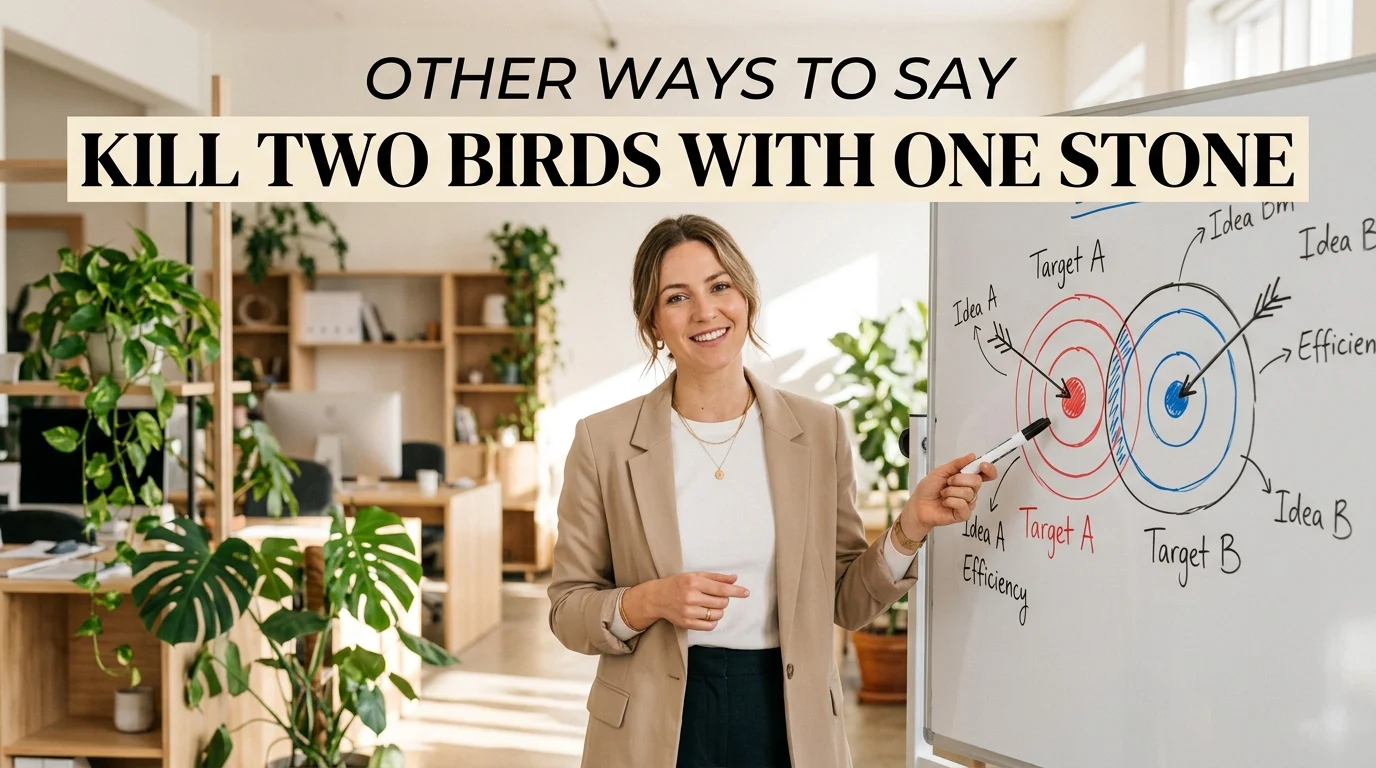
Quick Ans: “Kill two birds with one stone” means to accomplish two goals with a single action. Top alternatives include: accomplish two things at once, hit two targets with one shot, serve a dual purpose, cover two bases at once, and solve two problems in one move.
Have you ever finished one task and realized you solved two problems at the same time? That satisfying moment is exactly what “kill two birds with one stone” describes. It is one of the most colorful idioms in English, but it is also one of the easiest to misuse, especially in professional settings.
English learners and professionals often search for alternatives to “kill two birds with one stone” because the original phrase can sound violent, dated, or too casual in modern business communication. Saying it in a client presentation may raise eyebrows rather than admiration.
Learning other ways to say “kill two birds with one stone” helps you express efficiency in English without awkward imagery. You can sound strategic with executives, practical with colleagues, and natural with friends. This guide gives you 30 practical alternatives with clear examples so you can use each one with confidence.
“Efficiency sounds impressive. Violent imagery does not. Choose words that match your audience.”
Quick Categories
Formal alternatives to “Kill Two Birds With One Stone”
- Accomplish two objectives simultaneously
- Achieve a dual purpose
- Address two needs with one action
- Serve two functions at once
Pro Tips Box: Use formal alternatives in proposals, reports, and executive summaries where precision and professionalism matter.
Casual alternatives
- Knock out two things at once
- Get two for one
- Take care of both at the same time
- Do double duty
Pro Tips Box: Casual alternatives work best in team chats, friendly emails, or relaxed conversations.
Professional alternatives
- Achieve two outcomes with one initiative
- Maximize efficiency with a single solution
- Consolidate two efforts into one
- Deliver dual value
Pro Tips Box: Professional alternatives highlight strategic thinking and resource efficiency.
Informal expressions
- Two birds, one stone
- Hit two birds with one shot
- Kill two flies with one swat
- One and done, twice over
Pro Tips Box: Informal expressions in English add personality, but save them for people who share your sense of humor.
Common Mistakes
- Using the full idiom in formal writing
Example: “We will kill two birds with one stone by merging the teams.” This sounds too casual in a business report. - Assuming everyone finds the imagery acceptable
Example: “Kill two birds with one stone.” Some listeners find the violent image unpleasant. - Using it when only one goal is achieved
Example: “We killed two birds with one stone by finishing early.” Finishing early is one outcome, not two. - Overusing the idiom in one document
Example: “We killed two birds with one stone, then killed two more.” Repetition weakens impact. - Mixing it with unrelated metaphors
Example: “We killed two birds with one stone and hit a home run.” Mixed metaphors confuse listeners.
“One clear phrase beats three mixed metaphors every time.”
What Does “Kill Two Birds With One Stone” Mean?
“Kill two birds with one stone” is an idiom that means to achieve two separate goals through a single action or effort. It emphasizes efficiency, clever planning, and resourcefulness.
Grammar Note: The phrase functions as a verb idiom. It can be conjugated: “kills two birds with one stone,” “killed two birds with one stone,” or “killing two birds with one stone.”
Example Sentence: “By scheduling the client meeting during my trip to Chicago, I killed two birds with one stone.”
When to Use “Kill Two Birds With One Stone”
- When describing efficient solutions
- When explaining how one action serves two purposes
- When pitching cost-saving ideas
- When planning travel that combines work and leisure
- When justifying a strategic decision
Spoken vs Written: Common in both, but rare in highly formal written English.
Formal vs Informal: Mostly informal to semi-formal. Choose alternatives for executive communication.
Is It Professional or Polite to Say “Kill Two Birds With One Stone”?
Polite? Usually yes, but the violent imagery can bother some listeners.
Professional? Only in casual workplace settings. In formal business writing, it sounds out of place.
Business-style example: “This initiative allows us to achieve two strategic objectives simultaneously.”
“Professional English favors clarity over colorful imagery.”
Pros and Cons of Using “Kill Two Birds With One Stone”
Pros:
- Vivid and memorable
- Widely understood
- Expresses efficiency clearly
- Adds personality to speech
Cons:
- Violent imagery
- Too informal for formal writing
- Overused in casual speech
- Can sound clichéd
Other Ways to Say “Kill Two Birds With One Stone” (With Examples)
These alternatives will help you sound more fluent, confident, and natural in different situations. Use them according to tone, context, and audience to express efficiency, strategy, or clever problem-solving.
1. Phrase: Accomplish two things at once
Meaning: Complete two goals with one effort.
Explanation: Clear, neutral, and professional.
Example Sentence: “By combining the two reports, we accomplish two things at once.”
Best Use: Professional discussions
Worst Use: Casual banter
Tone: Neutral, professional, clear
Context Variability: Works in professional and casual contexts.
2. Phrase: Hit two targets with one shot
Meaning: Achieve two goals with a single action.
Explanation: Keeps the original imagery but sounds more strategic.
Example Sentence: “The new campaign will hit two targets with one shot.”
Best Use: Marketing discussions
Worst Use: Sensitive audiences
Tone: Strategic, vivid, confident
Context Variability: Works in professional and semi-professional contexts.
3. Phrase: Serve a dual purpose
Meaning: Fulfill two functions at the same time.
Explanation: Formal and precise.
Example Sentence: “The new software will serve a dual purpose for both teams.”
Best Use: Business communication
Worst Use: Casual chats
Tone: Formal, precise, neutral
Context Variability: Ideal for professional settings.
4. Phrase: Cover two bases at once
Meaning: Address two needs simultaneously.
Explanation: Common in project management and planning.
Example Sentence: “This schedule change will cover two bases at once.”
Best Use: Project planning
Worst Use: Formal reports
Tone: Practical, neutral, strategic
Context Variability: Works in professional and casual contexts.
5. Phrase: Solve two problems in one move
Meaning: Fix two issues with one action.
Explanation: Problem-solving focus.
Example Sentence: “By automating the process, we solve two problems in one move.”
Best Use: Problem-solving discussions
Worst Use: Casual conversations
Tone: Analytical, decisive, practical
Context Variability: Works in professional contexts.
6. Phrase: Achieve a dual outcome
Meaning: Produce two results from one effort.
Explanation: Formal and strategic.
Example Sentence: “This partnership will achieve a dual outcome for both companies.”
Best Use: Business proposals
Worst Use: Casual chats
Tone: Formal, strategic, precise
Context Variability: Ideal for professional settings.
7. Phrase: Get two for the price of one
Meaning: Gain two benefits from one effort.
Explanation: Familiar and relatable.
Example Sentence: “By attending the conference, I got two for the price of one: learning and networking.”
Best Use: Casual conversations
Worst Use: Formal reports
Tone: Casual, enthusiastic, relatable
Context Variability: Works in casual and semi-professional contexts.
8. Phrase: Maximize efficiency with one action
Meaning: Achieve more with less effort.
Explanation: Business-focused and strategic.
Example Sentence: “We can maximize efficiency with one action by merging the departments.”
Best Use: Business strategy
Worst Use: Casual chats
Tone: Strategic, formal, analytical
Context Variability: Ideal for professional settings.
9. Phrase: Address two needs simultaneously
Meaning: Meet two requirements at the same time.
Explanation: Formal and precise.
Example Sentence: “The new policy will address two needs simultaneously.”
Best Use: Policy discussions
Worst Use: Friendly banter
Tone: Formal, neutral, precise
Context Variability: Best in professional contexts.
10. Phrase: Knock out two things at once
Meaning: Complete two tasks in one effort.
Explanation: Casual and energetic.
Example Sentence: “If we carpool, we knock out two things at once: saving money and reducing emissions.”
Best Use: Casual planning
Worst Use: Formal writing
Tone: Casual, energetic, practical
Context Variability: Best in casual contexts.
11. Phrase: Take care of both at the same time
Meaning: Handle two matters together.
Explanation: Simple and friendly.
Example Sentence: “We can take care of both at the same time during the meeting.”
Best Use: Everyday planning
Worst Use: Formal proposals
Tone: Friendly, practical, neutral
Context Variability: Works in casual and semi-professional contexts.
12. Phrase: Do double duty
Meaning: Serve two functions at once.
Explanation: Common in design and product contexts.
Example Sentence: “This app does double duty as a planner and a tracker.”
Best Use: Product descriptions
Worst Use: Formal reports
Tone: Casual, practical, neutral
Context Variability: Works in casual and professional contexts.
13. Phrase: Consolidate two efforts into one
Meaning: Combine two actions for efficiency.
Explanation: Formal and strategic.
Example Sentence: “We can consolidate two efforts into one by merging the campaigns.”
Best Use: Business strategy
Worst Use: Casual conversations
Tone: Formal, strategic, efficient
Context Variability: Ideal for professional settings.
14. Phrase: Deliver dual value
Meaning: Provide two benefits at once.
Explanation: Business-oriented and positive.
Example Sentence: “This investment will deliver dual value: growth and stability.”
Best Use: Business pitches
Worst Use: Casual chats
Tone: Professional, positive, strategic
Context Variability: Best in professional contexts.
15. Phrase: Achieve two outcomes with one initiative
Meaning: Reach two goals through a single plan.
Explanation: Formal and results-focused.
Example Sentence: “The rebranding will achieve two outcomes with one initiative.”
Best Use: Strategic planning
Worst Use: Casual conversations
Tone: Formal, strategic, results-focused
Context Variability: Ideal for professional settings.
16. Phrase: Two birds, one stone
Meaning: A shortened version of the original idiom.
Explanation: Still informal, but quicker.
Example Sentence: “Two birds, one stone: we get feedback and free publicity.”
Best Use: Casual conversations
Worst Use: Formal writing
Tone: Casual, witty, informal
Context Variability: Best in casual contexts.
17. Phrase: Hit two birds with one shot
Meaning: A variation of the original idiom.
Explanation: Slightly more aggressive but familiar.
Example Sentence: “We hit two birds with one shot by launching during the holiday season.”
Best Use: Casual strategy talk
Worst Use: Sensitive audiences
Tone: Casual, vivid, strategic
Context Variability: Works in casual and semi-professional contexts.
18. Phrase: Kill two flies with one swat
Meaning: An alternative idiom with the same meaning.
Explanation: Common in some regions.
Example Sentence: “We killed two flies with one swat by combining the two events.”
Best Use: Regional conversations
Worst Use: International audiences
Tone: Casual, regional, vivid
Context Variability: Best in casual contexts.
19. Phrase: Solve two challenges at once
Meaning: Address two difficulties with one solution.
Explanation: Problem-solving focused.
Example Sentence: “The new workflow will solve two challenges at once.”
Best Use: Business discussions
Worst Use: Casual chats
Tone: Professional, analytical, practical
Context Variability: Works in professional contexts.
20. Phrase: Meet two objectives in one step
Meaning: Achieve two goals with one action.
Explanation: Formal and goal-oriented.
Example Sentence: “This decision will meet two objectives in one step.”
Best Use: Strategic planning
Worst Use: Casual conversations
Tone: Formal, strategic, precise
Context Variability: Ideal for professional settings.
21. Phrase: Get double the benefit
Meaning: Receive two advantages from one action.
Explanation: Positive and simple.
Example Sentence: “By exercising outdoors, you get double the benefit: fitness and fresh air.”
Best Use: Lifestyle advice
Worst Use: Formal reports
Tone: Positive, casual, practical
Context Variability: Works in casual and semi-professional contexts.
22. Phrase: Handle two tasks in one go
Meaning: Complete two jobs in a single effort.
Explanation: Casual and efficient.
Example Sentence: “We can handle two tasks in one go if we plan carefully.”
Best Use: Everyday planning
Worst Use: Formal proposals
Tone: Casual, practical, efficient
Context Variability: Best in casual contexts.
23. Phrase: Serve two purposes at once
Meaning: Fulfill two functions simultaneously.
Explanation: Neutral and flexible.
Example Sentence: “The new policy will serve two purposes at once.”
Best Use: Professional discussions
Worst Use: Casual banter
Tone: Neutral, professional, clear
Context Variability: Works in professional and casual contexts.
24. Phrase: Achieve more with less
Meaning: Get greater results with fewer resources.
Explanation: Efficiency-focused.
Example Sentence: “By streamlining the process, we achieve more with less.”
Best Use: Business strategy
Worst Use: Casual chats
Tone: Strategic, formal, efficient
Context Variability: Ideal for professional settings.
25. Phrase: Check two boxes with one action
Meaning: Satisfy two requirements at once.
Explanation: Common in corporate and academic settings.
Example Sentence: “This project will check two boxes with one action.”
Best Use: Professional discussions
Worst Use: Casual conversations
Tone: Professional, practical, neutral
Context Variability: Best in professional contexts.
26. Phrase: Combine two goals into one plan
Meaning: Merge two objectives into a single strategy.
Explanation: Strategic and organized.
Example Sentence: “We can combine two goals into one plan by aligning the timelines.”
Best Use: Strategic planning
Worst Use: Casual chats
Tone: Formal, strategic, organized
Context Variability: Ideal for professional settings.
27. Phrase: Efficiently address both
Meaning: Handle two matters efficiently.
Explanation: Simple and professional.
Example Sentence: “This approach will efficiently address both concerns.”
Best Use: Business communication
Worst Use: Casual conversations
Tone: Professional, neutral, efficient
Context Variability: Works in professional contexts.
28. Phrase: One action, two results
Meaning: A single action produces two outcomes.
Explanation: Clear and concise.
Example Sentence: “One action, two results: we save time and reduce costs.”
Best Use: Presentations
Worst Use: Casual chats
Tone: Neutral, clear, impactful
Context Variability: Works in professional and casual contexts.
29. Phrase: Double the payoff
Meaning: Receive twice the benefit from one effort.
Explanation: Positive and results-oriented.
Example Sentence: “Investing in training will double the payoff for the team.”
Best Use: Business pitches
Worst Use: Casual conversations
Tone: Positive, strategic, results-oriented
Context Variability: Works in professional contexts.
30. Phrase: Achieve two wins in one move
Meaning: Secure two victories with one action.
Explanation: Competitive and strategic.
Example Sentence: “This negotiation will achieve two wins in one move.”
Best Use: Negotiations
Worst Use: Casual chats
Tone: Strategic, confident, formal
Context Variability: Ideal for professional settings.
“Smart communicators do not just say what they mean. They say it in the way their audience will hear it best.”
Mini Quiz / Self-Check
- Which phrase is most appropriate for a business proposal?
a) Kill two birds with one stone
b) Achieve two outcomes with one initiative
c) Two birds, one stone - Which phrase is the most informal?
a) Serve a dual purpose
b) Knock out two things at once
c) Achieve a dual outcome - You want to sound strategic in a meeting. Which is best?
a) Get two for the price of one
b) Deliver dual value
c) Two birds, one stone - Which phrase avoids violent imagery entirely?
a) Hit two birds with one shot
b) Solve two problems in one move
c) Kill two birds with one stone
Answers: 1-b, 2-b, 3-b, 4-b
Comparison Table: Top Alternatives
| Phrase | Tone | Best Use |
|---|---|---|
| Accomplish two things at once | Neutral, professional | Professional discussions |
| Hit two targets with one shot | Strategic, vivid | Marketing discussions |
| Serve a dual purpose | Formal, precise | Business communication |
| Cover two bases at once | Practical, neutral | Project planning |
| Solve two problems in one move | Analytical, decisive | Problem-solving |
| Achieve a dual outcome | Formal, strategic | Business proposals |
| Get two for the price of one | Casual, enthusiastic | Casual conversations |
| Maximize efficiency with one action | Strategic, formal | Business strategy |
| Address two needs simultaneously | Formal, neutral | Policy discussions |
| Achieve two wins in one move | Strategic, confident | Negotiations |
FAQs
1. What is another way to say “kill two birds with one stone” professionally?
Use “achieve two outcomes with one initiative” or “serve a dual purpose” for a polished, professional tone.
2. Is “kill two birds with one stone” offensive?
Some listeners find the violent imagery unpleasant, especially in professional or international settings. Alternatives are often safer.
3. What does “kill two birds with one stone” mean?
It means to accomplish two goals with a single action or effort.
4. Can I use “kill two birds with one stone” in business writing?
It is generally too informal. Choose alternatives like “deliver dual value” or “consolidate two efforts into one.”
5. What is a short alternative to “kill two birds with one stone”?
“Two for one” or “dual purpose” are short and clear alternatives.
Conclusion
Learning other ways to say “kill two birds with one stone” gives you the flexibility to express efficiency in English without awkward imagery. Whether you need formal alternatives for a business proposal or casual phrases for a team chat, the right expression makes your communication sharper and more professional.
Practice these alternatives daily and pay attention to tone awareness. The more you experiment with different phrases, the more fluent and strategic you will sound.
CTA: Which phrase will you try first? Share your favorite in the comments below.
See also:
- Other Ways to Say “No Way” (30+ Examples)
- Professional English Guide: How to Sound Confident at Work

Lily Carter creates practical, easy-to-follow content for everyday readers at ResponseCraft.com. She enjoys turning complex topics into clear, actionable advice that helps people make smarter decisions.
3 thoughts on “Other Ways to Say Kill Two Birds With One Stone (50+ Examples)”