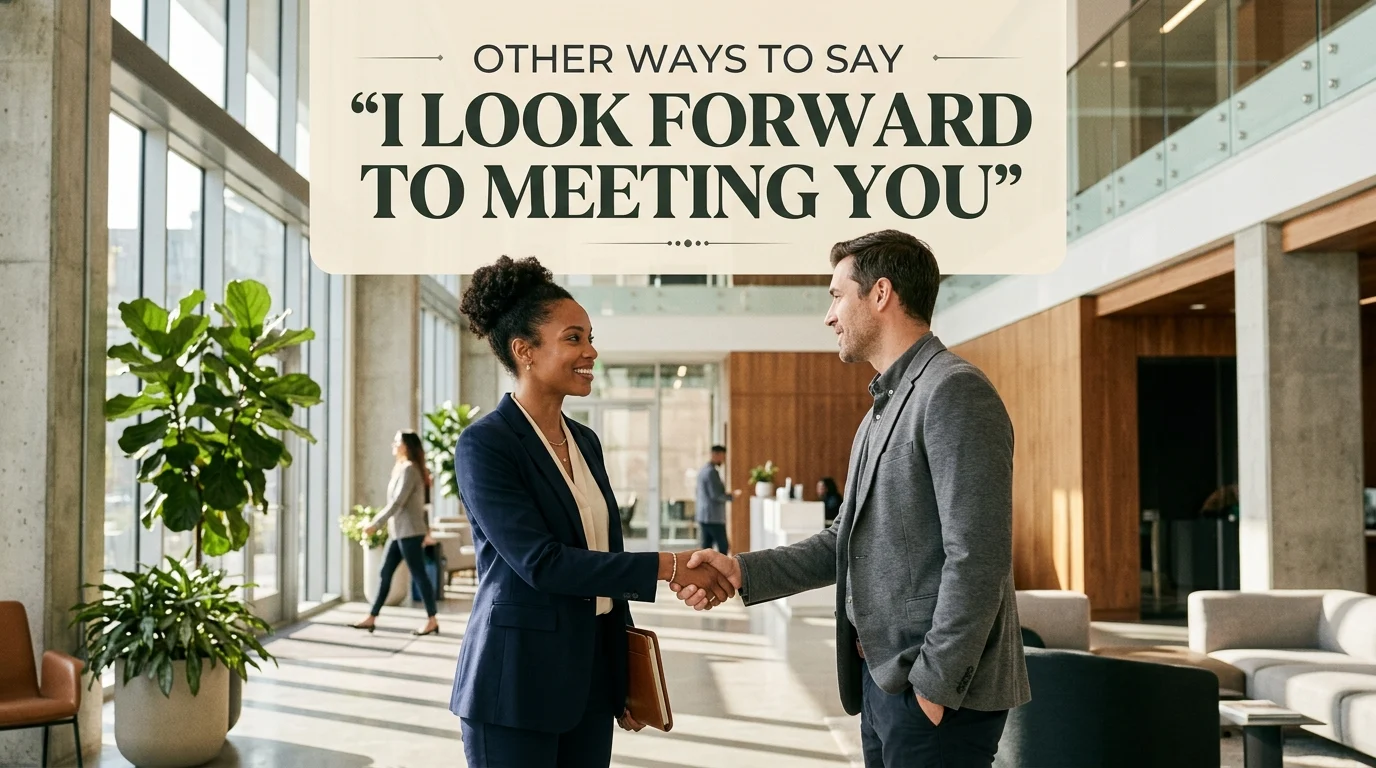
Quick Answer: “I look forward to meeting you” is a polite closing used to express anticipation before a first meeting. Top alternatives include: I am eager to meet you, it will be a pleasure to meet you, I anticipate our meeting with enthusiasm, looking forward to our introduction, and I am excited to make your acquaintance.
Have you ever wanted to end a professional email with something warmer than the same formal line everyone uses? That is exactly when you need alternatives to “I look forward to meeting you.” This phrase appears constantly in cover letters, client introductions, networking messages, and interview follow-ups.
English learners and professionals often repeat the same closing because it feels safe and correct. Learning alternatives to “I look forward to meeting you” helps you express genuine enthusiasm in English while matching the formality of each situation, whether you are writing to a recruiter, a client, or a new colleague.
Knowing other ways to say “I look forward to meeting you” gives you variety for every professional relationship. You can sound formal in a cover letter, warm in a networking message, or energetic in a team introduction. This guide gives you 30 practical alternatives with clear examples so you can use each one with confidence.
“First impressions are built long before the meeting begins.”
Quick Categories
Formal alternatives to “I Look Forward to Meeting You”
- I anticipate our meeting with pleasure
- It will be a privilege to meet you
- I eagerly await our introduction
- I am honored to be meeting you
Pro Tips Box: Formal alternatives suit cover letters, executive correspondence, and high-stakes professional introductions.
Casual alternatives
- Looking forward to meeting you
- Can’t wait to meet you
- Excited to meet you
- See you soon
Pro Tips Box: Casual alternatives work well in networking chats, team messages, and friendly professional settings.
Professional alternatives
- I am eager to connect with you
- I look forward to our conversation
- I am pleased to have this opportunity to meet you
- Looking forward to our discussion
Pro Tips Box: Professional alternatives balance warmth with respect for workplace norms and hierarchy.
Informal expressions
- Great to finally meet you soon
- Excited to put a face to the name
- Can’t wait to chat
- Looking forward to saying hello
Pro Tips Box: Informal expressions in English add personality, but save them for people you already know digitally.
Common Mistakes
- Using “I look forward to meet you” instead of “meeting you”
Example: “I look forward to meet you.” This is grammatically incorrect because “look forward to” requires a gerund. - Using overly casual phrases in a cover letter
Example: “Can’t wait to meet you!” This sounds too informal for a formal job application. - Repeating the phrase multiple times in one email
Example: “I look forward to meeting you. I also look forward to meeting you soon.” This weakens your message. - Forgetting to include a clear next step
Example: “I look forward to meeting you.” without confirming a time or date. This leaves the reader unsure. - Using it when no meeting is planned
Example: “I look forward to meeting you” when the conversation is purely transactional. This can feel misleading.
“Anticipation without clarity is just wishful thinking.”
What Does “I Look Forward to Meeting You” Mean?
“I look forward to meeting you” is a polite expression used to convey anticipation and enthusiasm about an upcoming first meeting. It combines the phrasal verb “look forward to” with the gerund “meeting” to express positive expectation.
Example Sentence: “Thank you for the opportunity, I look forward to meeting you next week.”
When to Use “I Look Forward to Meeting You”
- When writing a cover letter or job application
- When confirming a first client meeting
- When replying to a networking introduction
- When wrapping up an interview invitation
- When closing a professional email before a scheduled meeting
Spoken vs Written: More common in written English, especially emails and letters.
Formal vs Informal: Neutral to formal. Casual alternatives work better in informal professional settings.
Is It Professional or Polite to Say “I Look Forward to Meeting You”?
Polite? Yes, in almost every professional context.
Professional? Yes, it is standard and widely accepted in business English.
Business-style example: “Thank you for arranging this introduction. I am eager to meet you and discuss how we can collaborate.”
“Courtesy in writing opens doors before you walk through them.”
Pros and Cons of Using “I Look Forward to Meeting You”
Pros:
- Polite and professional
- Widely understood
- Expresses genuine anticipation
- Easy to use in many contexts
Cons:
- Extremely overused
- Can sound formulaic
- Limited emotional range
- Feels hollow without personalization
Other Ways to Say “I Look Forward to Meeting You” (With Examples)
These alternatives will help you sound more fluent, confident, and natural in different situations. Use them according to tone, context, and audience to express enthusiasm, respect, or warmth.
1. Phrase: Looking forward to meeting you
Meaning: A slightly casual version of the standard phrase.
Explanation: Drops “I” for a lighter tone.
Example Sentence: “Looking forward to meeting you at the conference next week.”
Best Use: Everyday emails
Worst Use: Highly formal letters
Tone: Friendly, casual, warm
Context Variability: Works in professional and casual contexts.
2. Phrase: I am eager to meet you
Meaning: Expresses strong enthusiasm.
Explanation: Warmer and more personal than the standard phrase.
Example Sentence: “I am eager to meet you and learn more about your team.”
Best Use: Networking emails
Worst Use: Formal contracts
Tone: Enthusiastic, warm, professional
Context Variability: Works in professional and semi-formal contexts.
3. Phrase: It will be a pleasure to meet you
Meaning: A formal and gracious expression.
Explanation: Polite and respectful.
Example Sentence: “It will be a pleasure to meet you in person next month.”
Best Use: Formal correspondence
Worst Use: Casual chats
Tone: Formal, gracious, warm
Context Variability: Ideal for professional and formal contexts.
4. Phrase: I anticipate our meeting with enthusiasm
Meaning: A formal expression of excitement.
Explanation: Polished and sincere.
Example Sentence: “I anticipate our meeting with enthusiasm and look forward to a productive discussion.”
Best Use: Executive communication
Worst Use: Quick texts
Tone: Formal, enthusiastic, professional
Context Variability: Ideal for formal contexts.
5. Phrase: Looking forward to our introduction
Meaning: Focuses on the initial connection.
Explanation: Slightly more formal than casual alternatives.
Example Sentence: “Looking forward to our introduction next Tuesday.”
Best Use: Professional emails
Worst Use: Casual banter
Tone: Professional, warm, polite
Context Variability: Works in professional contexts.
6. Phrase: I am excited to make your acquaintance
Meaning: A formal and slightly old-fashioned expression.
Explanation: Elegant and respectful.
Example Sentence: “I am excited to make your acquaintance at the summit.”
Best Use: Formal introductions
Worst Use: Casual conversations
Tone: Formal, respectful, elegant
Context Variability: Ideal for formal contexts.
7. Phrase: Can’t wait to meet you
Meaning: A high-energy expression of anticipation.
Explanation: Very casual and enthusiastic.
Example Sentence: “Can’t wait to meet you at the workshop.”
Best Use: Friendly messages
Worst Use: Formal letters
Tone: Enthusiastic, casual, warm
Context Variability: Best in casual contexts.
8. Phrase: Excited to meet you
Meaning: A simple expression of enthusiasm.
Explanation: Casual and friendly.
Example Sentence: “Excited to meet you and hear your ideas.”
Best Use: Networking messages
Worst Use: Formal reports
Tone: Enthusiastic, casual, warm
Context Variability: Works in casual and semi-professional contexts.
9. Phrase: See you soon
Meaning: A brief and friendly closing.
Explanation: Casual and warm.
Example Sentence: “See you soon at the client meeting.”
Best Use: Everyday emails
Worst Use: Formal correspondence
Tone: Casual, friendly, brief
Context Variability: Best in casual contexts.
10. Phrase: I am eager to connect with you
Meaning: Expresses anticipation of a professional relationship.
Explanation: Modern and warm.
Example Sentence: “I am eager to connect with you and explore potential synergies.”
Best Use: Networking emails
Worst Use: Casual chats
Tone: Professional, warm, enthusiastic
Context Variability: Works in professional contexts.
11. Phrase: I look forward to our conversation
Meaning: Focuses on the discussion ahead.
Explanation: Professional and specific.
Example Sentence: “I look forward to our conversation about the new role.”
Best Use: Professional emails
Worst Use: Quick texts
Tone: Professional, warm, respectful
Context Variability: Works in professional contexts.
12. Phrase: I am pleased to have this opportunity to meet you
Meaning: Acknowledges the value of the meeting.
Explanation: Formal and gracious.
Example Sentence: “I am pleased to have this opportunity to meet you and your team.”
Best Use: Formal correspondence
Worst Use: Casual banter
Tone: Formal, gracious, respectful
Context Variability: Ideal for professional contexts.
13. Phrase: Looking forward to our discussion
Meaning: A professional closing focused on dialogue.
Explanation: Concise and formal.
Example Sentence: “Looking forward to our discussion on Friday.”
Best Use: Business emails
Worst Use: Casual conversations
Tone: Professional, formal, warm
Context Variability: Works in professional contexts.
14. Phrase: It will be a privilege to meet you
Meaning: Expresses deep respect.
Explanation: Formal and sincere.
Example Sentence: “It will be a privilege to meet you at the gala.”
Best Use: Formal introductions
Worst Use: Casual chats
Tone: Formal, respectful, sincere
Context Variability: Ideal for formal contexts.
15. Phrase: I eagerly await our introduction
Meaning: A formal expression of anticipation.
Explanation: Polished and respectful.
Example Sentence: “I eagerly await our introduction next week.”
Best Use: Executive communication
Worst Use: Quick replies
Tone: Formal, respectful, warm
Context Variability: Ideal for formal contexts.
16. Phrase: I am honored to be meeting you
Meaning: Expresses respect and gratitude.
Explanation: Formal and warm.
Example Sentence: “I am honored to be meeting you and your leadership team.”
Best Use: Formal correspondence
Worst Use: Casual banter
Tone: Formal, respectful, warm
Context Variability: Ideal for professional contexts.
17. Phrase: Great to finally meet you soon
Meaning: A casual expression of anticipation.
Explanation: Warm and informal.
Example Sentence: “Great to finally meet you soon after all our emails.”
Best Use: Friendly colleagues
Worst Use: Formal letters
Tone: Casual, warm, friendly
Context Variability: Best in casual contexts.
18. Phrase: Excited to put a face to the name
Meaning: A friendly expression of anticipation.
Explanation: Warm and idiomatic.
Example Sentence: “Excited to put a face to the name at the conference.”
Best Use: Networking chats
Worst Use: Formal reports
Tone: Friendly, warm, casual
Context Variability: Works in casual and semi-professional contexts.
19. Phrase: Can’t wait to chat
Meaning: A very casual expression of anticipation.
Explanation: Short and warm.
Example Sentence: “Can’t wait to chat about the project next week.”
Best Use: Friendly messages
Worst Use: Formal emails
Tone: Casual, warm, friendly
Context Variability: Best in casual contexts.
20. Phrase: Looking forward to saying hello
Meaning: A gentle and friendly closing.
Explanation: Warm and approachable.
Example Sentence: “Looking forward to saying hello at the networking event.”
Best Use: Networking messages
Worst Use: Formal correspondence
Tone: Friendly, warm, casual
Context Variability: Works in casual and semi-professional contexts.
21. Phrase: I am keen to meet you
Meaning: A British-style expression of enthusiasm.
Explanation: Professional and warm.
Example Sentence: “I am keen to meet you and discuss the proposal.”
Best Use: Professional emails
Worst Use: Casual banter
Tone: Professional, warm, enthusiastic
Context Variability: Works in professional contexts.
22. Phrase: Looking forward to our first meeting
Meaning: Focuses on the initial encounter.
Explanation: Formal and clear.
Example Sentence: “Looking forward to our first meeting on Monday.”
Best Use: Business emails
Worst Use: Quick texts
Tone: Professional, formal, warm
Context Variability: Works in professional contexts.
23. Phrase: I am delighted at the prospect of meeting you
Meaning: A formal and elegant expression.
Explanation: Gracious and respectful.
Example Sentence: “I am delighted at the prospect of meeting you and your colleagues.”
Best Use: Formal letters
Worst Use: Casual chats
Tone: Formal, elegant, warm
Context Variability: Ideal for formal contexts.
24. Phrase: I await our meeting with interest
Meaning: A formal and professional expression.
Explanation: Measured and respectful.
Example Sentence: “I await our meeting with interest and look forward to your insights.”
Best Use: Executive communication
Worst Use: Casual banter
Tone: Formal, professional, respectful
Context Variability: Ideal for formal contexts.
25. Phrase: Looking forward to connecting in person
Meaning: A modern and professional closing.
Explanation: Warm and specific.
Example Sentence: “Looking forward to connecting in person at the summit.”
Best Use: Professional emails
Worst Use: Quick texts
Tone: Professional, warm, modern
Context Variability: Works in professional contexts.
26. Phrase: It will be great to meet you
Meaning: A friendly and warm expression.
Explanation: Casual and sincere.
Example Sentence: “It will be great to meet you after all our calls.”
Best Use: Friendly emails
Worst Use: Formal letters
Tone: Friendly, warm, casual
Context Variability: Works in casual and semi-professional contexts.
27. Phrase: I am looking forward to our introduction
Meaning: A complete and formal expression.
Explanation: Polished and respectful.
Example Sentence: “I am looking forward to our introduction next week.”
Best Use: Professional emails
Worst Use: Casual chats
Tone: Professional, formal, warm
Context Variability: Works in professional contexts.
28. Phrase: Anticipating our meeting with pleasure
Meaning: A formal and elegant closing.
Explanation: Gracious and warm.
Example Sentence: “Anticipating our meeting with pleasure and looking forward to a productive discussion.”
Best Use: Formal correspondence
Worst Use: Quick texts
Tone: Formal, gracious, warm
Context Variability: Ideal for formal contexts.
29. Phrase: Looking forward to meeting you in person
Meaning: Emphasizes the face-to-face aspect.
Explanation: Warm and specific.
Example Sentence: “Looking forward to meeting you in person at the conference.”
Best Use: Professional emails
Worst Use: Quick replies
Tone: Professional, warm, specific
Context Variability: Works in professional contexts.
30. Phrase: I am excited about our upcoming meeting
Meaning: A warm and professional expression.
Explanation: Enthusiastic and sincere.
Example Sentence: “I am excited about our upcoming meeting and the opportunities ahead.”
Best Use: Business emails
Worst Use: Casual chats
Tone: Professional, enthusiastic, warm
Context Variability: Works in professional contexts.
“Enthusiasm in writing must be measured. Too little feels cold, too much feels unprofessional.”
Mini Quiz / Self-Check
- Which phrase is best for a cover letter?
a) Can’t wait to meet you
b) It will be a pleasure to meet you
c) Excited to put a face to the name - Which phrase works best with a close networking contact?
a) I anticipate our meeting with enthusiasm
b) Can’t wait to meet you
c) I am honored to be meeting you - Which phrase is grammatically correct?
a) I look forward to meet you
b) I look forward to meeting you
c) I look forward to met you - Which phrase is most formal?
a) It will be a privilege to meet you
b) Looking forward to meeting you
c) See you soon
Answers: 1-b, 2-b, 3-b, 4-a
Comparison Table: Top Alternatives
| Phrase | Tone | Best Use |
|---|---|---|
| Looking forward to meeting you | Friendly, casual | Everyday emails |
| I am eager to meet you | Enthusiastic, warm | Networking emails |
| It will be a pleasure to meet you | Formal, gracious | Formal correspondence |
| I anticipate our meeting with enthusiasm | Formal, enthusiastic | Executive communication |
| Looking forward to our introduction | Professional, warm | Professional emails |
| Can’t wait to meet you | Enthusiastic, casual | Friendly messages |
| I am eager to connect with you | Professional, warm | Networking emails |
| I look forward to our conversation | Professional, respectful | Professional emails |
| I am keen to meet you | Professional, warm | Professional emails |
| Anticipating our meeting with pleasure | Formal, gracious | Formal correspondence |
FAQs
1. What is another way to say “I look forward to meeting you” formally?
Use “It will be a pleasure to meet you” or “I anticipate our meeting with enthusiasm” for a polished, professional tone.
2. Is “I look forward to meeting you” grammatically correct?
Yes, because “look forward to” is followed by a gerund, so “meeting” is correct.
3. Can I say “can’t wait to meet you” in a work email?
It is acceptable with close colleagues but too casual for clients or formal applications.
4. What is a warm way to express anticipation before a meeting?
“I am eager to meet you” or “Looking forward to connecting in person” add warmth while staying professional.
5. Why is this phrase so common in cover letters?
It signals enthusiasm, professionalism, and respect for the opportunity, which makes it a safe and effective closing.
Conclusion
Learning other ways to say “I look forward to meeting you” gives you the flexibility to close professional messages with warmth, precision, and variety. Whether you need formal alternatives for a cover letter or casual phrases for a networking chat, the right expression strengthens your first impression and opens the door to a positive relationship.
Practice these alternatives daily and pay attention to tone awareness. The more you experiment with different closings, the more fluent and professional you will become.
CTA: Which phrase will you try first? Share your favorite in the comments below.
See also:
- Other Ways to Say “Thank You for the Update” (30+ Examples)
- Professional English Guide: How to Sound Confident at Work

Emma Writes is a passionate content writer at ResponsCraft.com, creating practical, well-researched articles that help readers make informed decisions. She enjoys turning complex topics into clear, engaging and easy-to-follow content.