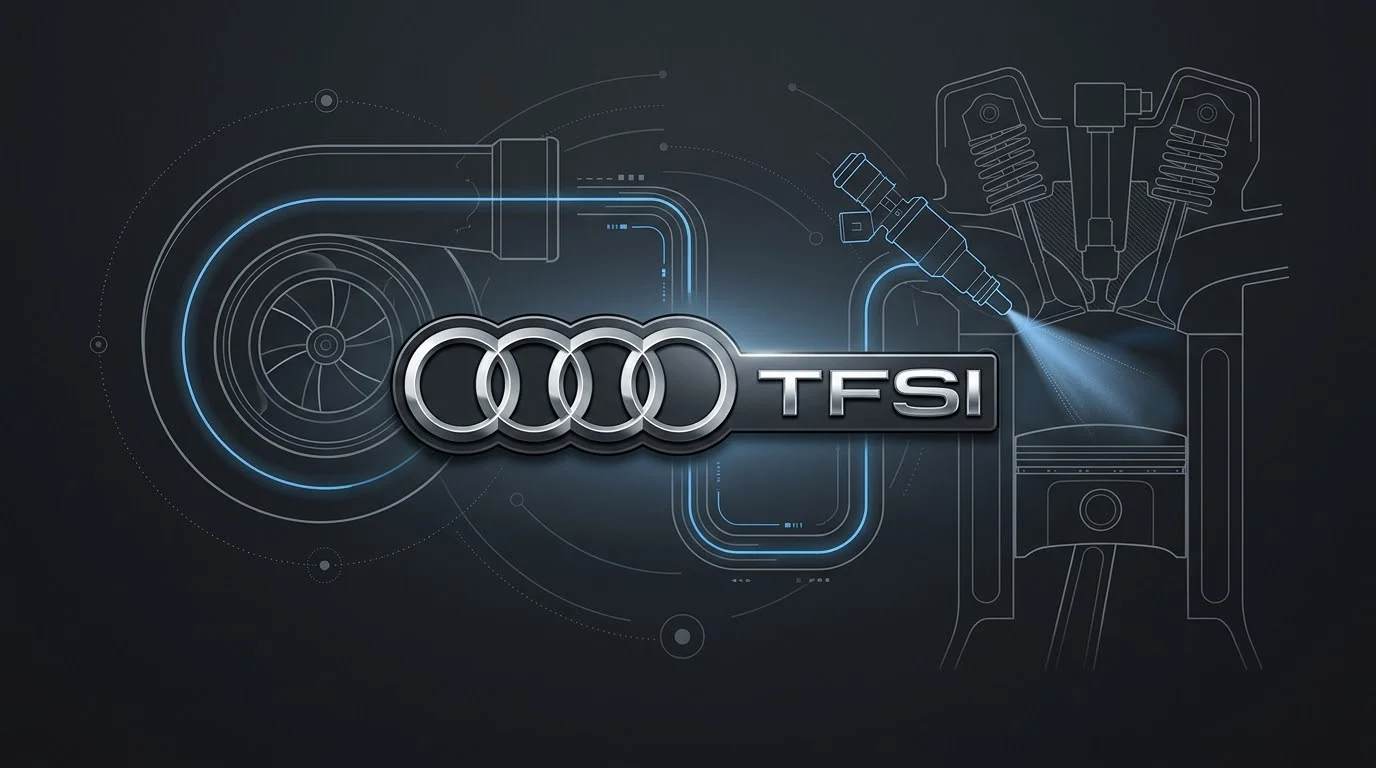
Quick Answer: TFSI stands for “Turbo Fuel Stratified Injection.” It is Audi’s name for its turbocharged gasoline engines that use direct fuel injection. The badge appears on almost every petrol Audi sold today, and it signals a combination of turbocharging and precise fuel delivery designed to balance performance with fuel efficiency .
If you have ever looked at the back of an Audi and wondered what those four letters mean, you are not alone. TFSI is one of the most recognizable badges in the automotive world, but its full meaning is rarely explained in plain language. Audi has used the TFSI name since 2004, when it introduced the world’s first turbocharged direct-injection gasoline engine in the Audi A3 . That technology has since become the foundation for nearly every petrol engine the brand produces.
Understanding TFSI matters whether you are shopping for a used Audi, comparing models, or simply curious about the car in your driveway. The badge tells you something specific about how the engine works and what kind of driving experience to expect. It also connects to a broader family of Volkswagen Group engine names, including TSI and FSI, which can be confusing at first glance.
This guide breaks down the Audi TFSI meaning completely. You will learn what the acronym stands for, how the technology works, what the numbers before TFSI mean, how it compares to TSI, and what to watch for if you own or buy a TFSI-powered car. The goal is to make a technical badge easy to understand.
What Does TFSI Stand For?
TFSI stands for Turbo Fuel Stratified Injection. Each word describes a specific part of the engine’s design .
Turbo refers to the turbocharger. This device uses exhaust gases to force more air into the engine, allowing it to produce more power from a smaller displacement. Fuel simply refers to gasoline. Stratified describes a combustion strategy where fuel is concentrated near the spark plug for efficient burning at low loads. Injection refers to direct fuel injection, where fuel is sprayed directly into the combustion chamber rather than into the intake manifold .
Audi was the first manufacturer worldwide to combine turbocharging with gasoline direct injection in 2004 . The combination solved an old problem. Directly injected fuel swirls in the combustion chamber and cools the walls, which reduces the risk of knocking at high compression. That allows Audi to run higher compression ratios, improving both power and efficiency .
| TFSI Component | What It Means |
|---|---|
| T | Turbocharger forces more air into the engine |
| F | Fuel, specifically gasoline |
| S | Stratified injection for efficient low-load combustion |
| I | Direct injection into the combustion chamber |
How Does TFSI Technology Work?
The TFSI system relies on two technologies working together: turbocharging and direct injection.
In a traditional port-injection engine, fuel is sprayed into the intake port and mixes with air before entering the cylinder. TFSI engines skip that step. Fuel is injected directly into the combustion chamber at high pressure, timed precisely to the moment of ignition . This gives the engine more control over how fuel is used and allows for a leaner air-fuel mixture at part throttle.
The stratified charge mode is the key to efficiency. At low loads, the engine creates a rich, ignitable mixture only around the spark plug, while the rest of the chamber contains mostly air. This reduces the amount of fuel needed to keep the engine running . At higher loads, the engine switches to homogeneous operation, where the entire chamber has a uniform mixture for maximum power.
The turbocharger adds another layer. By forcing more air into the engine, it allows a smaller engine to produce power comparable to a larger naturally aspirated one. Audi describes the result as impressive performance with low fuel consumption .
What Do the Numbers Before TFSI Mean?
Since autumn 2017, Audi has placed a two-digit number before the TFSI badge on many models. These numbers range from 25 to 70, and they do not correspond to engine size or exact horsepower .
Instead, the numbers represent a power output range. Audi introduced this system to make it easier to compare petrol, diesel, hybrid, and electric models across the lineup. For example, a 40 TFSI model typically produces between 167 and 201 horsepower, while a 45 TFSI model falls into a higher range .
The system is not always consistent. The 2025 Audi Q3 45 TFSI produces 228 horsepower, while other 45 TFSI models like the A4 and Q5 produce 261 horsepower. Both fall within the same broad range, but the exact output varies by model . Audi has also begun phasing out these numbers on some next-generation vehicles.
TFSI vs TSI: What’s the Difference?
Both TFSI and TSI describe turbocharged direct-injection gasoline engines developed by the Volkswagen Group. The difference is almost entirely branding .
Audi is the only brand in the Volkswagen Group that uses the TFSI badge. Volkswagen, SEAT, and Skoda use TSI instead. In modern cars, the engines are often identical and may even share the same engine codes. A 2.0-liter TSI in a Volkswagen and a 2.0-liter TFSI in an Audi are essentially the same engine wearing different badges .
Historically, there were some technical differences. The TFSI badge first appeared on the EA113 engine family, which used a timing belt. The EA888 engine that followed used a timing chain and carried the TSI badge in some applications. Today, however, both badges appear on the same EA888 engine family with no mechanical distinction .
| Badge | Brand | Meaning |
|---|---|---|
| TFSI | Audi | Turbo Fuel Stratified Injection |
| TSI | Volkswagen, Skoda, SEAT | Turbo Stratified Injection |
| FSI | Older Audi models | Fuel Stratified Injection (no turbo) |
TFSI vs FSI: What Changed?
Before TFSI, Audi used the FSI badge. FSI stands for Fuel Stratified Injection and describes a naturally aspirated engine with direct injection but no turbocharger .
The FSI technology introduced stratified charge combustion, which improved efficiency at part load. TFSI added a turbocharger to that foundation. Audi’s Technology Portal explains it simply: a turbocharger or supercharger makes a TFSI out of an FSI .
FSI engines are largely historical now. Almost every petrol engine Audi sells today uses the TFSI designation.
What About TFSI e and TFSI quattro?
Audi uses variations of the TFSI badge to indicate additional technology.
TFSI e denotes a plug-in hybrid. Audi couples a TFSI petrol engine with an electric motor to reduce fuel consumption. Models like the A3 Sportback TFSI e and Q3 TFSI e use this designation .
TFSI quattro indicates that the TFSI engine sends power to all four wheels through Audi’s quattro all-wheel-drive system. This badge appears on models like the RS 3 Sportback and A4 allroad .
Is a TFSI Engine Reliable?
TFSI engines are generally considered reliable when properly maintained, but there are known issues worth checking on used examples.
The EA888 engine family has been revised multiple times since its introduction, and newer generations are more dependable than early versions. First- and second-generation EA888 engines from 2007 to 2011 are the ones to approach with the most caution .
Common issues include:
- Carbon buildup on intake valves, a known downside of direct injection. Fuel does not wash over the valves the way it does in port-injection engines. Newer engines with dual injection help reduce this problem .
- PCV system problems that can lead to increased oil consumption on some earlier models .
- Water pump leaks on some EA211 engines used in smaller models .
Regular maintenance, high-quality fuel, and frequent oil changes can mitigate many of these issues. The 2.5 TFSI inline-five found in the RS 3 has a strong reputation for reliability and a distinctive sound .
Frequently Asked Questions About Audi TFSI
What does TFSI mean on an Audi?
TFSI stands for Turbo Fuel Stratified Injection. It is Audi’s name for its turbocharged gasoline engines with direct fuel injection. The badge appears on nearly every petrol Audi sold today .
Is TFSI better than TSI?
Mechanically, they are often the same engine. TFSI is Audi’s branding, while TSI is used by other Volkswagen Group brands like Volkswagen and Skoda. In modern cars, there is no meaningful performance difference between the two badges .
What do the numbers before TFSI mean?
The numbers represent a power output range, not engine size or exact horsepower. A 40 TFSI model falls into one power bracket, while a 45 TFSI falls into another. The system is designed to help compare models across different fuel types .
Does TFSI mean the car is turbocharged?
Yes. The “T” in TFSI stands for turbocharger. Every TFSI engine uses a turbocharger to force more air into the combustion chamber .
What is the difference between TFSI and FSI?
FSI is an older Audi designation for naturally aspirated direct-injection engines. TFSI adds a turbocharger to that technology. Audi no longer produces new FSI engines for most models .
Are TFSI engines expensive to maintain?
TFSI engines require regular maintenance, and some repairs can be more costly than those for simpler engines due to the advanced direct-injection and turbocharging systems. Carbon cleaning may be necessary on higher-mileage examples. However, routine oil changes and quality fuel help keep costs manageable .
Conclusion
The Audi TFSI meaning is straightforward once you break it down. It stands for Turbo Fuel Stratified Injection, a combination of turbocharging and direct fuel injection that Audi pioneered in 2004. The badge tells you the engine is turbocharged, fuel-efficient, and designed to deliver strong performance from a relatively small displacement. Whether you see TFSI alone, with a number like 45 TFSI, or paired with e or quattro, you now know what each part of the badge represents.
If you are shopping for an Audi, the TFSI badge is a sign of modern engine technology rather than a warning. Check the maintenance history, pay attention to the engine generation, and keep up with oil changes to get the most from the car. Share this guide with someone who has ever stared at an Audi badge and wondered what those four letters mean, or leave a comment with your own TFSI experience.

Chloe Brooks is a passionate writer at ResponsCraft.com, creating clear, practical and well-researched content to help readers make informed decisions. She focuses on delivering engaging articles that are accurate, useful and easy to understand.